01Apps designed for the real world
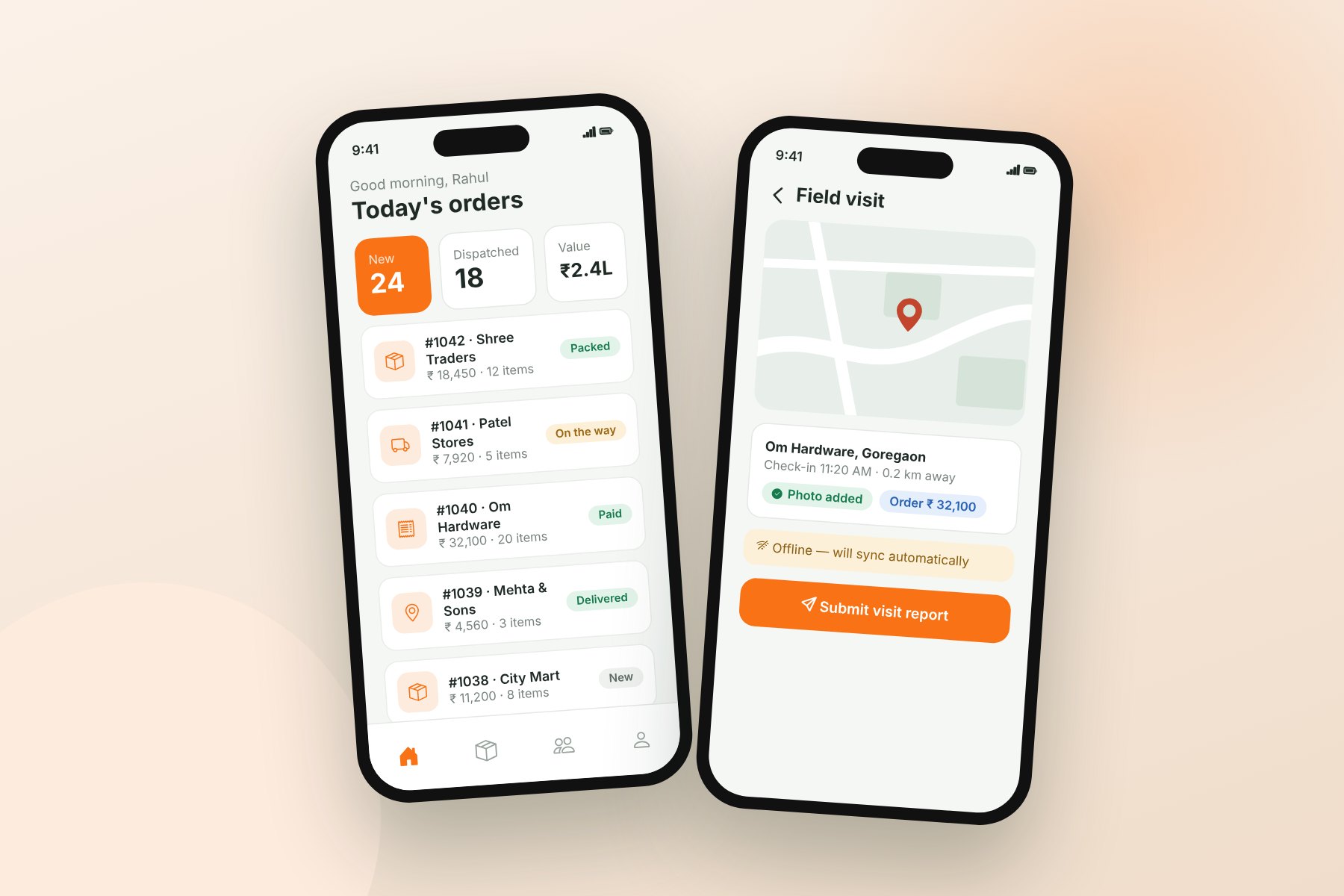
Many business apps look great in a demo and struggle in daily use. Field sales staff work in basements with no signal. Technicians wear gloves. Delivery staff read screens in direct sunlight while carrying parcels. We design mobile apps for these conditions from day one: large touch targets, high-contrast screens, minimal typing and offline-first behaviour that keeps working when the network does not.
The result is an app your team actually uses, which means the data reaching your office is complete, accurate and timely.
02What business apps can do
- Field sales and order booking - check stock and prices, book orders and capture payments at the customer’s location.
- Service and inspection apps - job cards, checklists, photos, signatures and location stamps.
- Delivery and logistics - route lists, proof of delivery, cash collection and live status updates.
- Warehouse and inventory - barcode and QR scanning for receiving, picking, dispatch and stock audits.
- Customer apps - ordering, bookings, loyalty, service requests and notifications for your customers.
- Employee self-service - attendance, leave, payslips and announcements.
03Native or cross-platform?
Cross-platform frameworks such as Flutter and React Native let one codebase run on both Android and iOS. For most business apps this is the most cost-effective choice, with performance that users cannot tell apart from native. Native development in Kotlin or Swift makes sense when an app depends heavily on advanced device features or needs maximum performance. We recommend the right approach after Discovery, based on your features, budget and timeline.
04Offline-first and syncing
Offline-first means the app stores data on the phone first and synchronises with the server whenever a connection is available. Users can keep working through dead zones, and the app resolves conflicts sensibly when two people update the same record. This is one of the most important - and most often overlooked - requirements for field apps in India.
05Connected to your systems
A mobile app is only as useful as the data behind it. We build secure APIs that connect the app to your ERP, CRM, billing or custom web platform, so the field and the office always see the same information. An admin panel lets your team manage users, content and settings without developer help.
06Questions to answer before you build
A clear brief makes a mobile project faster and cheaper. Before development, it helps to answer a few questions: Who will use the app - your staff, your customers or both? Which tasks must work without internet? Which existing systems must the app read from or write to? Do you need the camera, GPS, barcode scanning or push notifications? Will the app be distributed through public stores or privately to employees? During Discovery we work through these questions with you and turn the answers into a written scope.
07Mistakes to avoid
Common mobile mistakes include designing only for perfect network conditions, cramming every feature into the first version, ignoring older or low-cost Android phones that many field staff use, and launching without a plan for updates. App stores and operating systems change every year, so an app without ongoing maintenance slowly stops working well. We test on a range of real devices, keep the first release focused, and offer AMC plans so your app stays compatible, secure and fast.
08Launch, publishing and updates
We prepare store-ready builds, help with Play Store and App Store listings, and guide you through the review process. After launch, we monitor crashes and performance, release updates as operating systems change, and add new features based on real usage through our AMC and maintenance plans. Our five-phase approach - Discovery, Design, Development, Testing, Deployment & Support - keeps the project transparent from the first conversation to long after go-live.
If your team still relies on paper forms, phone calls or WhatsApp messages to report work from the field, a mobile app can change that quickly. Book a free consultation to discuss how it would work for your business.
09Why choose JMDA for Mobile App Development
JMDA Analytic Pvt Ltd brings 18+ years of industry experience - 13 years as a service provider, 4 years as a proprietorship and now as a private limited company - and more than 200 completed projects for Indian and international clients. That experience matters for mobile app development, because most problems are not purely technical: they come from unclear requirements, changing priorities and systems that were never designed to work together.
For this service we typically work with field sales & service teams, delivery & logistics, retail & consumer brands and warehouses & factories. Our team understands how these businesses operate day to day, which helps us design features such as offline-first, large touch targets, high-contrast ui around real workflows rather than assumptions. Because our developers, designers and project managers work together from our office in Goregaon West, Mumbai, you always have a direct line to the people building your solution.
Three principles guide every engagement:
- Clarity before code. Discovery and Design come first, so you approve screens and receive a fixed quote before development begins.
- Visible progress. You see working software at the end of every sprint and can change direction early, when it is still inexpensive.
- Long-term partnership. After go-live, our AMC and maintenance plans keep your mobile app development secure, fast and aligned with how your business grows.
We are also comfortable working with what you already have. If you use Tally, an existing CRM, a legacy database or third-party tools, we plan integrations and data migration during Discovery so nothing important is lost. And if a ready-made product would serve you better than a custom build, we will tell you honestly.
The easiest way to find out whether we are the right partner is a free, no-obligation consultation. Share your requirement through the quote form or WhatsApp, and we will come back with practical questions, a suggested approach and an estimate of the next steps.