01One set of numbers for the whole business
In many growing businesses, stores keep their own stock register, sales maintain a separate order sheet, production tracks jobs on a whiteboard and accounts reconcile everything at month-end. Each team works hard, but they are working from different numbers. Decisions get delayed, stock runs out unexpectedly and month-end becomes a stressful exercise in matching figures.
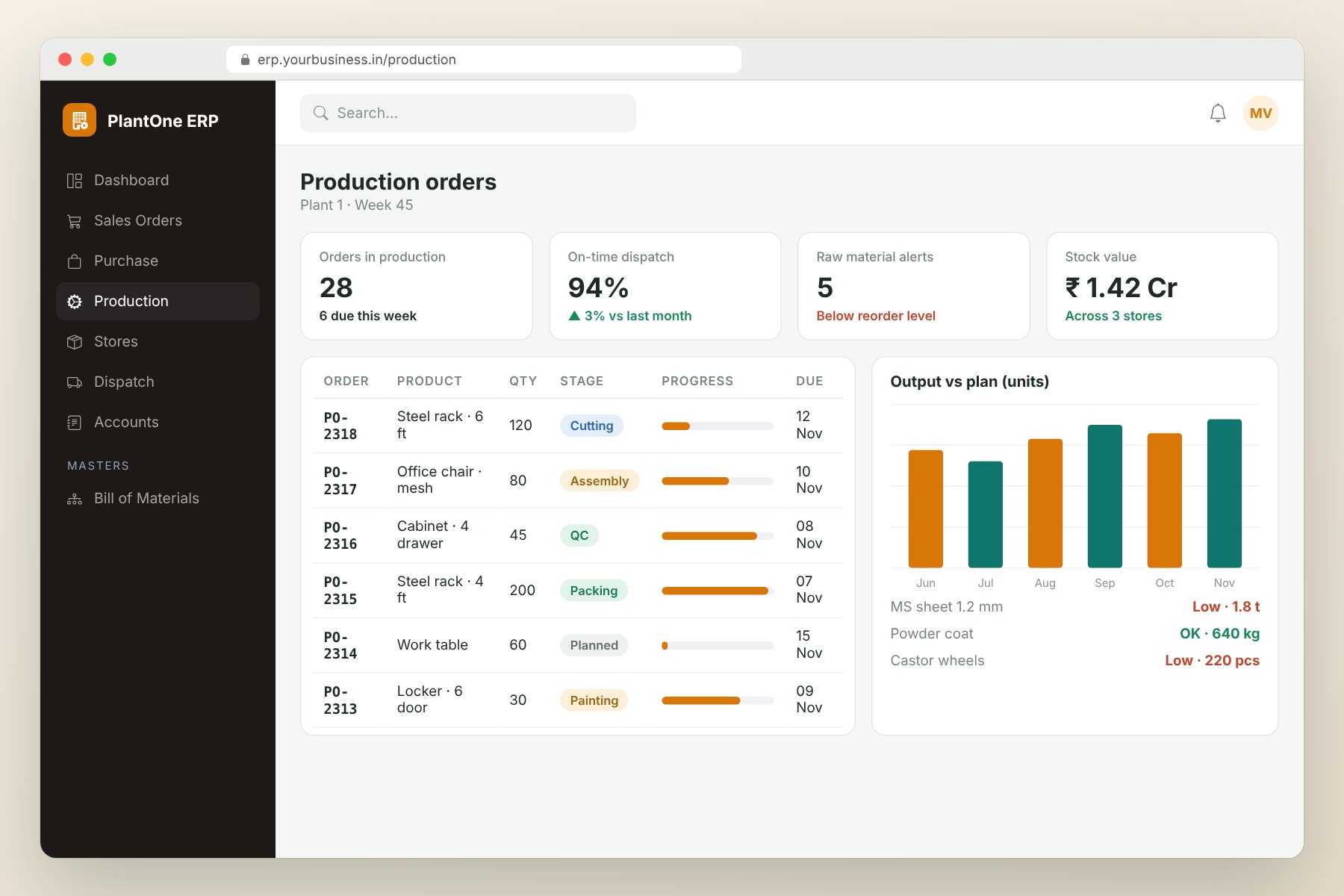
An Enterprise Resource Planning (ERP) system connects these departments through one shared database. When sales books an order, stores see the demand, purchase sees what to buy, production sees what to make and accounts see what to bill - automatically.
02ERP modules we implement
- Inventory - real-time stock by location, batch and serial number, with reorder levels.
- Purchase - indents, purchase orders, vendor management, goods receipt and quality checks.
- Sales - enquiries, quotations, sales orders, dispatch, invoicing and returns.
- Production - bills of materials, work orders, material issue, consumption and finished goods.
- Accounts - ledgers, receivables, payables, GST-ready reports and Tally integration.
- HR and payroll - optional modules for attendance, leave and salary.
- MIS dashboards - live KPIs for owners, plant heads and branch managers.
03Customised for your industry
A trading company, a pharmaceutical distributor and an engineering manufacturer all need an ERP, but their workflows are very different. We customise modules to reflect your industry’s realities - job work, multi-unit pricing, batch and expiry tracking, project-based costing, or multi-company accounting. The system follows your process instead of forcing a generic template onto your teams.
04Phased rollout, lower risk
Big-bang ERP launches are risky. We recommend a phased rollout: start with the modules that solve the most painful problem - often inventory and sales - then add purchase, production and accounts once the first modules are stable and trusted. Each phase follows our Discovery, Design, Development, Testing and Deployment approach, with data migration and training included.
05Data migration and integration
Your existing data - item masters, customer and vendor lists, opening stock and balances - is cleaned, mapped and imported with validation so the ERP starts with accurate information. Where you rely on Tally for accounting, we can sync vouchers and masters to avoid double entry. Other integrations, such as e-commerce platforms, barcode scanners or biometric devices, are planned during Discovery.
06Signs you need an ERP
Businesses usually recognise the need for an ERP when certain problems keep repeating: stock figures in the system don’t match the shelf; purchase orders are raised without knowing current stock; production plans change because materials are missing; sales commits delivery dates without visibility of capacity; and accounts spends the first week of every month reconciling. If two or more of these sound familiar, an ERP can bring the departments onto the same page and remove a large amount of manual coordination.
07Mistakes to avoid
ERP implementations are significant projects, and the common pitfalls are well known: trying to implement every module at once, not cleaning masters before migration, customising so heavily that upgrades become difficult, and underestimating the training needed for each department. Lack of a clear internal owner is another risk. We recommend a phased rollout with a named champion in each department, clean master data, sensible customisation and role-specific training, so each phase is stable before the next begins.
08Support after go-live
An ERP becomes more valuable as your team uses it more deeply. After go-live, our AMC and maintenance plans cover bug fixes, enhancements, performance monitoring, backups and additional training. As the business grows - new branches, new product lines, new reporting needs - the ERP grows with it.
If your teams are working from different numbers, a free consultation is the best place to start. We will study your process and recommend a practical, phased ERP plan.
09Why choose JMDA for ERP Solutions
JMDA Analytic Pvt Ltd brings 18+ years of industry experience - 13 years as a service provider, 4 years as a proprietorship and now as a private limited company - and more than 200 completed projects for Indian and international clients. That experience matters for erp solutions, because most problems are not purely technical: they come from unclear requirements, changing priorities and systems that were never designed to work together.
For this service we typically work with manufacturers, traders & distributors, multi-location retailers and project-based businesses. Our team understands how these businesses operate day to day, which helps us design features such as inventory, purchase, sales around real workflows rather than assumptions. Because our developers, designers and project managers work together from our office in Goregaon West, Mumbai, you always have a direct line to the people building your solution.
Three principles guide every engagement:
- Clarity before code. Discovery and Design come first, so you approve screens and receive a fixed quote before development begins.
- Visible progress. You see working software at the end of every sprint and can change direction early, when it is still inexpensive.
- Long-term partnership. After go-live, our AMC and maintenance plans keep your erp solutions secure, fast and aligned with how your business grows.
We are also comfortable working with what you already have. If you use Tally, an existing CRM, a legacy database or third-party tools, we plan integrations and data migration during Discovery so nothing important is lost. And if a ready-made product would serve you better than a custom build, we will tell you honestly.
The easiest way to find out whether we are the right partner is a free, no-obligation consultation. Share your requirement through the quote form or WhatsApp, and we will come back with practical questions, a suggested approach and an estimate of the next steps.