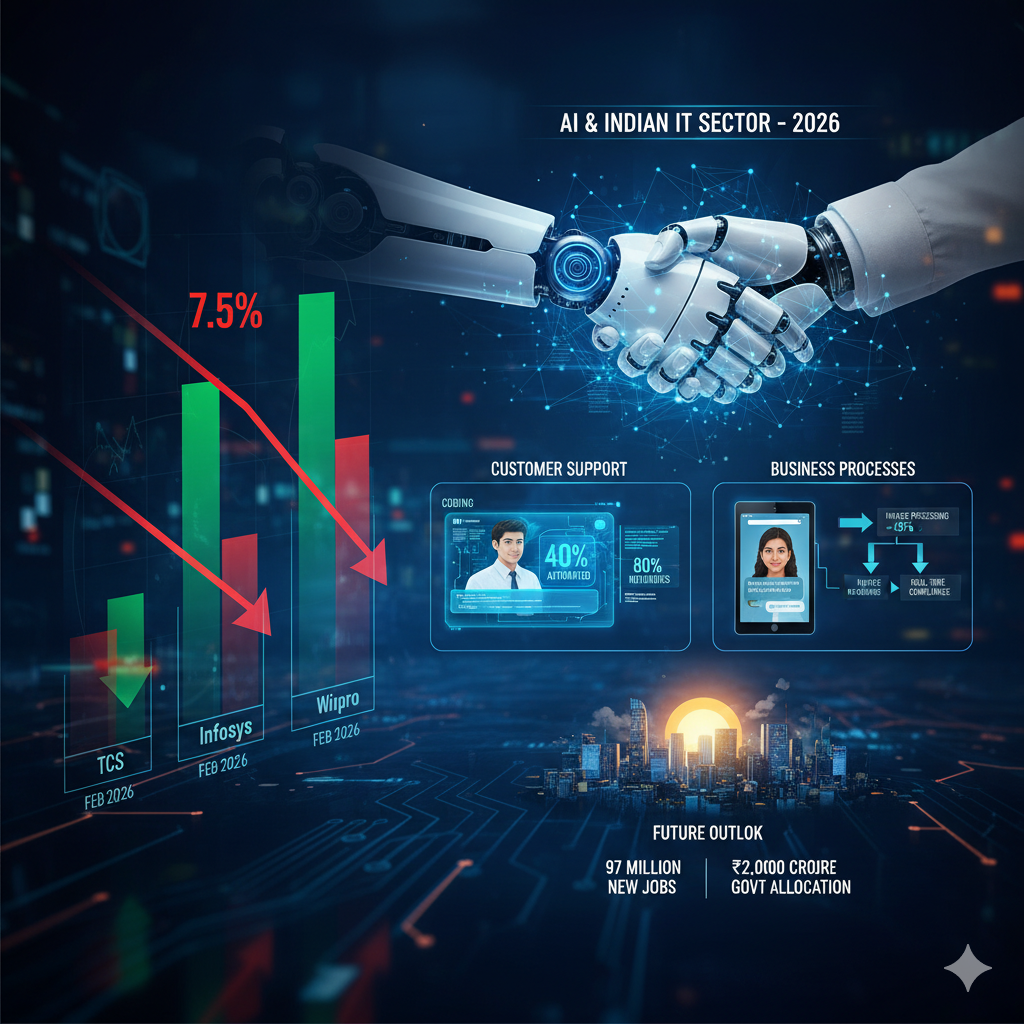
Artificial Intelligence (AI) is no longer a futuristic concept. It is already writing code, answering customer queries, automating business workflows, analyzing financial data, and even creating software architecture suggestions. Naturally, a big question arises:
If AI does coding, support, and business processes — will IT companies become more profitable? Or will they suffer?
For countries like India, where IT services form a major economic pillar, this question is critical. Large companies such as Tata Consultancy Services, Infosys, HCL Technologies, and Wipro built their global dominance on manpower-driven outsourcing models.
Now, AI is changing the rules of the game.
This blog explores the full picture not fear-based assumptions, but real business economics and what it means for the future of IT companies.
The Traditional IT Services Model: How Companies Earn
To understand AI’s impact, we first need to understand how Indian IT companies traditionally make money.
Most large IT firms follow a services-based model built around:
- Billing per employee (per hour or per month)
- Offshore delivery centers
- Large workforce deployment
- Long-term enterprise contracts
- Maintenance & support agreements
In simple terms:
More employees deployed = More billable hours = More revenue.
If a U.S. company needs 100 developers for a 3-year project, they sign a contract worth millions of dollars. The IT company deploys engineers, project managers, testers, and support staff. Revenue grows as headcount grows. This model worked extremely well for decades. But AI directly challenges this formula.
Where AI Is Disrupting Work
AI tools are now capable of:
1. Coding Assistance
- Auto-generating code
- Fixing bugs
- Writing test cases
- Converting legacy code
2. Customer Support
- Chatbots handling first-level queries
- Automated ticket categorization
- AI voice agents
3. Business Process Automation
- Invoice processing
- Data entry automation
- HR workflows
- Predictive analytics
These tasks previously required thousands of employees. Now, a combination of AI + smaller teams can handle them.
So the big question is:
If AI reduces manpower, does profit increase or decrease? The answer depends on business strategy.
Scenario 1: AI Increases Profit (Optimistic View)
AI can increase profits under certain conditions.
1. Reduced Cost of Delivery
If a project earlier required:
- 50 developers
- 10 testers
- 5 support staff
With AI, the same project might require:
- 20 developers
- 5 testers
- 2 support staff
This reduces salary costs significantly. If the company still charges similar contract value, margins improve.
Example:
Old model: Revenue = ₹10 crore Cost = ₹8 crore Profit = ₹2 crore
AI model: Revenue = ₹9 crore Cost = ₹5 crore Profit = ₹4 crore
Profit doubles.
That’s powerful.
2. Faster Delivery
AI increases speed:
- Projects finish earlier
- More projects handled per year
- Increased scalability
This means revenue per employee increases — which improves operating margin.
3. Premium AI Services
Companies that build AI expertise can:
- Sell AI transformation consulting
- Charge higher billing rates
- Provide AI integration services
- Offer AI governance and compliance consulting
Instead of selling "developers," they sell "intelligence transformation." This shifts them into higher-value segments.
Scenario 2: AI Reduces Revenue (Risk View)
Now let’s examine the danger side.
1. Clients Use AI Directly
If enterprises adopt AI tools internally:
- They may not need 50 outsourced developers
- They may hire 5 in-house AI engineers
- They may reduce outsourcing contracts
This directly impacts revenue for service companies.
2. Billing Model Disruption
Traditional IT services depend on manpower billing. AI reduces the need for manpower. So if billing is linked to headcount:
Lower manpower = Lower billing = Lower revenue
Even if costs reduce, revenue may shrink faster. That’s why markets worry about IT stocks during AI hype cycles.
The Real Shift: From Manpower Model to Value Model
AI is forcing IT companies to evolve from:
“Body Shopping Model” to “Outcome-Based & AI-Driven Model”
Old model:
- Bill per employee
- Long contracts
- Manual development
New model:
- Bill per outcome
- AI-accelerated delivery
- Automation-first approach
- Platform-based solutions
This transition is not easy.
It requires:
- Reskilling workforce
- Investing in AI infrastructure
- Changing sales pitch
- Rebuilding service architecture
Companies that adapt will win. Companies that resist may shrink.
Why Indian IT Companies Still Have an Advantage
Despite AI fears, Indian IT firms have structural strengths:
1. Massive Enterprise Relationships
Companies like Tata Consultancy Services and Infosys have 20–30 year relationships with Fortune 500 clients. Enterprises do not suddenly abandon trusted partners. Instead, they ask:
“Help us implement AI.”
That creates new demand.
2. Integration Complexity
AI tools alone are not enough.
Enterprises need:
- Integration with legacy systems
- Data migration
- Cloud infrastructure alignment
- Security compliance
- Industry-specific customization
This complexity creates work for IT service providers. AI does not eliminate complexity, it shifts it.
3. Scale Advantage
Indian IT firms can:
- Train thousands of employees quickly
- Invest heavily in AI training programs
- Deploy AI frameworks across multiple clients
This scale advantage is difficult for small firms to match.
Short-Term Impact on IT Companies
Over the next 1–2 years:
- Stock price volatility likely
- Revenue growth may slow
- Clients may delay decision-making
- Margins may fluctuate due to AI investments
But this is transition noise. The bigger story is long-term adaptation.
Long-Term Industry Evolution
Over 5–10 years, we may see:
1. Smaller Teams, Higher Productivity
Revenue per employee will increase.
2. Fewer Entry-Level Jobs
Low-level coding roles may decline.
3. Rise of AI Engineers & Consultants
Demand for:
- AI architects
- Data scientists
- Prompt engineers
- Automation consultants
4. Hybrid Workforce
Human + AI collaboration model becomes standard.
What This Means for Small & Mid-Sized IT Companies
If you run or manage a growing IT company, this is crucial.
Step 1: Use AI Internally
- Automate testing
- Automate documentation
- Automate reporting
- Use AI coding assistants
Increase margin immediately.
Step 2: Build AI Service Offerings
Offer:
- AI chatbot development
- Workflow automation
- AI-powered CRM solutions
- Predictive analytics dashboards
Don’t just use AI, sell AI.
Step 3: Shift Pricing Model
Move toward:
- Value-based pricing
- Subscription-based SaaS
- Automation packages
Reduce dependency on hourly billing.
The Profit Equation in AI Era
Profit = Revenue – Cost
AI reduces cost. But sustainable growth requires: Revenue stability + Differentiation + High-value services
If AI reduces revenue drastically, profit will shrink. If AI increases productivity while maintaining pricing power, profit expands. It depends on strategy.
Will AI Fully Replace IT Companies?
No. AI is a tool.
Companies still need:
- Strategy
- Architecture
- Governance
- Custom integration
- Industry expertise
AI may reduce repetitive work, but it increases strategic complexity. In fact, enterprises overwhelmed by AI may depend even more on experienced IT firms.
Final Conclusion: Threat or Opportunity?
AI is neither pure threat nor pure opportunity.
It is a transition force.
For IT companies:
- Traditional low-end outsourcing is at risk
- Revenue models must evolve
- AI-enabled transformation services will grow
- Companies that adapt will see higher margins
For leaders in the IT space, the question is not:
“Will AI replace us?”
The real question is:
“How fast can we redesign our business model around AI?”
The Future Belongs to AI-Integrated IT Companies
The winners of the next decade will not be companies that resist AI.
They will be companies that:
- Use AI internally
- Train employees aggressively
- Build proprietary AI frameworks
- Focus on enterprise transformation
- Shift to platform-driven models
AI will shrink inefficient processes. But it will expand intelligent businesses. The real risk is not AI. The real risk is staying traditional in a transforming world.