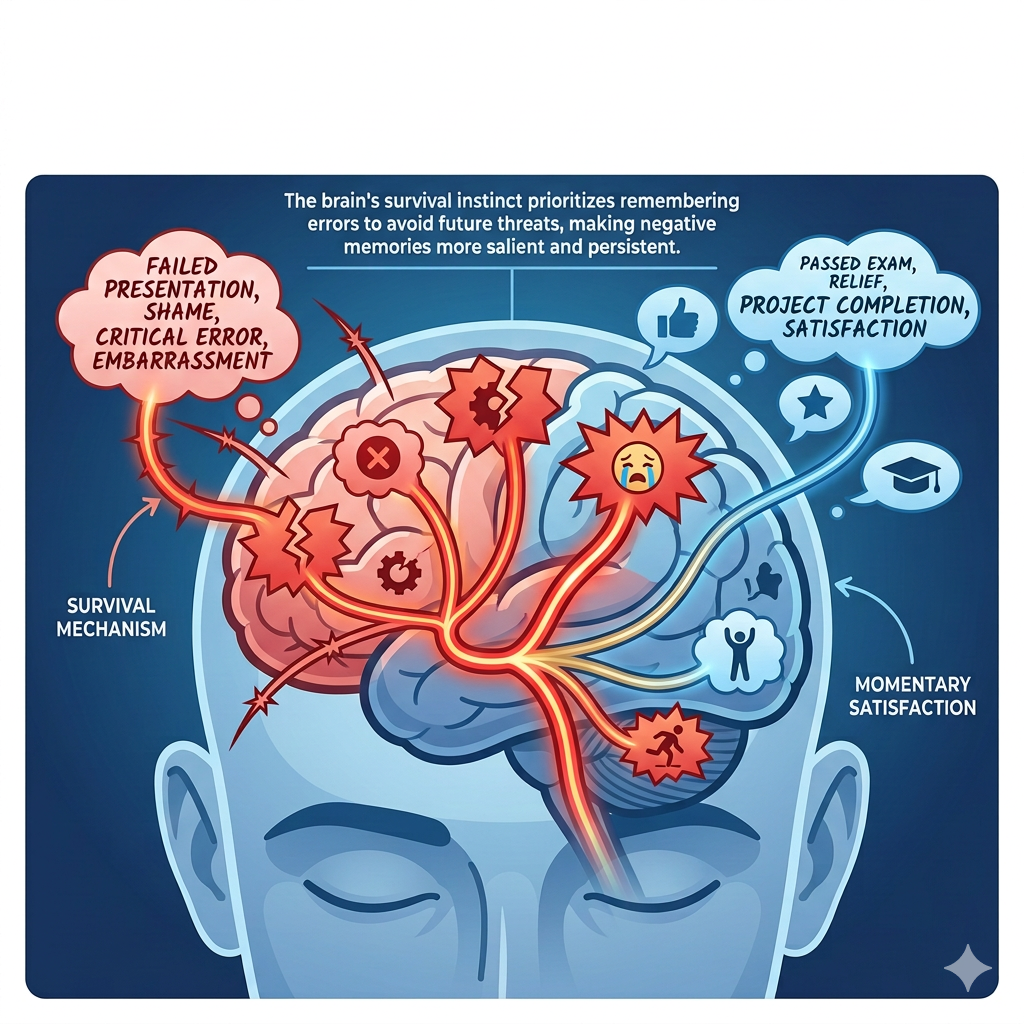
Human memory does not treat all experiences equally. While successes can bring satisfaction and recognition, failures often leave deeper and more lasting impressions. Many people can recall mistakes, missed opportunities, or unsuccessful outcomes in vivid detail, sometimes years after they occurred. In contrast, successful moments may fade more quickly from memory. This tendency reflects a well-documented psychological pattern: humans often remember failures more strongly than successes.
One explanation lies in the brain’s evolutionary design. For much of human history, survival depended on identifying and avoiding threats. Remembering negative experiences—such as danger, mistakes, or harmful outcomes—provided an adaptive advantage. If early humans remembered the locations of hazards, dangerous animals, or unsuccessful strategies, they were more likely to avoid repeating those mistakes. Over time, the human brain developed mechanisms that prioritize the storage of negative information.
This pattern is commonly referred to as negativity bias. Psychological research suggests that negative events tend to produce stronger emotional responses than positive ones. Because emotional intensity influences memory formation, experiences associated with stress, disappointment, or fear are more likely to be encoded deeply in memory. Success, while pleasant, often produces less intense emotional signals, making it less memorable in comparison.
Another factor influencing memory is the role of learning signals. Failures often indicate that expectations did not match reality. When outcomes differ from predictions, the brain interprets the discrepancy as information that requires attention. This mismatch triggers deeper cognitive processing as individuals analyze what went wrong and how to avoid repeating the mistake. As a result, failure-related experiences become embedded more strongly in memory.
Success, by contrast, typically confirms existing expectations. When an outcome matches what individuals hoped or predicted, there may be less incentive for detailed analysis. The brain registers the result as confirmation rather than a signal requiring adjustment. Consequently, the event may not receive the same level of cognitive processing.
Social and cultural dynamics also contribute to the prominence of failure in memory. In professional and educational environments, mistakes often receive greater scrutiny than successes. Performance reviews, academic feedback, and public evaluations frequently focus on identifying areas for improvement. While this approach encourages learning, it can also reinforce the mental emphasis placed on errors.
Another aspect involves self-reflection and personal standards. Many individuals maintain high expectations for their performance. When outcomes fall short of those expectations, the resulting disappointment can lead to repeated mental review of the event. This reflective process strengthens memory retention because the brain revisits the experience multiple times.
Perceived responsibility further intensifies this effect. Failures that individuals attribute to their own decisions or actions are more likely to remain memorable. When people believe they could have acted differently, they often replay the situation mentally in search of alternative choices. These repeated evaluations reinforce the memory over time.
Interestingly, the same mechanisms that make failures memorable can also contribute to personal and professional growth. Because failures attract deeper attention, they often generate valuable learning opportunities. Analyzing mistakes encourages individuals to refine strategies, develop new skills, and improve future performance.
In fields such as science, engineering, and entrepreneurship, failure analysis is an essential component of progress. Researchers examine unsuccessful experiments to identify flawed assumptions or methodological errors. Businesses review unsuccessful product launches or campaigns to understand customer behavior more clearly. In these contexts, remembering failure serves as a foundation for innovation and improvement.
However, the emphasis on negative experiences can also create challenges. If individuals focus too heavily on past failures, they may develop excessive caution or self-doubt. Persistent rumination about mistakes can reduce confidence and discourage risk-taking, even when experimentation is necessary for growth.
Balancing memory of failures with recognition of successes is therefore important for maintaining psychological resilience. Successes provide evidence of capability and progress, reinforcing motivation and confidence. When individuals acknowledge both achievements and setbacks, they develop a more accurate perspective on their overall performance.
Cognitive psychology suggests several ways to encourage this balance. One approach involves reflective journaling, where individuals document both successful outcomes and lessons from mistakes. Recording achievements alongside failures helps strengthen positive memory patterns that might otherwise fade.
Another strategy is structured performance review. Instead of focusing solely on problems, effective reviews evaluate what worked well and why. This approach ensures that successful strategies are also analyzed and remembered, allowing them to be repeated or scaled.
Team environments can also influence how successes and failures are remembered. Organizations that celebrate progress and learning encourage employees to view failures as part of development rather than as defining events. When both positive and negative experiences are discussed openly, memory patterns become more balanced.
Neuroscience research also highlights the importance of emotional context. Experiences associated with gratitude, pride, or shared accomplishment are more likely to become memorable when individuals take time to recognize them intentionally. Celebrating achievements strengthens the emotional signals that support memory formation.
It is important to note that remembering failures is not inherently negative. In fact, this tendency often serves as a powerful learning mechanism. The key challenge lies in ensuring that failures inform improvement without overshadowing the recognition of progress.
Ultimately, the reason we remember failures more than successes reflects the brain’s priority for learning from potential threats and mistakes. Negative experiences generate stronger emotional signals, deeper cognitive processing, and repeated reflection, all of which reinforce memory retention.
Understanding this pattern allows individuals and organizations to manage it more effectively. By consciously acknowledging achievements while analyzing setbacks constructively, people can harness the learning value of failure without allowing it to dominate their perception of progress.
In complex environments where growth depends on experimentation and adaptation, both success and failure provide valuable information. Remembering failures may help prevent repeated mistakes, but remembering successes ensures that effective strategies are not overlooked. Balancing these memories supports continuous learning and sustainable progress.