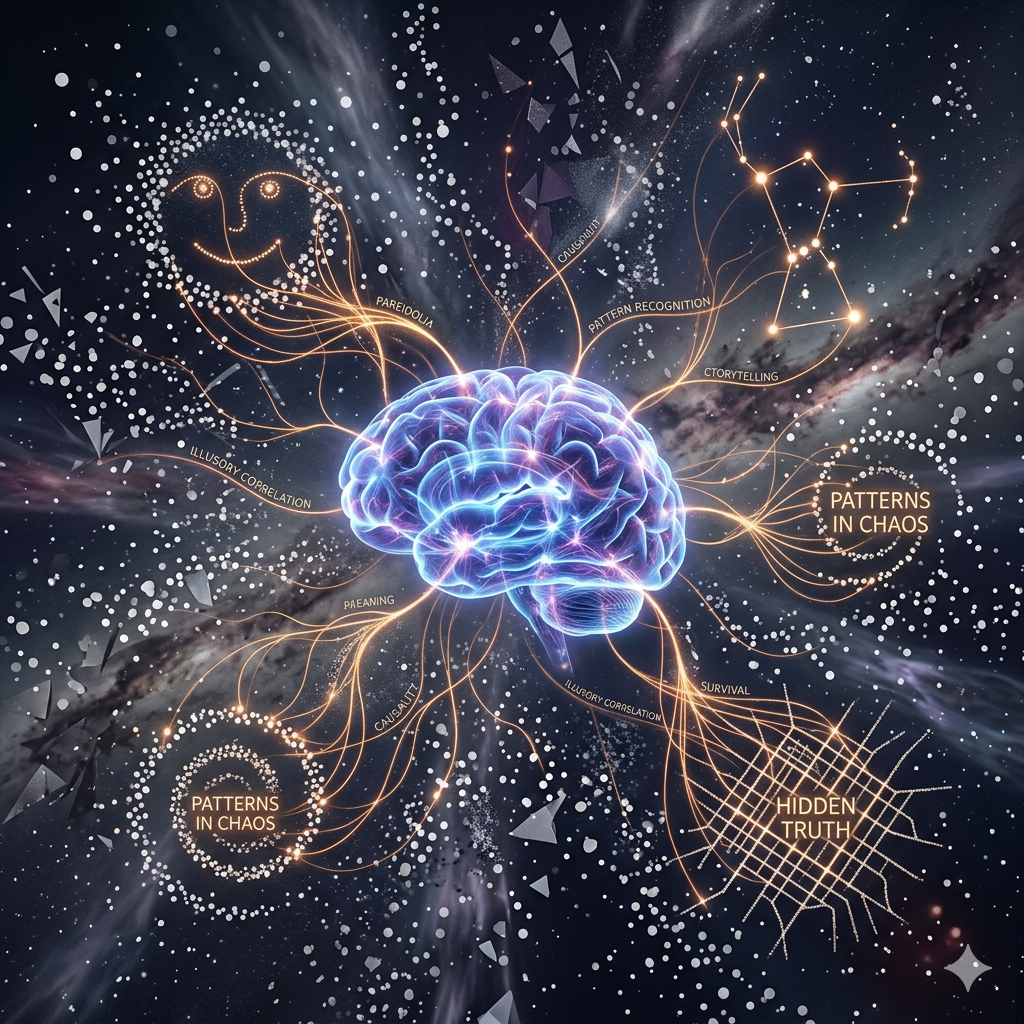
Human beings have a natural tendency to search for patterns and meaning in the world around them. From interpreting coincidences to identifying trends in markets or predicting outcomes in daily life, the brain constantly tries to organize information into understandable structures. This ability to detect patterns has been essential for learning, survival, and decision-making. However, this same cognitive mechanism can also lead people to see meaning in events that are actually random. Understanding why the brain looks for meaning in random events reveals how human cognition balances efficiency, prediction, and uncertainty.
One of the most important explanations lies in the brain’s role as a pattern-recognition system. The human mind is designed to detect relationships between events. In early human history, recognizing patterns in nature—such as seasonal changes, animal behavior, or environmental signals—helped people predict outcomes and improve survival. For example, identifying patterns in weather or animal movement could guide hunting or agriculture. Because pattern recognition offered clear advantages, the brain evolved to detect connections quickly, sometimes even when those connections do not truly exist.
This tendency is often referred to as patternicity, the inclination to perceive patterns in unrelated or random data. When the brain encounters information, it tries to organize it into coherent structures. If several events occur close together in time, people may assume that they are connected. Even when events are independent, the brain may interpret them as part of a meaningful sequence.
Another concept that explains this phenomenon is apophenia, which describes the human tendency to perceive meaningful relationships between unrelated events. Examples of this can be seen in many everyday situations. People may believe that a series of coincidences carries hidden significance, interpret random fluctuations in financial markets as predictable trends, or assume that unrelated occurrences are linked by cause and effect.
The brain’s search for meaning is closely connected to the need for predictability and control. Randomness can feel uncomfortable because it introduces uncertainty. When events appear unpredictable, individuals may feel less able to influence outcomes. By identifying patterns or explanations—even if those explanations are inaccurate—the brain reduces uncertainty and creates a sense of order.
This process is also related to causal reasoning, the human tendency to assume that events occur for specific reasons. People generally prefer explanations that identify clear causes rather than accepting that some events occur without intentional patterns. When a surprising event occurs, individuals instinctively ask why it happened, even if the true explanation is simply chance.
Memory processes further reinforce this tendency. When individuals notice events that appear connected, those observations are often remembered more strongly than events that contradict the perceived pattern. For example, if someone believes that certain behaviors lead to specific outcomes, they may recall instances that support this belief while overlooking situations that do not. This selective memory strengthens the illusion that the pattern is real.
Another factor contributing to the search for meaning in randomness is confirmation bias. Once individuals believe that a pattern exists, they begin to notice evidence that confirms their assumption. At the same time, they may ignore information that challenges the perceived relationship. Over time, this bias can make a random sequence of events appear increasingly meaningful.
Emotion also plays an important role in this process. When events carry emotional significance—such as unexpected success, failure, or coincidence—the brain becomes more motivated to interpret their meaning. Emotional experiences activate cognitive systems that search for explanations, even when no clear causal relationship exists.
In social environments, the desire for meaningful explanations can be amplified by storytelling. Humans naturally organize experiences into narratives that explain why events occurred and what they represent. Narratives are easier to understand and communicate than complex descriptions of randomness. As a result, people often create stories that link events together even when those connections are not supported by evidence.
In business and financial contexts, this psychological tendency can influence decision-making. Investors, managers, and analysts often attempt to interpret patterns in data to forecast future outcomes. While pattern analysis can be useful when real relationships exist, random fluctuations can sometimes be mistaken for meaningful trends. When individuals rely too heavily on perceived patterns without verifying them through rigorous analysis, decisions may be based on misleading signals.
However, the human search for meaning is not purely a cognitive error. In many situations, pattern recognition allows individuals to detect real relationships that might otherwise remain hidden. Scientific discovery, technological innovation, and strategic decision-making often begin with the identification of patterns within complex data.
The challenge arises when the brain treats all patterns as equally meaningful. Distinguishing between genuine relationships and random coincidences requires systematic methods such as statistical analysis, controlled experimentation, and critical thinking. These tools help determine whether observed patterns reflect real causal connections or simply random variation.
Education in probability and statistics can also help individuals understand how randomness operates. Many natural processes produce sequences that appear patterned even when they are generated by chance. Recognizing these patterns as statistical variation reduces the likelihood of misinterpreting them as meaningful signals.
Another useful approach involves questioning initial assumptions about patterns. When individuals ask whether an observed relationship could have occurred by chance, they create an opportunity to evaluate evidence more carefully. This reflective thinking helps counteract the brain’s automatic tendency to assign meaning too quickly.
Ultimately, the brain looks for meaning in random events because pattern recognition has historically been beneficial for survival and learning. By quickly identifying relationships in the environment, humans were able to anticipate risks and opportunities. However, in complex modern systems where randomness often plays a significant role, this tendency can sometimes produce misleading interpretations.
Understanding this cognitive mechanism allows individuals to approach patterns more critically. Rather than assuming that every coincidence or trend reflects a deeper meaning, people can examine evidence carefully and consider the possibility of randomness.
By balancing the brain’s natural pattern-seeking instincts with analytical reasoning, individuals and organizations can improve their ability to distinguish meaningful insights from chance events. This balance supports better decision-making, clearer thinking, and a more accurate understanding of the complex systems that shape everyday life.