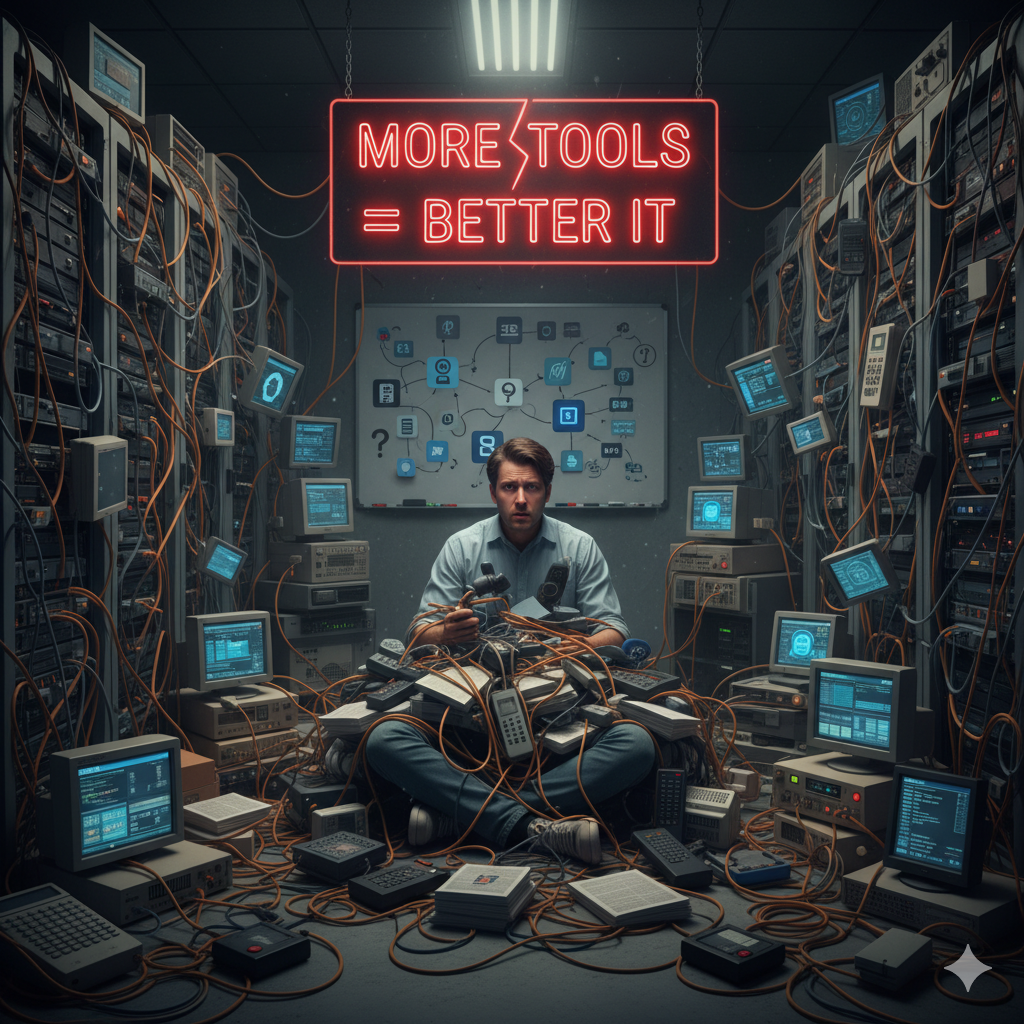
In modern organizations, there is a common belief that adding more technology automatically improves performance. When productivity slows, a new platform is introduced. When communication breaks down, another collaboration app is adopted. When reporting becomes complex, a new analytics tool is purchased. Over time, the organization accumulates dozens of systems — each promising efficiency, visibility, and growth. Yet despite increasing investments in software, many companies experience the opposite effect. Complexity rises. Costs increase. Teams become confused. Integration issues multiply. Instead of clarity, there is fragmentation. More tools do not automatically create better IT. In many cases, they introduce operational friction that slows progress rather than accelerating it.
Below are six critical reasons why expanding your technology stack without strategic discipline can weaken performance instead of strengthening it.
1. Tool Overload Creates System Fragmentation
Every new tool added to the organization introduces another data source, another login, another interface, and another integration requirement. While each platform may solve a specific problem individually, collectively they can fragment workflows. For example, sales teams may use one CRM, marketing uses separate automation software, finance relies on different reporting systems, and operations track performance in standalone dashboards. If these systems do not communicate seamlessly, employees spend time switching between platforms and manually reconciling information. Fragmentation reduces visibility. Leadership struggles to gain a unified view of performance. Departments operate in silos. Data becomes inconsistent across reports. Instead of improving efficiency, multiple disconnected tools create administrative overhead. Employees spend more time managing systems than executing strategy. True IT maturity requires consolidation, integration, and architectural alignment — not uncontrolled expansion.
2. Integration Complexity Increases Technical Risk
Each additional system requires integration with existing infrastructure. Integrations demand configuration, testing, monitoring, and ongoing maintenance.
As the number of tools grows, integration points multiply exponentially. This increases the likelihood of:
- Data synchronization failures
- API compatibility issues
- Security vulnerabilities
- Performance degradation
When one system updates its framework or API structure, connected systems may break. IT teams then shift focus to troubleshooting compatibility instead of pursuing innovation. Complex integration environments also increase cybersecurity exposure. Every connection represents a potential attack surface. Organizations often underestimate the long-term maintenance burden of maintaining a large, loosely integrated tool ecosystem. A smaller, well-integrated technology stack is often more stable and scalable than a large, fragmented one.
3. Overlapping Functionality Reduces Efficiency
Many tools in the market offer overlapping features. For example, collaboration platforms may include file sharing, messaging, and task management. CRM systems may include marketing automation components. Accounting software may provide reporting dashboards. When organizations adopt multiple tools with similar capabilities, confusion arises regarding which system should be used for specific tasks. Employees duplicate work across platforms or rely on outdated versions of data stored in different systems. This redundancy leads to inefficiency rather than productivity. Training becomes more complicated. Onboarding new employees takes longer. Internal processes lose clarity. Instead of enhancing capability, excessive tools dilute focus. Effective IT strategy emphasizes clearly defined system roles. Each tool should serve a distinct purpose within a structured ecosystem.
4. Increased Costs Without Proportional Value
Technology investments include more than subscription fees. Costs also include:
- Implementation services
- Integration development
- Training programs
- Maintenance contracts
- Security management
- Infrastructure scaling
As tool count increases, so does operational expense. However, the return on investment does not always scale proportionally. Organizations often discover that multiple premium tools are underutilized. Employees may only use a small fraction of available features. In some cases, entire platforms remain inactive after initial adoption enthusiasm fades. Without periodic cost-benefit evaluation, technology spending can quietly exceed value generation. Strategic IT governance requires auditing tool usage, consolidating redundant platforms, and eliminating underperforming systems. Investment discipline is essential to maintaining profitability.
5. User Experience Becomes Complicated
From an employee perspective, navigating numerous systems daily creates cognitive overload. Switching between interfaces reduces concentration and increases error rates. Multiple authentication processes, inconsistent design patterns, and fragmented notifications create friction in routine tasks. Instead of simplifying workflows, excessive tools complicate them. User frustration can lead to shadow IT employees adopting unauthorized tools that feel easier to use. This introduces further security and compliance risks. Technology should simplify human work. When employees feel burdened by systems rather than supported by them, productivity declines. Streamlined digital environments with intuitive workflows foster higher adoption and engagement.
6. Strategy Gets Replaced by Reaction
Perhaps the most significant issue with excessive tool adoption is the absence of strategic alignment. When organizations continuously add new systems in response to emerging challenges, technology decisions become reactive. Instead of evaluating root causes, leadership seeks quick solutions through additional platforms. This pattern creates a patchwork ecosystem where tools are layered on top of existing inefficiencies. Without a long-term architectural vision, technology sprawl becomes inevitable. IT teams spend increasing amounts of time managing vendor relationships, renewing contracts, troubleshooting integrations, and training users. Innovation slows because energy is diverted toward system management rather than strategic development. Better IT is not defined by the number of platforms deployed. It is defined by coherence, alignment, and purposeful design.
Conclusion
More tools do not guarantee better performance. In fact, uncontrolled expansion of technology ecosystems often introduces fragmentation, complexity, rising costs, integration risks, and reduced productivity. Effective IT leadership prioritizes consolidation, integration, and clear architectural strategy. Every tool should serve a defined role within a cohesive system. Redundancy should be eliminated. Adoption should be measured. Performance impact should be evaluated continuously. Technology is an enabler, not a collection of applications. Organizations that focus on simplicity, interoperability, and strategic alignment achieve stronger operational performance than those that accumulate tools without structure. The goal is not to build the largest technology stack. The goal is to build the smartest one. Better IT is not about having more. It is about having what works integrated, optimized, and aligned with business growth.