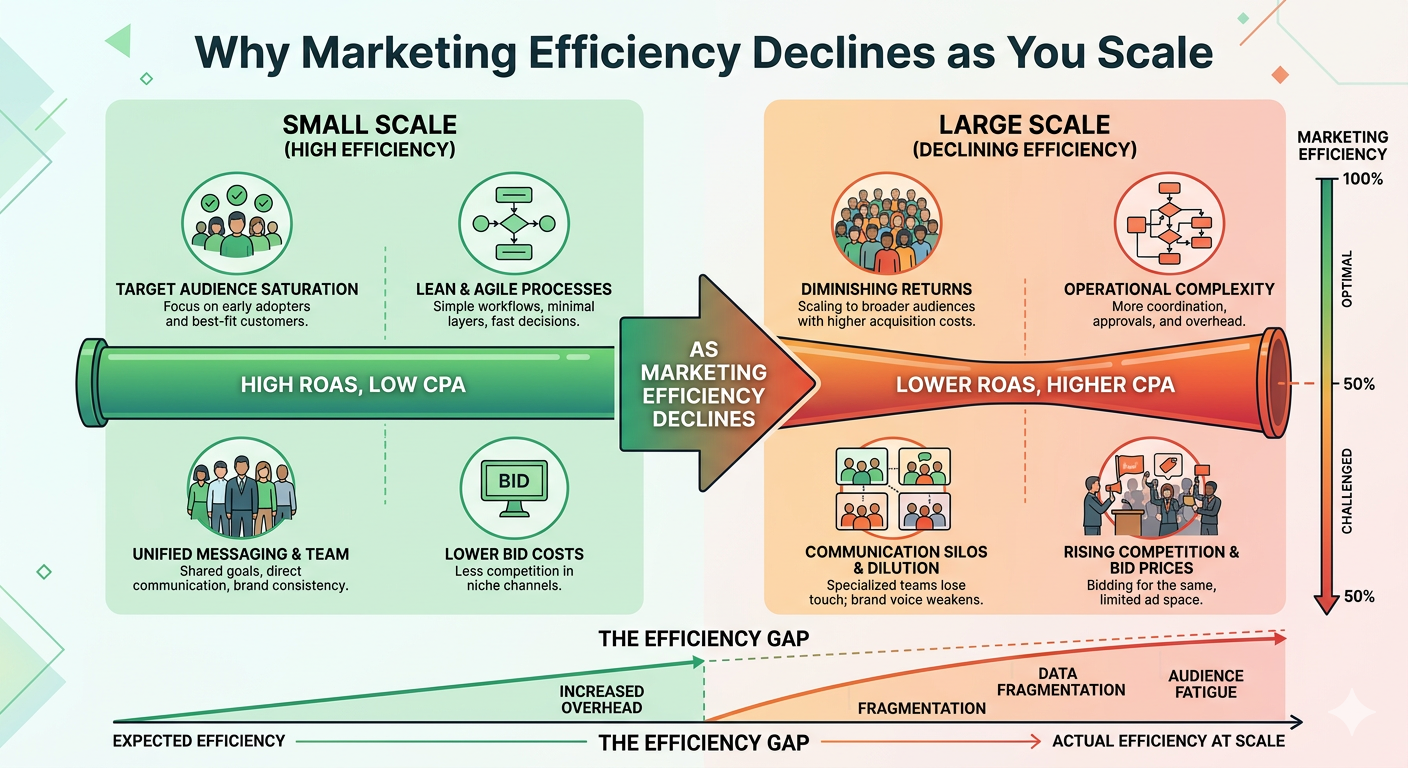
Growth is often celebrated as proof that a marketing strategy is working. When campaigns deliver strong results at a small scale, the natural decision is to increase budget, expand reach, and accelerate performance. In the early stages, this approach frequently works. Costs remain stable, audiences respond positively, and metrics such as conversion rate, cost per acquisition (CPA), and return on ad spend (ROAS) appear healthy. However, as organizations scale aggressively, a common and often misunderstood pattern emerges: marketing efficiency declines as you scale. What once produced strong returns begins to generate weaker marginal outcomes. Understanding why this happens is essential for building sustainable and financially disciplined growth.
At the core of this issue lies the economic principle of diminishing marginal returns. In marketing, the most responsive and high-intent audiences are typically reached first. Early campaigns target individuals already interested in the product or actively searching for solutions. These customers convert at lower acquisition costs. When budget increases, businesses must expand into broader, less-qualified audience segments. As targeting widens, conversion probability decreases and acquisition cost rises. Even if total revenue increases, efficiency metrics begin to deteriorate.
Auction-based advertising platforms amplify this effect. Digital advertising operates within competitive bidding systems where brands compete for attention. When you increase budget, you often increase bid intensity. This can drive up cost per click (CPC) and ultimately raise customer acquisition cost (CAC). In saturated markets, incremental spending does not produce proportionate incremental revenue. Instead, each additional dollar invested generates smaller returns than the previous dollar.
Audience fatigue also contributes to declining efficiency. When campaigns scale rapidly, the same audience segments may see advertisements repeatedly. Overexposure reduces engagement and lowers conversion rates. Creative performance weakens, and frequency increases without corresponding impact. Refreshing creative assets helps temporarily, but the structural limitation of audience size remains. Once high-quality demand pools are exhausted, efficiency inevitably declines.
Another factor is the expansion into new channels. Early-stage scaling often focuses on the most efficient platforms. As these channels saturate, businesses diversify into secondary platforms with lower performance benchmarks. While diversification can expand reach, it may reduce overall blended efficiency. Without careful analysis, companies may mistake increased volume for improved performance.
Operational complexity increases as scale expands. Campaign management becomes more intricate, data sets grow larger, and attribution modeling becomes more challenging. Errors in tracking, reporting delays, and optimization gaps can reduce efficiency. At small scale, manual oversight may ensure precision. At large scale, systemic inefficiencies become harder to detect.
The relationship between Customer Lifetime Value (CLV) and acquisition cost becomes more volatile under scaling conditions. Early adopters often demonstrate strong loyalty and higher retention rates. As marketing expands into broader audiences, customer quality may decline. New customers may exhibit lower repeat purchase behavior or higher churn rates. Even if acquisition costs remain stable, reduced lifetime value compresses profitability.
Pricing strategy further influences efficiency decline. To sustain conversion rates while scaling, companies sometimes introduce discounts or promotional offers. While this may preserve top-line growth, it reduces gross margin per transaction. The apparent stability of ROAS can mask shrinking contribution margins. Scaling with reduced margin buffers accelerates financial pressure.
Brand perception also plays a role. Aggressive advertising can temporarily boost awareness, but if messaging becomes repetitive or overly promotional, brand equity may weaken. Lower perceived value makes customers more price-sensitive, increasing dependence on discounts and reducing long-term efficiency.
Data misinterpretation is another hidden cause. Aggregate performance metrics often obscure marginal trends. A blended ROAS may appear acceptable, even though incremental campaigns perform poorly. Without isolating incremental contribution, businesses risk scaling based on average performance rather than marginal performance. Sustainable scaling requires tracking incremental ROI, not just overall averages.
Market maturity matters as well. In emerging markets, demand growth can support efficient scaling for longer periods. In mature markets, competition is intense and audience pools are limited. Scaling in saturated markets almost always reduces efficiency faster. Strategic planning must account for market stage.
Internal organizational dynamics can accelerate decline. When leadership sets aggressive growth targets without profitability constraints, marketing teams may prioritize volume over efficiency. Incentive structures influence behavior. If teams are rewarded for revenue growth alone, cost discipline may weaken.
Economic conditions influence scalability too. Rising inflation, supply chain disruptions, or increased input costs reduce margin flexibility. When cost structures tighten, even minor increases in acquisition cost can eliminate profitability. Scaling under such conditions requires even stricter financial analysis.
Predictive analytics can help anticipate efficiency decline. Modeling conversion elasticity relative to spend provides insight into optimal budget thresholds. Rather than scaling linearly, organizations should identify the point at which marginal cost equals marginal revenue. Beyond this threshold, expansion destroys value.
Retention strategy becomes increasingly important as acquisition efficiency declines. Improving customer experience, loyalty programs, and repeat purchase incentives can offset rising acquisition costs. Sustainable growth shifts focus from purely acquiring new customers to maximizing value from existing ones.
Technology platforms often encourage aggressive scaling through automated recommendations. While algorithms can optimize for engagement or conversions, they may not prioritize profitability. Embedding financial constraints within optimization frameworks ensures that automation aligns with economic goals.
Leadership alignment between marketing and finance is critical. Scaling decisions should incorporate contribution margin analysis, cash flow modeling, and scenario forecasting. Cross-functional collaboration prevents overexpansion based on incomplete data.
The psychological momentum of early success can create overconfidence. When initial campaigns perform strongly, teams may assume scalability without limits. However, marketing ecosystems are nonlinear. Recognizing natural efficiency decline as scale increases fosters disciplined decision-making.
Long-term sustainability depends on balancing growth ambition with operational reality. Efficient scaling is possible when incremental revenue exceeds incremental cost consistently. When that balance shifts, strategic adjustment is necessary.
Ultimately, marketing efficiency declines as you scale because the easiest opportunities are captured first, competition intensifies, audience quality varies, and marginal costs increase. The objective should not be avoiding scale but managing it intelligently. Sustainable growth requires continuous measurement of marginal profitability, integration of financial analytics, and strategic pacing of expansion.
Scaling remains a powerful lever for growth, but it must be guided by economic insight rather than optimism. Organizations that understand the structural reasons behind declining efficiency can adapt proactively, protecting profitability while expanding reach. In a competitive digital landscape, the ability to scale responsibly is what separates temporary momentum from durable success.