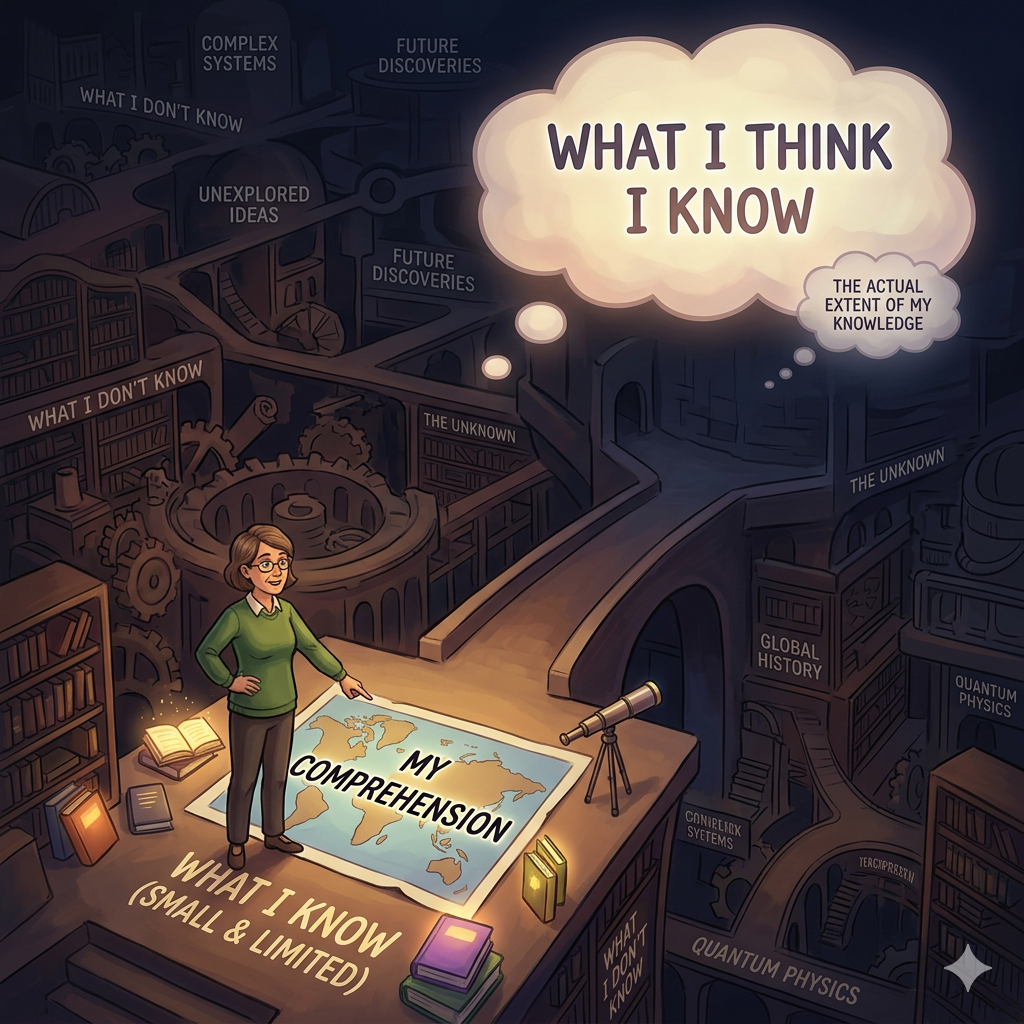
Human beings often feel more confident about their understanding of the world than the evidence justifies. This tendency to overestimate one’s own knowledge is widespread and appears across many domains, including business, science, politics, and everyday decision-making. While confidence can be beneficial in motivating action, excessive confidence can lead individuals to underestimate uncertainty, overlook important information, and make flawed judgments.
One of the most well-known explanations for this phenomenon comes from research in cognitive psychology known as the Dunning–Kruger effect. This principle describes how individuals with limited knowledge or skill in a particular area may overestimate their competence. Because they lack sufficient understanding of the subject, they also lack the ability to accurately evaluate their own performance. As a result, they may believe they know more than they actually do.
Interestingly, this bias is not limited to those with low expertise. Even highly educated or experienced individuals can misjudge the limits of their knowledge. The difference is that experts are often better at recognizing uncertainty within their fields, while non-experts may assume that complex topics are simpler than they really are.
A related concept is known as the illusion of explanatory depth. People frequently believe they understand how systems work until they attempt to explain them in detail. When asked to describe mechanisms—such as how a bicycle stays balanced, how a market economy operates, or how a technological device functions—many individuals discover that their understanding is far more superficial than they initially assumed.
This gap between perceived knowledge and actual understanding arises partly because the brain often relies on mental summaries rather than detailed models. Instead of storing every technical detail about a subject, people tend to remember simplified explanations or key ideas. These summaries are usually sufficient for everyday reasoning, but they can create the impression of deeper understanding than truly exists.
Social environments also contribute to overconfidence. In modern societies, knowledge is distributed across large networks of people and institutions. Individuals often rely on experts, organizations, and technology for information. Because these systems function smoothly most of the time, people may feel as though they personally understand systems that are actually supported by collective expertise.
Another important factor is the role of confidence in communication and leadership. In many professional settings, confidence is interpreted as competence. Individuals who present ideas assertively are often perceived as knowledgeable, even when their understanding is incomplete. Over time, this cultural reinforcement can encourage people to express certainty even when uncertainty would be more accurate.
Cognitive shortcuts also play a role. When evaluating a problem, the brain often uses heuristics—quick rules of thumb that simplify decision-making. These shortcuts allow individuals to form opinions rapidly, but they can also create a false sense of mastery over complex subjects.
Memory limitations further contribute to this phenomenon. People typically remember conclusions more easily than the reasoning that led to them. Over time, the underlying uncertainty or assumptions behind a belief may fade, leaving only the conclusion. As a result, individuals may become increasingly confident in ideas whose original reasoning they no longer fully recall.
Overconfidence can also emerge from success experiences. When individuals make decisions that produce positive outcomes, they may attribute those outcomes to their own knowledge or skill. While this attribution may sometimes be correct, it can also overlook the role of external factors such as timing, market conditions, or random variation.
In business environments, overestimating knowledge can influence strategic decisions. Leaders may rely on intuition or past experience without recognizing how much the environment has changed. Markets evolve, technologies advance, and customer behaviors shift. Confidence built on outdated assumptions may therefore produce inaccurate forecasts or ineffective strategies.
However, the human tendency toward overconfidence also has some advantages. Moderate confidence encourages initiative, innovation, and risk-taking. Without a degree of belief in their own abilities, individuals might avoid pursuing ambitious goals or exploring new ideas. In this sense, confidence can function as a motivational force.
The challenge arises when confidence becomes disconnected from evidence or analysis. When individuals assume they already understand a situation fully, they may stop seeking additional information. This reduces the opportunity to learn and adapt.
One useful strategy for addressing this bias is structured reflection. When individuals are encouraged to explain their reasoning step by step, gaps in understanding often become visible. Writing explanations, teaching concepts to others, or discussing ideas in detail can reveal areas where knowledge is incomplete.
Another helpful practice is intellectual humility—the recognition that one’s knowledge is always partial. Intellectual humility does not mean lacking confidence, but rather acknowledging uncertainty and remaining open to new information.
Organizations can also encourage better decision-making by creating environments where questioning and debate are welcomed. When teams feel comfortable challenging assumptions, collective knowledge becomes more accurate and robust.
Evidence-based decision processes provide another safeguard. By grounding decisions in data, experimentation, and systematic analysis, organizations can reduce the influence of individual overconfidence.
Continuous learning is equally important. Fields such as technology, finance, and marketing evolve rapidly. Professionals who actively update their knowledge are better equipped to recognize when their previous understanding no longer applies.
Ultimately, the human tendency to overestimate knowledge reflects the brain’s effort to simplify a complex world. Complete understanding of every system we encounter would require far more cognitive resources than any individual possesses. Instead, the mind builds simplified mental models that allow people to navigate everyday life efficiently.
Recognizing the limits of those models is essential for effective thinking. When individuals remain curious, question assumptions, and seek deeper explanations, they reduce the gap between perceived knowledge and actual understanding.
In this way, awareness of the limits of one’s knowledge becomes not a weakness, but a powerful foundation for learning, collaboration, and more accurate decision-making.