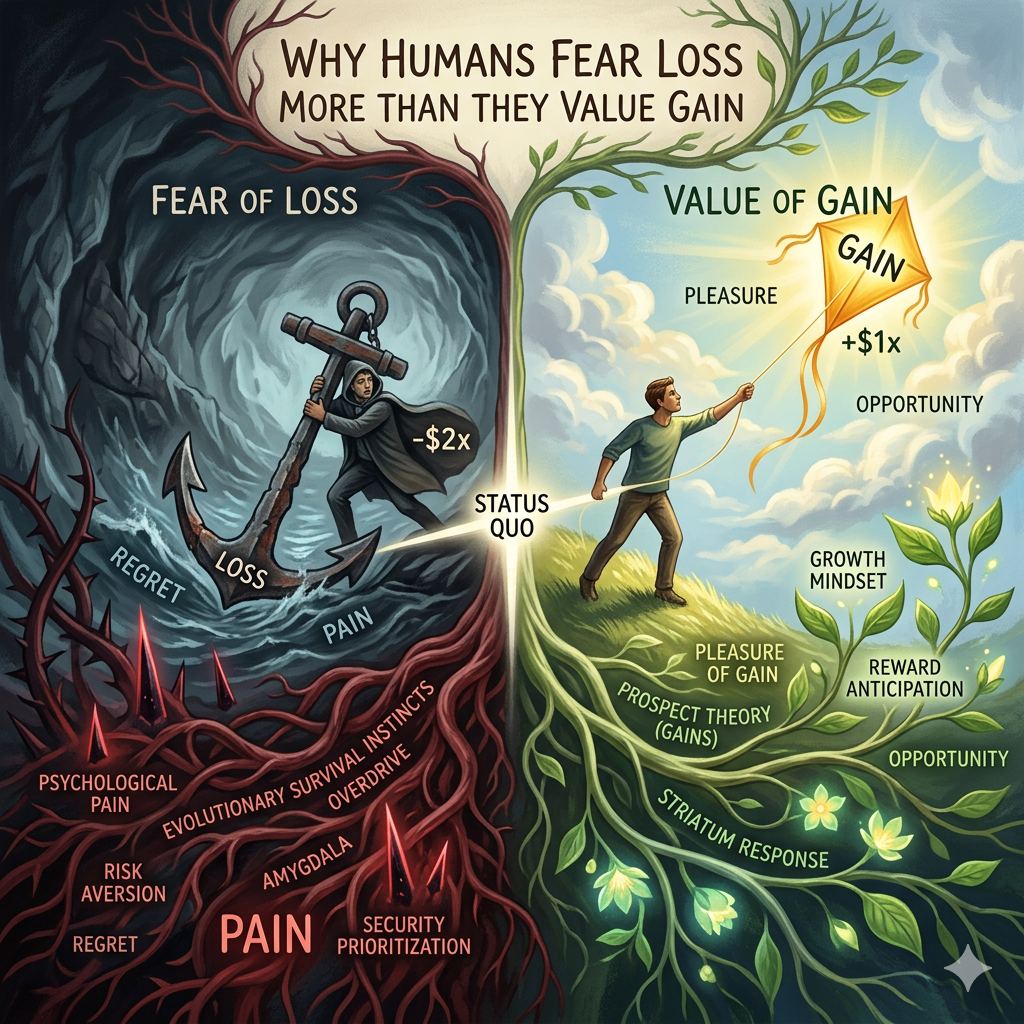
Human decision-making is rarely based purely on logical calculations. Instead, emotions, perceptions, and cognitive biases often shape how individuals evaluate outcomes. One of the most powerful psychological tendencies influencing human behavior is the strong reaction people have toward losing something they already possess. In many situations, individuals feel the pain of losing something more intensely than the satisfaction of gaining something new. Understanding why humans fear loss more than they value gain reveals important insights into how the mind evaluates risk, reward, and decision-making.
This tendency is widely associated with the concept of loss aversion, a psychological principle describing how people perceive losses and gains differently. When individuals face a choice between potential gains and potential losses, the emotional weight attached to losses is usually stronger. For example, losing a certain amount of money often feels more painful than the happiness created by gaining the same amount. Even though the objective value may be equal, the psychological impact is not balanced.
One explanation for this behavior lies in the brain’s evolutionary history. Early human survival depended heavily on protecting existing resources such as food, shelter, and safety. Losing these resources could significantly reduce the chances of survival. As a result, the brain developed mechanisms that prioritize avoiding losses over seeking new rewards. This protective bias encouraged cautious behavior and helped individuals maintain the resources necessary for survival.
Another important factor is the role of emotional processing in decision-making. When individuals imagine losing something they already possess, the brain often activates emotional responses related to fear, anxiety, or regret. These emotional reactions make the potential loss feel immediate and personal. In contrast, potential gains often feel uncertain or distant, which reduces their emotional intensity.
The concept of ownership also plays a significant role in how losses are perceived. Once people feel that something belongs to them, its value increases in their mind. This psychological effect means that losing an owned item feels more significant than never having it at all. As a result, individuals become more protective of what they already possess, whether it involves money, possessions, opportunities, or relationships.
Memory and past experiences also influence sensitivity to loss. Negative experiences often leave stronger impressions than positive ones. When individuals remember previous losses, those memories reinforce caution in future decisions. The brain learns to associate certain actions with potential negative outcomes, encouraging behavior that avoids repeating similar experiences.
Another important factor is uncertainty. Gains often involve risk and unpredictability, while maintaining the current situation feels more stable. When people face decisions that could lead to both gains and losses, the possibility of losing what they already have can appear more threatening than the uncertain promise of improvement. This perception encourages individuals to favor safer options even when potential gains are significant.
Social and cultural influences can also reinforce loss-averse thinking. In many environments, individuals receive stronger criticism for losses than recognition for gains. For example, leaders or decision-makers may be judged more harshly for mistakes than praised for successes. This pattern creates additional pressure to avoid outcomes that might result in visible losses.
The influence of loss aversion can be observed in many real-world behaviors. In financial decisions, investors sometimes hold on to declining assets longer than they should because selling would confirm the loss. Similarly, individuals may avoid switching careers, ending unproductive projects, or exploring new opportunities because doing so involves letting go of something familiar.
Another situation where loss aversion appears is in negotiations and pricing decisions. People often resist giving up something they already have, even when the alternative option might provide greater benefits. The emotional discomfort associated with loss can outweigh the logical evaluation of potential advantages.
Loss aversion also affects risk perception. When individuals evaluate risky situations, they often focus more on the possibility of losing than on the probability of gaining. This imbalance can lead to overly cautious decisions in some circumstances, while in others it may encourage individuals to take greater risks in an attempt to avoid realizing a loss.
Despite its strong influence, loss aversion is not always harmful. In many situations, caution and resource protection can prevent unnecessary risks. This instinct encourages individuals to think carefully before making important decisions and helps maintain stability in uncertain environments.
However, excessive focus on avoiding loss can sometimes prevent beneficial change. When individuals become too protective of their current situation, they may miss opportunities for improvement or innovation. Balancing caution with openness to potential gains becomes essential for long-term progress.
One useful strategy for managing this bias involves reframing decisions. Instead of focusing only on what might be lost, individuals can also consider the potential benefits and opportunities associated with change. This broader perspective helps reduce the emotional dominance of loss-related concerns.
Another helpful approach involves evaluating decisions based on long-term outcomes rather than immediate reactions. When individuals step back and examine the bigger picture, they may realize that accepting a small loss today can lead to greater advantages in the future.
Awareness also plays an important role in reducing the influence of loss aversion. When people understand that their brains naturally react strongly to potential losses, they can examine their decisions more carefully and distinguish between emotional reactions and objective evaluation.
Ultimately, why humans fear loss more than they value gain is closely connected to evolutionary survival mechanisms, emotional processing, and the psychological significance of ownership. These factors combine to create a strong bias toward protecting existing resources rather than pursuing uncertain rewards.
Recognizing this tendency allows individuals to approach decisions more thoughtfully. By balancing the instinct to avoid loss with a realistic evaluation of potential gains, people can make choices that support both stability and progress. Understanding this psychological pattern does not eliminate it entirely, but it helps create awareness that encourages more balanced and informed decision-making.