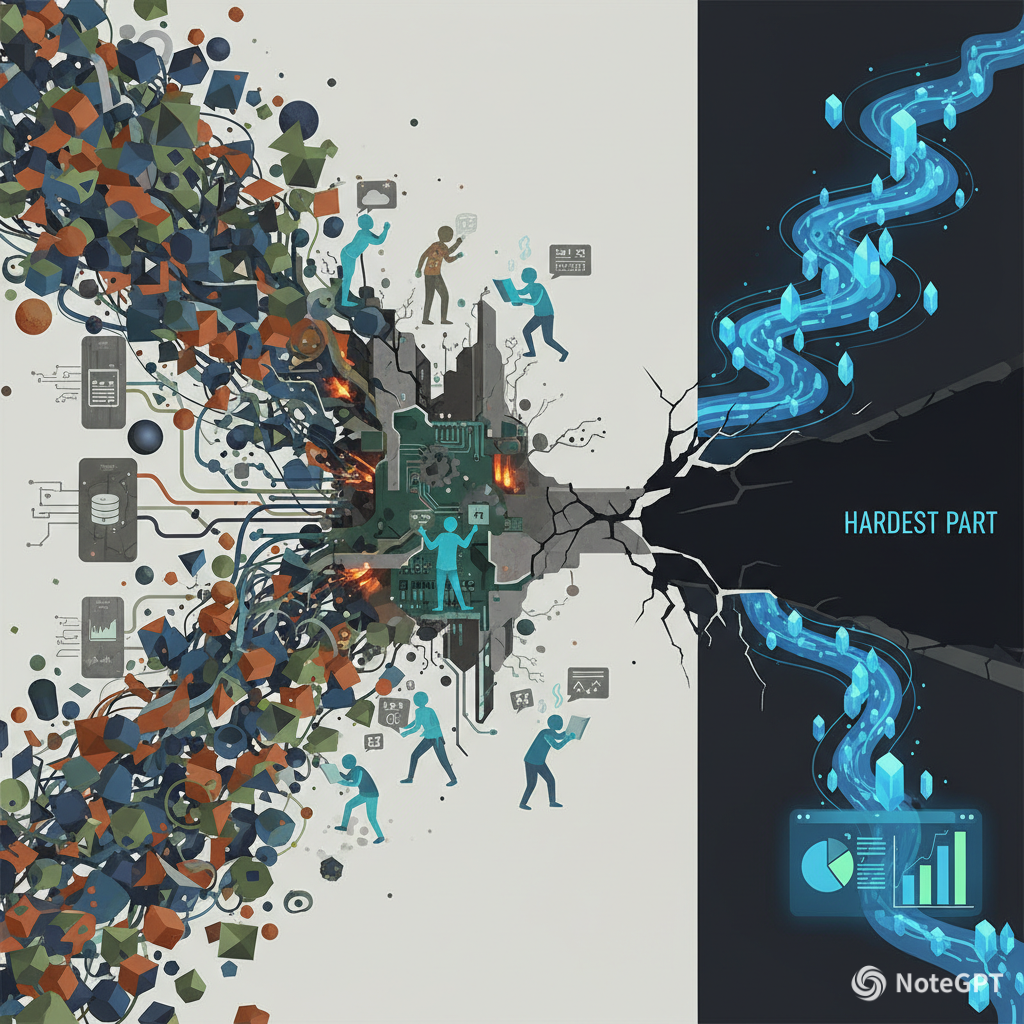
Organizations across industries are investing heavily in analytics to improve decision-making, understand customers, and optimize operations. With the rapid growth of data collection technologies, businesses now generate information from websites, mobile applications, sales systems, customer relationship platforms, supply chains, and financial systems. While this abundance of data creates valuable opportunities for insight, it also introduces a major challenge. One of the most difficult steps in any analytics initiative is bringing these different data sources together in a consistent and usable form. Understanding why data integration is the hardest part of analytics projects reveals the complexity behind transforming scattered information into meaningful insights.
At its simplest level, data integration refers to the process of combining data from multiple systems so that it can be analyzed collectively. The goal is to create a unified view of business activities, allowing organizations to observe patterns that would not be visible when datasets remain separate. Although this concept appears straightforward, the actual implementation often becomes highly complicated due to the structure and diversity of modern data environments.
One major challenge arises from the existence of multiple independent data sources. In many organizations, different departments operate specialized software systems tailored to their specific needs. Marketing teams may rely on digital analytics platforms, sales teams may use customer relationship management tools, finance departments manage accounting systems, and operations teams maintain logistics or inventory software. Each system collects valuable data, but the structure, format, and definitions used in these systems are often different.
Because these systems were not originally designed to communicate with one another, integrating them requires significant effort. Data fields may have different names, formats, or measurement units even when they represent the same concept. For example, one system may record dates in a particular format while another uses a completely different structure. Reconciling these inconsistencies is necessary before meaningful analysis can begin.
Another difficulty involves data quality issues. Real-world data rarely arrives in perfect condition. Records may contain missing values, duplicate entries, inconsistent formatting, or outdated information. When datasets from multiple systems are combined, these quality problems often become more visible and complex. Without careful cleaning and validation, integrated datasets can produce misleading insights.
The challenge of data integration also increases because of data volume and complexity. Modern businesses generate massive quantities of information every day. Transaction records, customer interactions, operational logs, and digital engagement data accumulate rapidly. Integrating these large datasets requires systems capable of processing high volumes efficiently while maintaining accuracy.
In addition to size, the diversity of data types adds another layer of complexity. Businesses often work with structured data such as spreadsheets or databases, semi-structured data such as logs or system exports, and unstructured data including text or multimedia. Each type requires different processing methods before it can be integrated into a unified analytical environment.
Another important factor is the issue of data ownership and governance. Different departments within an organization may control specific datasets and maintain their own procedures for managing information. When integration projects begin, questions often arise about who has authority to modify, access, or distribute certain data sources. Without clear governance policies, integrating datasets can lead to confusion or conflict between departments.
Security and privacy considerations further complicate the process. Some data sources may contain sensitive information about customers, employees, or financial transactions. Integrating these datasets requires strict controls to ensure that privacy regulations and organizational policies are respected. As a result, data integration projects must balance accessibility with security, which often requires additional planning and technical safeguards.
Another major difficulty arises from inconsistent definitions of business metrics. Different departments sometimes interpret the same metric in different ways. For example, one team might define a “customer” as anyone who has registered on a website, while another team considers only individuals who have completed a purchase. When these datasets are combined, such differences can create confusion and inaccurate reporting unless definitions are standardized.
Time-related discrepancies also present challenges during integration. Systems may record events at different frequencies or time intervals. Some databases update information in real time, while others refresh only once a day or once a week. Aligning these timelines requires careful synchronization so that comparisons between datasets remain meaningful.
Technical infrastructure can also affect the complexity of integration. Legacy systems that were developed many years ago may lack modern interfaces for data sharing. Connecting these systems to newer platforms may require additional development work, specialized tools, or manual processes.
Beyond technical difficulties, integration projects also require strong cross-department collaboration. Analysts, engineers, managers, and domain experts must work together to understand how different datasets relate to one another. Without effective communication between these groups, integration efforts may stall or produce incomplete results.
Another reason data integration becomes challenging is that it often receives less attention than more visible stages of analytics projects. Organizations sometimes focus heavily on building dashboards, predictive models, or advanced analytical tools, assuming that the underlying data will naturally align. However, if integration is incomplete or inconsistent, even the most advanced analytical tools cannot produce reliable insights.
In many analytics initiatives, data integration consumes the majority of project time and resources. Analysts frequently spend far more effort preparing and combining data than actually analyzing it. This preparation phase includes cleaning datasets, reconciling definitions, verifying accuracy, and designing systems that allow data to flow between platforms.
Despite these difficulties, successful data integration provides enormous benefits. When datasets are combined effectively, organizations gain a comprehensive view of their operations. They can track customer journeys across multiple channels, analyze relationships between marketing activities and sales outcomes, and identify operational patterns that affect efficiency.
To improve the success of integration projects, many organizations adopt structured data governance frameworks. These frameworks define clear standards for data collection, storage, and usage across departments. Establishing consistent definitions, formats, and processes reduces confusion and simplifies integration over time.
Modern integration technologies also play an important role. Automated data pipelines, integration platforms, and standardized interfaces can help move information between systems more efficiently. While these tools cannot eliminate all complexity, they can significantly reduce the manual effort required.
Ultimately, why data integration is the hardest part of analytics projects lies in the diversity and fragmentation of modern data environments. Businesses generate information across numerous systems, formats, and departments, each with its own structure and priorities. Bringing these elements together into a coherent analytical framework requires technical expertise, organizational coordination, and careful attention to detail.
When organizations successfully overcome these challenges, they unlock the true potential of analytics. Integrated data provides a complete and reliable foundation for analysis, allowing leaders to make informed decisions based on a holistic understanding of their operations. Without effective integration, even the most advanced analytical tools remain limited by fragmented and incomplete information.