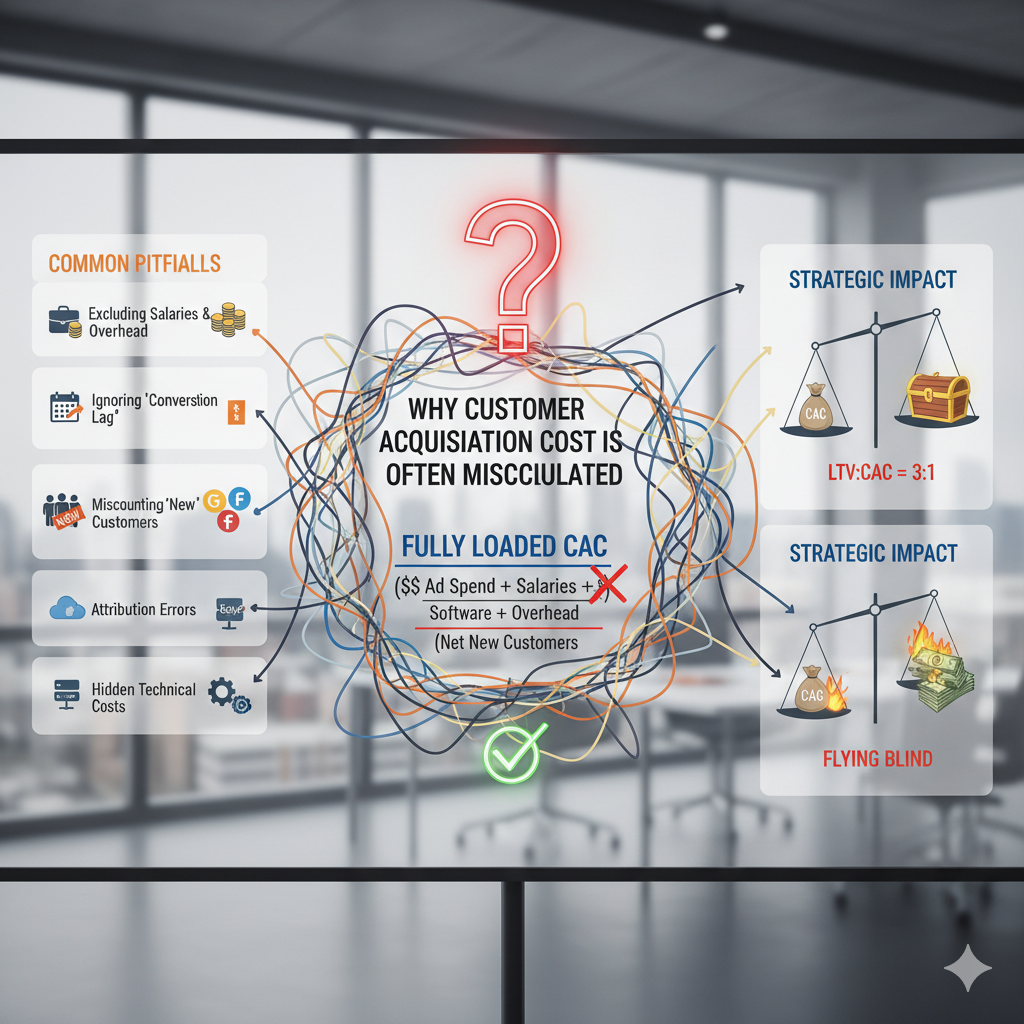
In modern business strategy, few metrics receive as much attention as Customer Acquisition Cost (CAC). Investors examine it closely, founders reference it in pitch decks, marketing teams optimize around it, and finance departments rely on it to evaluate efficiency. On the surface, CAC appears straightforward: divide total marketing and sales expenses by the number of new customers acquired within a specific period. The result seems clear and measurable. However, despite its apparent simplicity, CAC is frequently miscalculated. The numbers presented in reports often underestimate real costs, exclude indirect expenses, or rely on flawed attribution models. As a result, businesses make strategic decisions based on incomplete or distorted information.
One of the most common mistakes in calculating CAC is excluding indirect costs. Many organizations consider only advertising spend when determining acquisition expenses. They calculate the cost of paid campaigns, divide it by the number of customers gained, and label the result as CAC. However, true acquisition involves far more than media spend. It includes salaries of marketing and sales teams, technology subscriptions, creative production costs, agency fees, content development, software tools, and overhead allocation. When these components are ignored, the reported CAC appears artificially low. This miscalculation can lead to overconfidence in scaling campaigns that may not actually be profitable.
Another frequent issue involves misalignment between marketing expenses and customer acquisition timelines. Customer journeys are rarely instantaneous. In many industries, prospects engage with content, attend events, receive follow-up emails, and interact with sales representatives over weeks or months before converting. If expenses are recorded in one period while conversions are counted in another, CAC calculations become distorted. Failing to match costs with the correct acquisition window produces inaccurate ratios and weakens financial forecasting.
Attribution errors also contribute significantly to miscalculated CAC. Modern consumers interact with multiple channels before making a purchase decision. They may see social media ads, read blog posts, receive email campaigns, and speak with sales teams. Assigning full credit to the final touchpoint often referred to as last-touch attribution oversimplifies the customer journey. It undervalues earlier marketing efforts that contributed to awareness and consideration. Conversely, some companies double-count channels, attributing one acquisition to multiple campaigns. Without a disciplined multi-touch attribution framework, acquisition costs and customer counts become inconsistent.
The treatment of organic channels further complicates CAC calculations. Businesses sometimes treat organic traffic, word-of-mouth referrals, and brand recognition as “free” acquisitions. While these channels may not involve direct advertising expenses, they are supported by investments in content creation, brand development, SEO optimization, and public relations. Ignoring these underlying costs leads to incomplete reporting. True CAC must account for all resources dedicated to attracting new customers, not just paid campaigns.
Sales expenses are another overlooked factor. In organizations with dedicated sales teams, acquisition involves commissions, bonuses, training costs, and administrative support. Some companies calculate CAC using only marketing spend while excluding sales-related expenditures. This approach understates total acquisition investment and creates a misleading perception of efficiency. For accurate evaluation, CAC should reflect the combined cost of both sales and marketing alignment efforts.
Discount strategies also influence CAC calculations. Promotions and price reductions often drive higher customer acquisition numbers, making CAC appear lower when calculated purely on volume. However, if these discounts reduce profit margins significantly, the apparent improvement in CAC may not translate into sustainable growth. Acquisition efficiency must be analysed alongside customer profitability, not in isolation.
Another critical issue is failing to distinguish between new customers and returning customers. If existing customers make additional purchases during a campaign, they should not be counted as newly acquired. Inflating acquisition numbers by including repeat buyers reduces the calculated CAC artificially. Clear definitions and consistent tracking systems are necessary to prevent this misclassification.
Technology limitations and fragmented data systems further complicate measurement accuracy. Marketing data often resides in advertising platforms, analytics tools, email systems, and CRM software. Without proper data integration, tracking the full customer journey becomes challenging. Incomplete data pipelines result in partial cost accounting and inaccurate customer counts. Companies may believe they are calculating CAC precisely when, in reality, they are relying on isolated datasets.
Time horizon misalignment also contributes to miscalculation. Some businesses calculate CAC on a monthly basis without considering long-term trends. Short-term fluctuations in campaign performance can distort monthly CAC figures. A more reliable approach involves analysing CAC over extended periods, smoothing anomalies and capturing the true cost of sustained acquisition efforts.
Another dimension often ignored is the relationship between CAC and Customer Lifetime Value (CLV). CAC alone does not determine sustainability. A high acquisition cost may be acceptable if customers generate substantial lifetime revenue. Conversely, a low CAC may still be problematic if retention rates are weak. Businesses that focus narrowly on reducing CAC without considering long-term value risk sacrificing quality for volume.
Psychological biases within organizations can also distort CAC reporting. Marketing teams may feel pressure to demonstrate efficiency, leading to optimistic assumptions about attribution and cost allocation. Finance teams may rely on simplified models for ease of reporting. Without cross-functional validation, CAC figures can become negotiation outcomes rather than objective measurements.
Rapid scaling introduces additional challenges. When start-ups increase advertising budgets quickly, early CAC figures may not reflect long-term efficiency. Initial campaigns often target highly responsive audiences, producing favourable CAC numbers. As these audiences saturate, acquisition becomes more expensive. Businesses that fail to account for diminishing returns may underestimate future costs.
External factors such as seasonality, economic shifts, and competitive activity also influence CAC. During peak demand periods, acquisition costs may decrease due to higher conversion rates. In competitive environments, advertising costs may rise significantly. Accurate CAC analysis requires contextual understanding rather than isolated numerical comparison.
To calculate CAC accurately, organizations must adopt comprehensive cost accounting practices. This includes aggregating all marketing and sales expenses, aligning costs with acquisition timelines, implementing robust attribution models, and integrating data systems. Clear definitions of what constitutes a new customer are essential. Regular audits of reporting methodologies strengthen reliability and transparency.
Advanced data analytics and automation tools can improve precision. By connecting CRM systems with advertising platforms, businesses can track revenue back to specific campaigns. Predictive modelling helps forecast acquisition costs under varying budget scenarios. However, technology alone cannot guarantee accuracy. Strategic discipline and cross-department collaboration remain fundamental.
Ultimately, miscalculating CAC leads to flawed decision-making. Underestimated acquisition costs may encourage aggressive scaling that erodes profitability. Overestimated CAC may discourage investment in channels that are actually efficient. Accurate measurement provides clarity for budget allocation, pricing strategies, and long-term growth planning.
In competitive markets, clarity around Customer Acquisition Cost is essential for sustainable performance. It influences valuation, investor confidence, and operational strategy. Businesses that commit to rigorous, transparent measurement gain a strategic advantage. They align acquisition spending with profitability goals and ensure that growth is both measurable and sustainable.
In conclusion, CAC is often miscalculated due to incomplete cost inclusion, flawed attribution models, data fragmentation, and organizational bias. While the formula appears simple, the execution requires disciplined methodology and integrated systems. True understanding of acquisition cost demands comprehensive analysis rather than surface level reporting. Organizations that recognize this complexity transform CAC from a misleading metric into a reliable foundation for strategic growth.