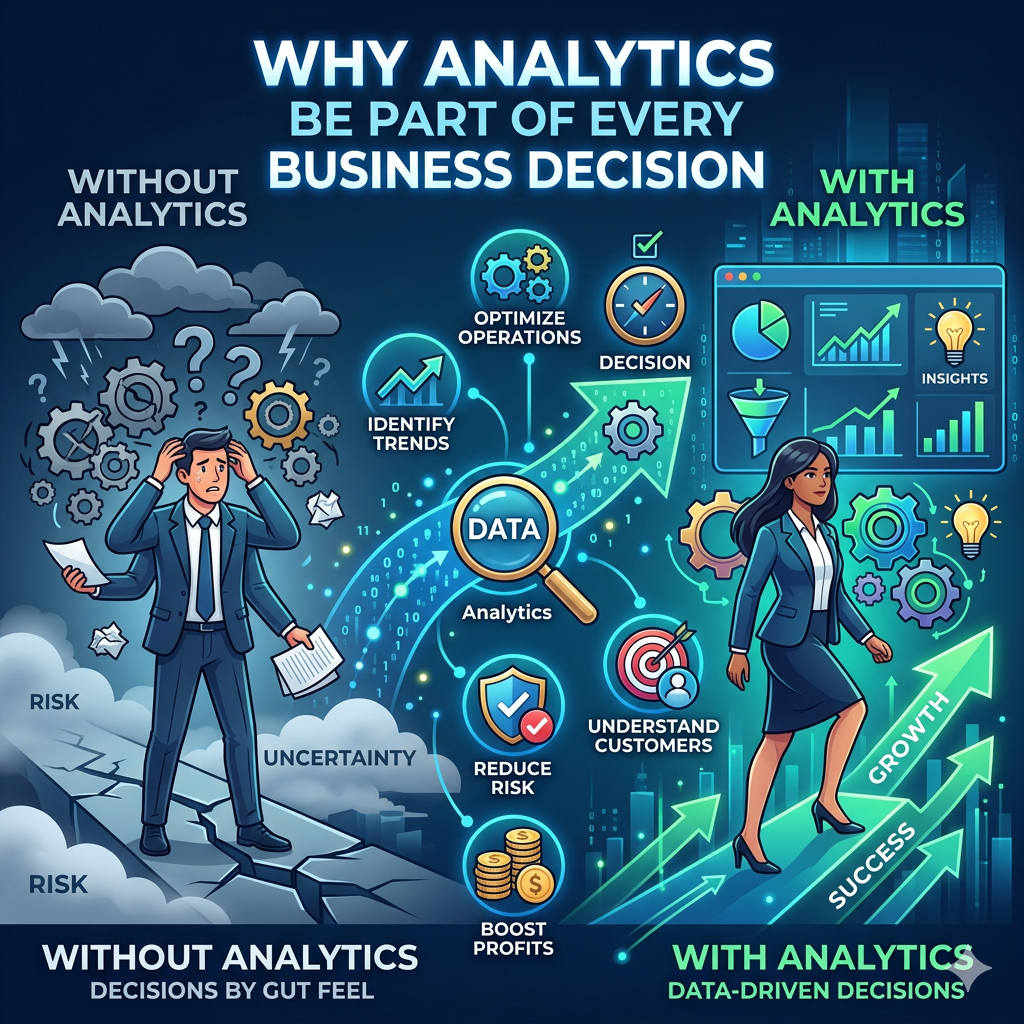
In modern business environments, organizations operate in conditions of constant change. Markets evolve, customer preferences shift, technology advances rapidly, and competition continues to intensify. In such an environment, relying solely on intuition or past experience is often insufficient for making effective decisions. Businesses increasingly recognize that data can provide valuable insights into patterns, risks, and opportunities. This realization has led to the growing importance of analytics in business decision-making. Understanding why analytics should be part of every business decision highlights how organizations can improve accuracy, reduce uncertainty, and create more sustainable strategies.
At its core, business analytics involves examining data to identify patterns, relationships, and trends that inform strategic choices. Every organization generates large amounts of information through daily operations. Sales transactions, customer interactions, marketing campaigns, financial records, and operational processes all produce data that reflects how the business functions. When analyzed properly, this information reveals insights that can guide decision-makers toward more effective actions.
One of the most important advantages of analytics is its ability to reduce uncertainty. Business decisions often involve evaluating incomplete information about the future. Market demand may fluctuate, competitors may introduce new strategies, and customer behavior may evolve unexpectedly. Analytics helps organizations study historical data and identify patterns that improve their understanding of these uncertainties. By examining past performance and trends, decision-makers gain a clearer perspective on possible outcomes.
Another key benefit of analytics is its ability to improve strategic planning. Businesses frequently face decisions related to pricing, product development, market expansion, and resource allocation. Without analytical insights, these choices may depend largely on assumptions. Analytics provides evidence that supports or challenges those assumptions. For example, analyzing customer purchase patterns can reveal which products generate the highest revenue or which markets show the strongest growth potential.
Analytics also enables organizations to measure performance more accurately. Many business activities involve multiple variables that influence results. Marketing campaigns may generate engagement, but engagement alone does not guarantee revenue. Operational improvements may reduce costs, but the overall financial impact may depend on other factors. Analytics allows companies to track key performance indicators and evaluate how different actions influence outcomes.
Another important advantage involves customer understanding. Modern businesses interact with customers across numerous channels, including websites, mobile applications, retail stores, and social platforms. Each interaction generates data about preferences, behavior, and satisfaction. By analyzing this information, companies can identify patterns in customer needs and expectations.
These insights help organizations design better products, improve customer experiences, and tailor marketing strategies. Instead of relying on general assumptions about consumer behavior, analytics allows businesses to base their strategies on real evidence.
Analytics also plays a critical role in operational efficiency. Many organizations manage complex processes that involve supply chains, logistics systems, workforce scheduling, and production activities. Small inefficiencies within these processes can accumulate over time and create significant costs. Analytical tools examine operational data to identify patterns of delay, waste, or resource imbalance. Detecting these issues early enables organizations to make adjustments that improve productivity.
Risk management is another area where analytics contributes significantly. Business environments often involve uncertainties related to financial stability, market volatility, and operational disruptions. Analytical models help organizations assess potential risks by examining historical patterns and identifying warning signals. For example, financial analytics may reveal declining profit margins or increasing operational costs before they develop into serious problems.
Predictive analytics extends this capability by estimating possible future outcomes. Instead of simply analyzing past data, predictive models use statistical techniques to forecast trends and identify potential scenarios. These forecasts help leaders prepare for changes in demand, anticipate customer churn, or adjust inventory levels before shortages occur.
Another important reason analytics should guide decisions is its ability to challenge assumptions. Human judgment can be influenced by biases, personal experiences, or incomplete information. Analytics introduces a structured approach to evaluating evidence. When data contradicts assumptions, organizations gain an opportunity to reconsider strategies and avoid costly mistakes.
Collaboration within organizations also benefits from analytics. When teams base discussions on shared data rather than personal opinions, decision-making becomes more transparent and objective. Data-driven discussions encourage departments such as marketing, finance, operations, and sales to align their strategies with measurable outcomes.
In addition, analytics helps organizations evaluate the effectiveness of past decisions. By examining the results of previous strategies, businesses can identify which approaches succeeded and which did not. This process creates a feedback loop that continuously improves future decision-making.
However, the value of analytics depends on how effectively organizations integrate it into their culture. Simply collecting data or generating reports does not automatically improve decisions. Businesses must ensure that analytical insights are actively considered when planning strategies or evaluating performance.
Successful organizations often establish data-driven decision frameworks that encourage managers to review analytical insights before finalizing major actions. This approach does not eliminate human judgment but complements it with evidence-based analysis.
Data quality also remains essential for reliable insights. Accurate, consistent, and well-governed data ensures that analytical conclusions reflect real conditions rather than errors or inconsistencies. Without strong data management practices, analytics can produce misleading interpretations.
Technology also plays an important role in enabling analytics-driven decisions. Modern analytical platforms allow organizations to process large datasets quickly and visualize insights in accessible formats. These tools help decision-makers understand complex relationships within data and communicate insights across teams.
Ultimately, why analytics should be part of every business decision lies in its ability to transform raw information into actionable understanding. In an environment where competition and uncertainty continue to increase, relying solely on intuition or tradition can limit strategic effectiveness.
Analytics provides a structured method for evaluating evidence, identifying trends, and anticipating challenges. When integrated into everyday decision-making processes, it helps organizations move beyond guesswork and toward more informed strategies.
In the long run, businesses that consistently incorporate analytics into their decisions gain a significant advantage. They are better equipped to understand their markets, respond to changes, manage risks, and allocate resources effectively. By combining human expertise with data-driven insights, organizations create a stronger foundation for sustainable growth and long-term success.