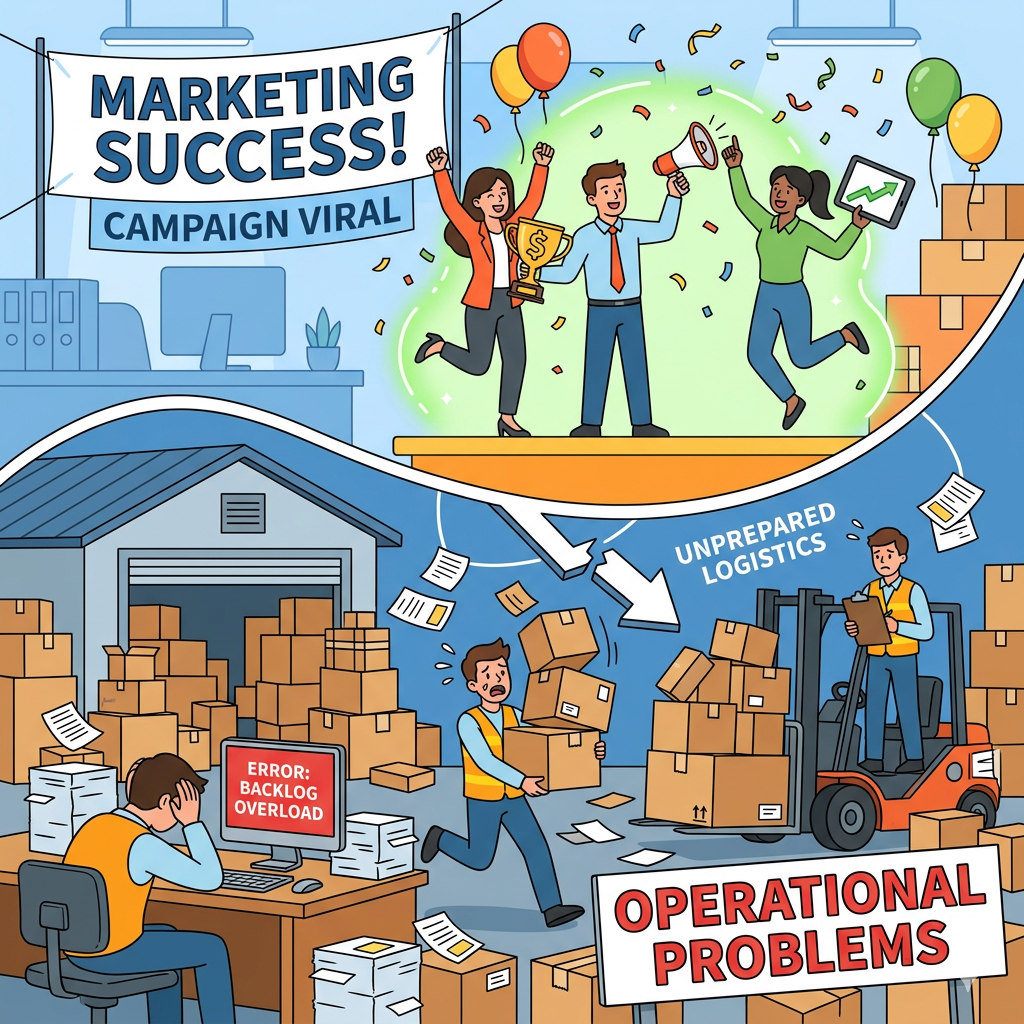
Marketing success is typically celebrated as a sign of effective strategy and strong market demand. Campaigns that generate surges in website traffic, rapid increases in orders, or sudden spikes in customer inquiries are often viewed as clear indicators of business momentum. However, when marketing performance accelerates faster than operational capacity, success can create unexpected challenges. In many organizations, strong marketing results expose weaknesses in logistics, customer service, inventory management, and production systems. This phenomenon highlights an important but often overlooked reality: marketing success can create operational problems when growth is not aligned across the organization.
One of the most immediate consequences appears in inventory management. Effective campaigns can drive demand far beyond initial forecasts. If supply chains are not prepared for sudden increases in orders, stockouts occur. While high demand may appear positive, unavailable products lead to delayed fulfillment, cancelled orders, and frustrated customers. Over time, repeated stock shortages can damage customer trust and brand reputation.
Operational strain also emerges in order fulfillment systems. Logistics infrastructure is typically designed around expected demand patterns. When marketing campaigns significantly exceed these expectations, warehouses and fulfillment teams may struggle to process orders efficiently. Processing delays, shipping backlogs, and higher operational error rates can follow. What begins as a marketing victory may result in declining customer satisfaction.
Customer service departments often feel the impact as well. Rapid increases in new customers generate higher volumes of inquiries, support requests, and return claims. If support teams are not scaled accordingly, response times increase. Customers who were initially attracted by marketing campaigns may become dissatisfied due to slow assistance or unresolved issues. This disconnect between marketing promises and service experience weakens brand loyalty.
Production capacity presents another constraint. In industries that manufacture physical products, scaling output quickly can be difficult. Machinery capacity, supplier lead times, and workforce limitations restrict how rapidly production can expand. When marketing demand outpaces production capability, companies may face long backorder queues or inconsistent product availability.
Financial implications also arise from rapid marketing-driven growth. Sudden increases in order volume require greater working capital to fund production, procurement, and logistics operations. If payment cycles from customers are slower than supplier obligations, businesses may experience cash flow pressure despite rising revenue. Growth without financial planning can create liquidity challenges.
Another operational challenge involves quality control. When companies rush to meet unexpectedly high demand, quality assurance processes may become compressed. Increased production speed or outsourcing to new suppliers can introduce defects or inconsistencies. Product quality problems can quickly undermine the brand credibility that marketing efforts worked to build.
Marketing-driven growth can also strain technology infrastructure. E-commerce platforms, payment gateways, and customer databases must handle increased traffic and transaction volumes. If digital systems are not designed for scalability, website outages or slow performance may occur during peak demand periods. Such technical failures directly impact conversion rates and customer experience.
The relationship between marketing and operations is often complicated by organizational structure. In many companies, marketing teams focus primarily on demand generation, while operations teams concentrate on supply and delivery. When communication between these functions is limited, marketing initiatives may proceed without full visibility into operational constraints. Campaigns may launch successfully from a promotional perspective but overwhelm internal systems.
Demand forecasting becomes particularly critical in this context. Accurate forecasting allows operations teams to prepare inventory, staffing, and logistics capacity ahead of major marketing initiatives. When marketing strategies are developed independently of operational planning, forecasts may underestimate the true impact of campaigns.
Promotional timing also affects operational stability. Large-scale sales events, seasonal promotions, or influencer-driven campaigns can concentrate demand within short periods. This demand clustering can overwhelm operational capacity even if total annual demand remains manageable. Spreading promotional activity more evenly across time can help maintain operational balance.
Another issue involves customer expectation management. Marketing campaigns often emphasize speed, convenience, and product availability. If operational capacity cannot consistently deliver these promises, the gap between expectation and reality becomes visible. Disappointed customers may share negative feedback, reducing the long-term value of marketing efforts.
Operational stress can also affect employee performance. Sudden demand surges may require extended working hours, temporary staff hiring, or rushed workflows. Over time, these conditions increase the likelihood of errors and employee burnout. Sustainable growth requires balancing marketing ambition with workforce capacity.
The solution is not to limit marketing effectiveness but to integrate marketing strategy with operational planning. Cross-functional coordination ensures that demand generation aligns with supply capability. Before launching major campaigns, organizations should evaluate operational readiness across inventory, logistics, technology infrastructure, and customer support.
Data analytics can help bridge this gap. By analyzing historical campaign performance, companies can estimate likely demand surges and prepare accordingly. Scenario planning allows teams to model different growth outcomes and identify potential bottlenecks before they occur.
Scalable systems are another key factor. Flexible supply chains, cloud-based digital infrastructure, and adaptable staffing models allow organizations to handle fluctuating demand more effectively. Companies that invest in scalability can convert marketing success into sustainable growth rather than operational stress.
Communication between departments also plays a central role. Regular coordination meetings between marketing, operations, finance, and customer service teams ensure that campaign plans reflect operational realities. Shared performance metrics can align objectives across functions.
Ultimately, marketing success should strengthen the entire business ecosystem rather than create internal pressure points. Growth that overwhelms operations risks damaging the customer experience and eroding long-term brand value.
The most resilient organizations treat marketing and operations as interconnected components of a unified strategy. Marketing creates demand, but operations fulfill the promise. When both functions evolve together, companies can transform marketing success into reliable customer satisfaction, stable financial performance, and sustainable long-term growth.