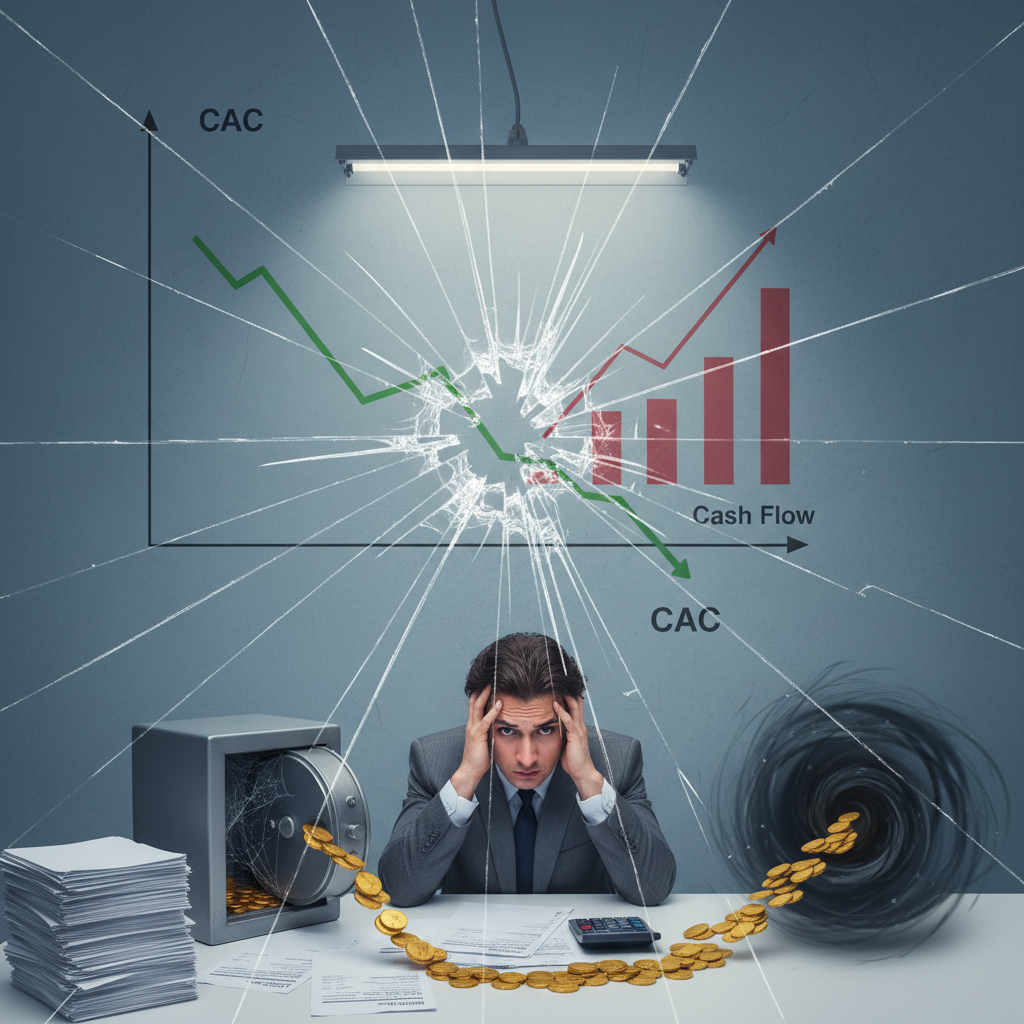
In performance-driven organizations, few metrics receive as much attention as Customer Acquisition Cost (CAC). It is presented in board meetings, highlighted in dashboards, and used as a benchmark for marketing efficiency. When CAC declines, teams celebrate. Lower acquisition cost appears to signal improved targeting, optimized campaigns, and stronger funnel performance. On paper, everything looks efficient. Yet many companies encounter a troubling contradiction: even when CAC looks good, cash flow suffers. This disconnect reveals a deeper financial reality acquisition efficiency does not automatically translate into liquidity strength.
At first glance, a declining CAC suggests that the company is spending less to acquire each new customer. Marketing teams may have refined ad targeting, improved landing page conversion rates, or negotiated lower platform costs. However, CAC is only one component of financial health. It measures the cost to acquire a customer, not the timing of revenue realization. If revenue collection lags behind marketing expenditure, cash flow strain emerges despite favorable CAC metrics.
One of the most common causes of this imbalance lies in payment structures. Many businesses operate on subscription models, installment billing, or extended payment terms. Marketing expenses are typically paid upfront—advertising platforms require immediate payment, agencies invoice monthly, and campaign tools charge fixed fees. Revenue, however, may be collected gradually over several months. Even if Customer Lifetime Value (CLV) exceeds CAC comfortably, delayed inflows create short-term liquidity pressure. A business can be profitable on paper while struggling to meet immediate obligations.
Another overlooked factor is the difference between accounting profit and cash flow. Revenue recognition under accrual accounting may record sales at the time of transaction, even if payment has not yet been received. Reports may show healthy margins and efficient CAC ratios, yet accounts receivable accumulate. Without strong cash flow management, growth accelerates financial stress. Expansion funded by delayed revenue can outpace working capital capacity.
Discount strategies often distort perception. Marketing teams may reduce CAC by offering aggressive promotions to drive higher conversion rates. Lower acquisition cost per customer may appear efficient, but if discounts reduce gross margin significantly, each sale contributes less cash to the business. Scaling such campaigns can increase sales volume while compressing operating cash. Efficiency in acquisition does not compensate for weakened margin structure.
Operational costs add another layer of complexity. Acquiring customers is only the beginning. Fulfillment, onboarding, support, logistics, and service delivery require resources. If CAC calculations exclude these downstream expenses, decision-makers gain an incomplete picture. A low CAC combined with high servicing costs erodes available cash. Comprehensive financial discipline requires evaluating total customer acquisition and servicing cost, not just advertising spend.
Timing mismatches within marketing attribution also influence perception. CAC is often calculated using attributed conversions within a specific time frame. However, refunds, cancellations, and churn may occur later. If customers acquired at low CAC churn quickly, projected lifetime value diminishes. Initial efficiency becomes misleading. Monitoring retention and payback period is essential to understand whether acquisition generates sustainable liquidity.
The payback period is a crucial but underutilized metric in this context. It measures how long it takes to recover acquisition cost from customer revenue. Even with a favorable CAC-to-CLV ratio, a long payback period increases risk. Rapid scaling under long recovery cycles ties up capital and increases reliance on external funding. Healthy growth balances acquisition efficiency with acceptable payback timelines.
Growth ambition frequently amplifies cash strain. When CAC declines, organizations often increase marketing budgets to capture additional market share. While strategic scaling is logical, aggressive expansion multiplies upfront expenses. Without proportional acceleration in cash inflows, working capital requirements surge. Companies that ignore this dynamic may encounter liquidity constraints despite strong reported performance.
Credit policies further influence outcomes. Offering extended payment terms to customers may stimulate demand and reduce CAC by improving conversion rates. However, longer collection cycles reduce immediate cash availability. Marketing optimization decisions must align with financial policy to prevent imbalance between revenue generation and cash realization.
Another factor involves inventory management. In product-based businesses, successful acquisition campaigns drive demand for physical goods. Scaling marketing without coordinating supply chain planning can result in overproduction or excess stock. Capital becomes tied up in inventory, reducing available cash. Efficient acquisition must integrate with operational forecasting to maintain liquidity stability.
The role of financial forecasting cannot be overstated. Marketing teams often focus on campaign metrics, while finance evaluates liquidity projections. When these functions operate independently, disconnects emerge. Collaborative forecasting aligns projected customer acquisition with anticipated cash inflows and outflows. Shared dashboards linking marketing analytics with cash flow projections enable informed scaling decisions.
Investors and stakeholders sometimes reinforce short-term efficiency focus. Emphasis on CAC reduction may overshadow liquidity metrics. However, sustainable enterprises prioritize balance. Liquidity ensures resilience during market fluctuations, algorithm changes, or seasonal downturns. Without adequate cash reserves, even efficient acquisition strategies become vulnerable.
Technology also influences perception. Automated advertising platforms optimize for conversion cost but do not account for cash timing or margin impact. Algorithms pursue defined objectives; if profitability and liquidity are not embedded into optimization goals, efficiency remains superficial. Integrating financial constraints into performance targets strengthens long-term outcomes.
Leadership discipline plays a defining role. Celebrating low CAC without examining broader financial implications encourages narrow thinking. Executives must evaluate acquisition in the context of working capital management, gross margin, and recovery timelines. Asking how quickly acquisition cost converts into positive cash ensures strategic alignment.
Ultimately, the tension between favorable CAC and strained cash flow highlights a critical lesson: efficiency metrics are incomplete without financial context. Acquisition cost measures marketing effectiveness, but cash flow measures business sustainability. Sustainable growth requires harmony between the two.
Organizations that integrate marketing analytics with financial modeling avoid this trap. They track CAC alongside payback period, retention rate, servicing cost, and cash cycle length. They scale campaigns responsibly, ensuring liquidity remains strong. They recognize that growth financed through fragile cash structures creates instability.
In competitive markets, disciplined companies balance ambition with prudence. They treat acquisition as investment capital, evaluating both return and timing. When CAC looks good but cash flow suffers, the issue is not marketing failure alone—it is strategic misalignment. Aligning acquisition strategy with financial discipline transforms growth from risky expansion into resilient progress.
The true measure of marketing success is not just how cheaply customers are acquired, but how sustainably those customers generate cash. Efficiency without liquidity is fragile. Sustainable enterprises understand that favorable CAC is only the beginning; financial discipline ensures that growth strengthens rather than strains the foundation of the business.