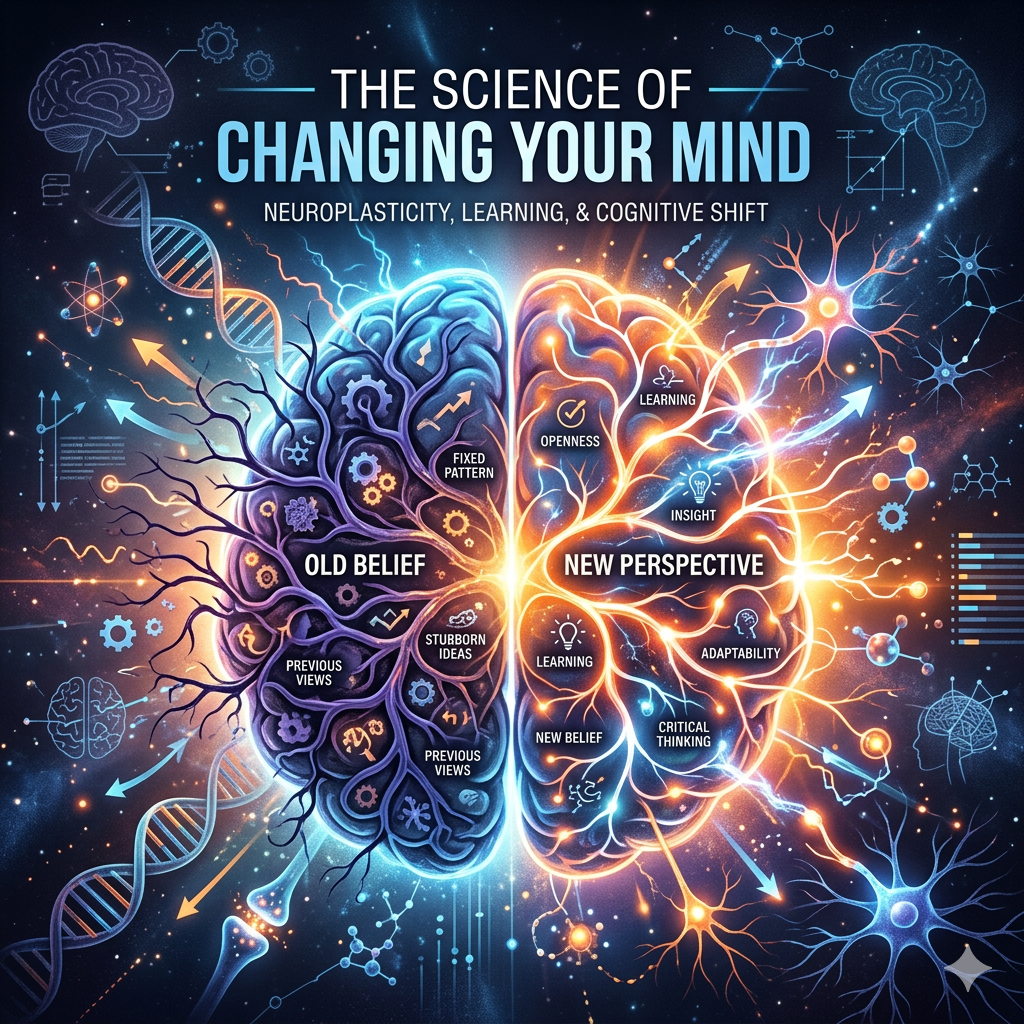
Changing one’s mind is often perceived as a sign of uncertainty or weakness. In many professional and social contexts, consistency is valued, and individuals are expected to defend their decisions with confidence. Yet from a scientific and cognitive perspective, the ability to revise beliefs in response to new evidence is one of the most important components of sound reasoning. The science of changing your mind reveals that intellectual flexibility is not a flaw—it is a critical skill for navigating complex and evolving environments.
Human beliefs are shaped through a combination of experience, social influence, and cognitive interpretation. Once formed, these beliefs tend to become stable mental frameworks that help individuals interpret new information efficiently. Stability in beliefs can be useful because it allows people to make decisions quickly without re-evaluating every assumption from the beginning. However, this same stability can make belief revision difficult even when new evidence suggests that previous conclusions may be incomplete or incorrect.
One of the central psychological barriers to changing one’s mind is cognitive dissonance. This occurs when new information conflicts with existing beliefs or decisions. The discomfort created by this conflict encourages individuals to resolve the tension, often by dismissing or reinterpreting the new evidence rather than reconsidering the original belief. In many situations, maintaining internal consistency feels easier than admitting that a previous assumption was flawed.
Another factor is identity attachment. People often integrate their beliefs into their sense of identity. Professional expertise, political views, strategic frameworks, or management philosophies can become closely linked to how individuals see themselves. When a belief is tied to identity, revising that belief may feel like a threat to personal credibility or self-image.
Social dynamics also influence the difficulty of changing one’s mind. In professional environments, leaders are often expected to demonstrate confidence and decisiveness. Publicly revising a previous position may appear inconsistent, even when new evidence justifies the change. As a result, individuals may hesitate to update their views once they have publicly committed to a particular perspective.
Despite these challenges, research in cognitive science and behavioral psychology suggests that belief revision is not only possible but also systematic. One important concept is Bayesian updating, a statistical principle that describes how rational decision-makers adjust their beliefs when new information becomes available. Instead of treating beliefs as fixed positions, Bayesian reasoning views them as probabilities that can shift gradually as evidence accumulates.
In practical terms, this means that strong beliefs should not be treated as permanent conclusions but as hypotheses supported by current evidence. As new data emerges, the probability that a belief is correct may increase or decrease. The willingness to update beliefs in this way allows individuals to refine their understanding continuously.
Another element of the science of changing one’s mind involves metacognition, or the ability to think about one’s own thinking processes. Individuals who regularly question how they arrived at their conclusions are more likely to recognize when their assumptions require revision. Metacognitive awareness encourages reflection on the quality of evidence, the reliability of sources, and the potential influence of biases.
Evidence evaluation also plays a critical role. Not all new information should automatically lead to belief revision. Effective belief updating requires distinguishing between reliable evidence and weak signals. Scientific reasoning emphasizes the importance of replicable data, controlled experimentation, and statistical validity when evaluating whether beliefs should change.
Another useful practice is separating beliefs from personal identity. When individuals treat ideas as tools rather than personal commitments, they become more open to revising those ideas when better alternatives emerge. This perspective allows people to maintain intellectual flexibility without feeling that their credibility is at risk.
Curiosity is another powerful driver of belief change. Individuals who approach new information with curiosity rather than defensiveness are more likely to explore alternative explanations. Curiosity shifts the focus from defending existing views to discovering more accurate understanding.
In organizational contexts, the ability to change one’s mind is especially valuable. Markets evolve, technologies advance, and customer behavior shifts over time. Strategies that once worked effectively may become less relevant under new conditions. Leaders who adapt their thinking in response to changing evidence are better positioned to guide organizations through uncertainty.
Scientific progress itself depends on this process. Many major advances in knowledge occur when established theories are reconsidered in light of new observations. The willingness to revise assumptions allows science to evolve and refine its understanding of complex phenomena.
However, belief revision should not be confused with indecision. Changing one’s mind does not mean abandoning convictions whenever new opinions appear. Instead, it involves systematically evaluating evidence and adjusting beliefs when the balance of information shifts significantly.
Structured decision processes can help facilitate this balance. For example, organizations often conduct post-decision reviews or retrospective analyses to evaluate whether previous assumptions proved accurate. These reviews provide opportunities to learn from outcomes and refine future decisions.
Another helpful approach involves probabilistic thinking. Rather than framing beliefs as completely right or wrong, probabilistic thinking acknowledges varying degrees of certainty. When beliefs are expressed as probabilities rather than absolute conclusions, updating them becomes a natural part of the reasoning process.
Psychological safety within teams also encourages belief revision. When individuals feel comfortable admitting uncertainty or revising earlier positions, discussions become more open and productive. Teams that value learning over status are more likely to adjust strategies when evidence changes.
Importantly, changing one’s mind often leads to better long-term outcomes. Individuals and organizations that adapt their thinking can respond more effectively to new information, avoid persistent errors, and refine their strategies over time.
The science of changing your mind ultimately reflects a broader principle of intellectual progress: knowledge evolves. What appears certain today may require adjustment tomorrow as new evidence emerges. Recognizing this dynamic nature of understanding encourages humility and continuous learning.
Rather than viewing belief revision as inconsistency, it can be understood as a commitment to accuracy. The willingness to update conclusions when evidence changes demonstrates intellectual integrity and analytical maturity.
In complex environments where uncertainty is inevitable, the most valuable skill may not be always being right, but being willing to become more right over time. Changing one’s mind, when guided by evidence and thoughtful analysis, represents not weakness but one of the strongest indicators of disciplined reasoning.