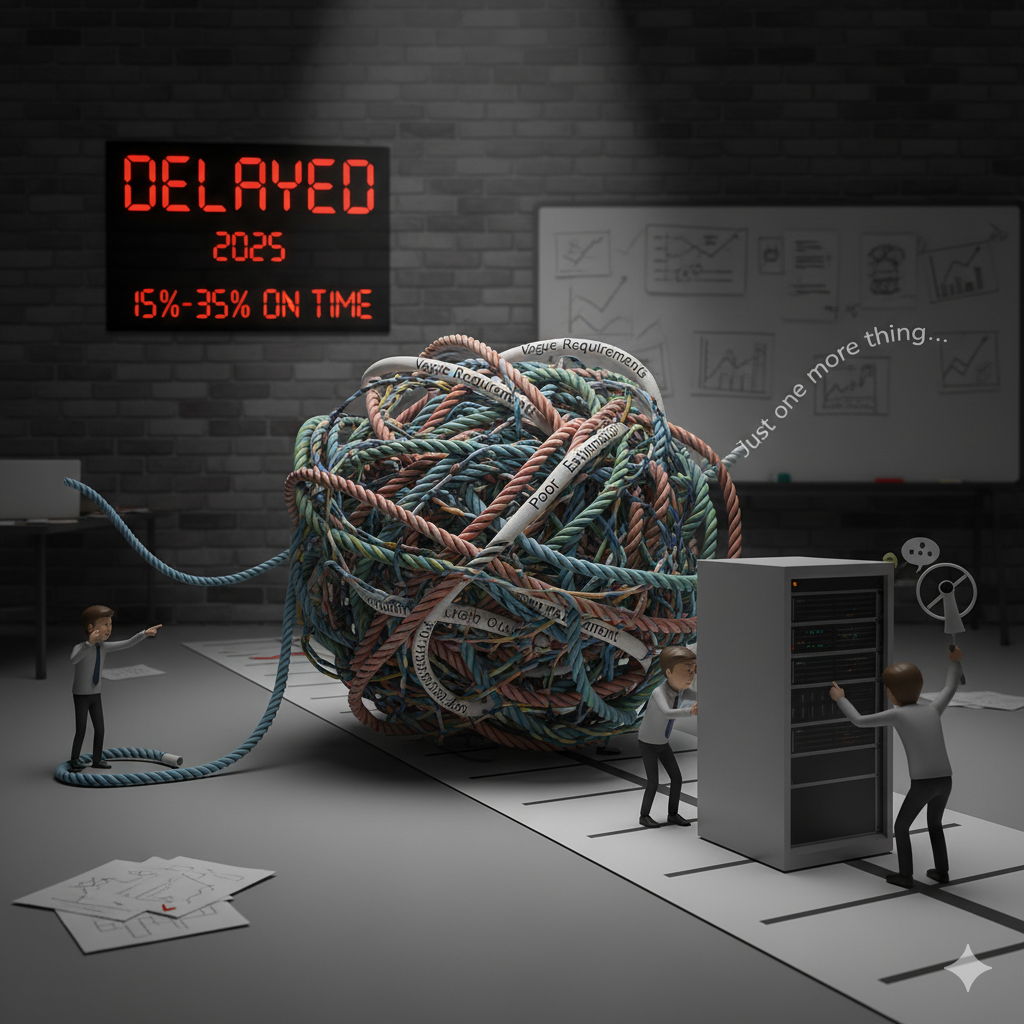
When an IT project gets delayed, the immediate assumption is usually technical failure.
The software didn’t integrate properly.
The system was too complex.
The platform had unexpected bugs.
The vendor underperformed.
Technology often takes the blame.
However, in most cases, technology is not the real cause of delay.
The deeper reasons behind stalled IT initiatives are rooted in planning gaps, leadership misalignment, unclear objectives, and human factors. Modern technology is more capable than ever. Yet project timelines continue to slip across industries.
Understanding the real causes of IT project delays is essential for organizations that want consistent execution and measurable results.
Below are five core reasons IT projects fall behind schedule — and why technology is rarely the true problem.
1. Unclear Objectives and Scope Creep
One of the most common reasons IT projects are delayed is lack of clarity at the beginning.
Many initiatives start with broad goals such as:
- “Improve efficiency”
- “Modernize systems”
- “Enhance customer experience”
- “Digitize operations”
While these objectives sound strategic, they are often too vague to guide execution. Without clearly defined deliverables, timelines, and measurable outcomes, projects begin to drift. Stakeholders may interpret goals differently. Teams may prioritize conflicting features. Decision-making becomes inconsistent.
Scope creep quickly follows. New requirements are added mid-project. Additional features are requested without adjusting timelines. Business leaders may attempt to include “just one more enhancement” before launch. Each incremental addition seems minor, but collectively they extend development cycles significantly. Technology may still be functioning correctly. The delay occurs because the destination was never clearly defined. Successful IT projects begin with detailed scoping, documented requirements, and strict change management controls. Without them, timelines become fluid and unpredictable.
2. Leadership Misalignment and Slow Decision-Making
IT projects often involve multiple departments operations, finance, marketing, compliance, and executive leadership. Each group has its own priorities and expectations. When leadership is not aligned, progress slows.
For example:
- One department prioritizes speed, while another prioritizes cost control.
- Executives debate vendor selection for weeks.
- Approval processes require multiple layers of authorization.
- Conflicting feedback delays configuration decisions.
Technology teams cannot proceed efficiently when strategic direction keeps shifting. In many delayed projects, developers and engineers are waiting not coding. They are waiting for clarity, sign-offs, or consensus. Decision-making bottlenecks frequently extend timelines more than technical complexity does. Clear governance structures, defined decision authorities, and aligned executive sponsorship significantly reduce delay risk. Without alignment at the top, even well-designed technical plans struggle to move forward.
3. Underestimating Resource Requirements
Another frequent cause of delays is unrealistic planning around resources. Organizations may assume existing teams can handle large transformation projects alongside daily responsibilities. However, IT professionals often already manage:
- Infrastructure maintenance
- Security monitoring
- User support
- Compliance tasks
- Vendor coordination
Adding a major project without reallocating capacity leads to overload. As workloads increase, priorities compete. Urgent operational issues take precedence over long-term projects. Milestones slip quietly. Additionally, businesses sometimes underestimate the expertise required. Specialized skills such as cloud architecture, cybersecurity integration, or advanced data analytics may not exist internally. When knowledge gaps are discovered mid-project, external consultants are hired often late in the timeline. Onboarding new contributors takes time, which further extends schedules. Technology itself may function as expected. Delays occur because the human and operational resources required to implement it were not accurately assessed. Realistic workload planning and dedicated project teams are essential for on-time delivery.
4. Poor Communication Between Technical and Non-Technical Teams
Communication gaps are among the most underestimated causes of IT project delays. Business stakeholders may describe requirements in functional language. Technical teams translate those needs into system specifications. If translation is incomplete or misunderstood, rework becomes inevitable.
For example:
- A feature is built based on assumed requirements, only to be revised later.
- Reporting dashboards are developed without clarity on metrics.
- Security controls are implemented without understanding compliance nuances.
Each revision adds time. In many cases, technical teams may fully understand system capabilities, but non-technical stakeholders may not understand limitations or dependencies. This disconnect creates unrealistic expectations. Regular alignment meetings, shared documentation, and collaborative planning sessions reduce misinterpretation. When communication is reactive rather than proactive, projects slow down due to corrections and clarifications. Technology may operate flawlessly but miscommunication extends timelines.
5. Resistance to Change and Organizational Culture
Perhaps the most overlooked reason IT projects stall is cultural resistance. New systems change workflows. They require training. They may alter reporting structures or accountability mechanisms. Employees comfortable with existing processes may resist adoption, even if those processes are inefficient.
Resistance can appear in subtle ways:
- Delayed feedback
- Minimal engagement in testing
- Reluctance to adopt new workflows
- Preference for legacy tools
When adoption slows, implementation timelines extend. Leaders may hesitate to enforce change due to internal pushback. Training sessions may be postponed. System rollouts may be phased slowly to avoid disruption. Technology cannot overcome organizational hesitation. Even the most advanced platform will fail to deliver results if users do not embrace it. Successful IT initiatives require change management strategies — including communication plans, leadership advocacy, training programs, and measurable adoption goals.
Without cultural readiness, implementation drags.
The Hidden Pattern Behind Delayed Projects
When examining delayed IT initiatives across industries, a clear pattern emerges:
- Objectives were unclear.
- Leadership alignment was incomplete.
- Resources were insufficient.
- Communication was inconsistent.
- Organizational change was underestimated.
Technology was rarely the primary obstacle.
In fact, modern platforms are increasingly reliable, scalable, and well-supported. Failures often originate from planning and governance not code.
Blaming technology may feel convenient, but it prevents organizations from addressing root causes.
Building IT Projects That Stay on Track
Organizations can reduce delay risk by focusing on structured execution:
1. Define Clear Outcomes Before Development Begins
Detailed scope documentation prevents shifting expectations.
2. Establish Strong Executive Sponsorship
Aligned leadership ensures fast decision-making and consistent direction.
3. Allocate Dedicated Resources
Separate operational responsibilities from project execution to avoid overload.
4. Maintain Transparent Communication
Frequent check-ins reduce misunderstandings and prevent rework.
5. Invest in Change Management
Prepare employees early. Communicate benefits clearly. Provide structured training. When these foundational elements are in place, technology performs as intended and projects move forward efficiently.
Conclusion
IT projects rarely fail because technology is incapable. They fail because planning is incomplete, leadership is misaligned, resources are stretched, communication breaks down, or organizational culture resists change. Technology is a tool. Execution determines outcomes. Organizations that focus only on technical specifications while ignoring governance and human factors are likely to experience delays. Those that treat IT initiatives as strategic transformations supported by clear objectives, strong leadership, and structured change management are far more likely to deliver on time and within scope. Because the real reason IT projects get delayed is not technology. It is everything surrounding it.