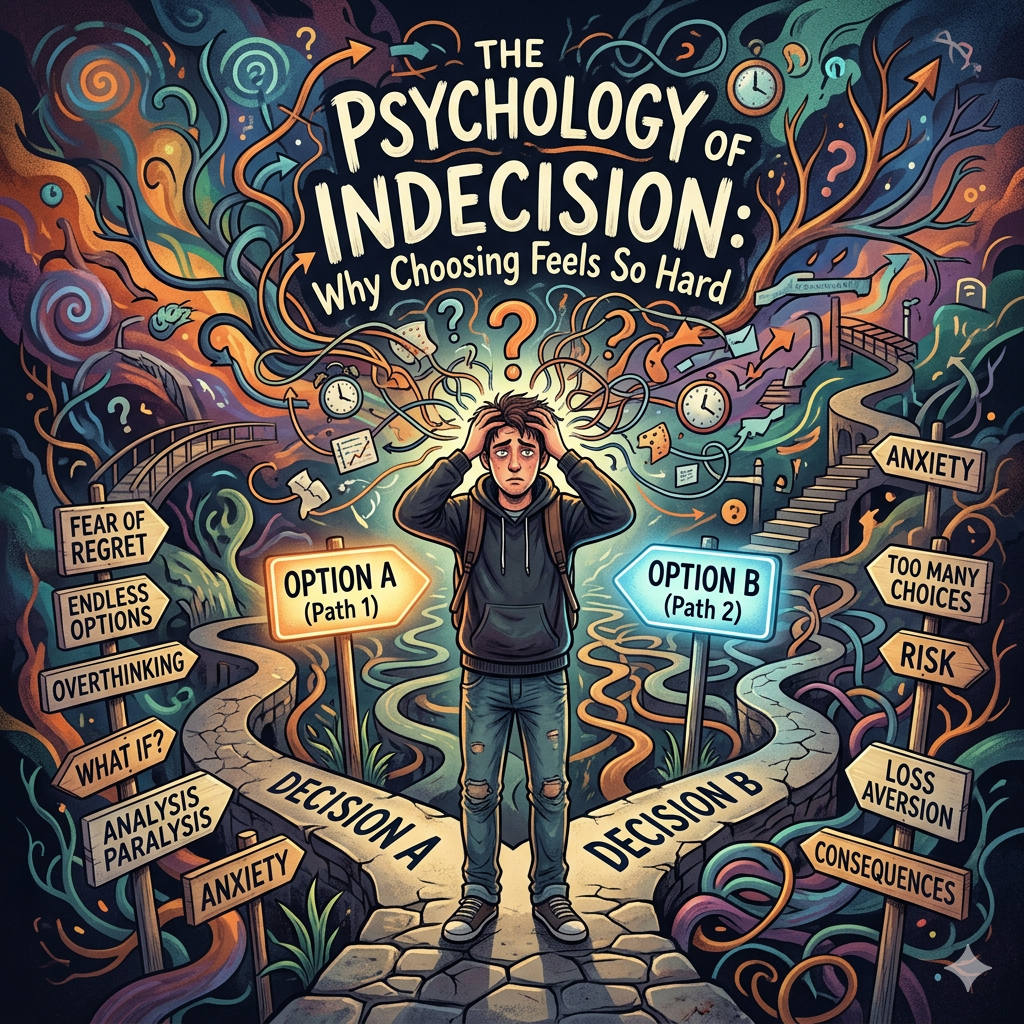
Making decisions is a constant part of human life. From small everyday choices to major life decisions, individuals regularly evaluate options and determine which path to follow. Yet despite the importance of decision-making, many people experience difficulty when faced with choices. The feeling of hesitation, delay, or uncertainty that occurs when deciding between alternatives is known as indecision. Understanding the psychology of indecision reveals why choosing can feel so mentally demanding and why people sometimes struggle to commit to a single option.
At the center of indecision lies the human brain’s attempt to evaluate potential outcomes. Every choice carries possible benefits and risks, and the mind naturally tries to predict the consequences before taking action. This process involves comparing alternatives, estimating rewards, and imagining possible problems. While this evaluation is helpful in many situations, it can also become overwhelming when the number of variables increases. As the brain tries to calculate every possible outcome, decision-making slows down and uncertainty grows.
One major reason choosing feels difficult is the fear of making the wrong decision. Humans often want to avoid regret, and the possibility of selecting an option that leads to negative results can create anxiety. When people imagine that a wrong decision could lead to missed opportunities or negative consequences, they may postpone the decision in order to avoid responsibility for the outcome. This hesitation can create a cycle in which delaying the decision temporarily reduces anxiety but ultimately increases stress as the unresolved choice remains.
Another important factor in indecision is the presence of too many choices. In modern environments, individuals frequently encounter a large number of alternatives when making decisions. While having options can appear beneficial, an excessive number of possibilities can make evaluation more complex. The brain must process additional information, compare multiple scenarios, and consider numerous potential outcomes. As the number of choices grows, the cognitive effort required to select one option increases significantly.
This situation often leads to analysis paralysis, a state in which individuals continue evaluating options without reaching a conclusion. Instead of simplifying the decision process, they gather more information, reconsider alternatives repeatedly, and attempt to eliminate every possible risk. However, because complete certainty rarely exists, the search for a perfect answer may continue indefinitely.
Emotional factors also contribute to indecision. Decisions frequently involve personal values, expectations, and long-term goals. When a choice affects identity or future direction, the emotional weight of the decision becomes heavier. Individuals may worry about how the decision will affect relationships, career opportunities, or personal satisfaction. These emotional considerations make the process more complex than simple logical comparison.
Another psychological influence is loss aversion, the tendency to focus more strongly on potential losses than potential gains. When individuals evaluate options, the possibility of losing something often feels more significant than the possibility of gaining something new. As a result, the mind becomes cautious and reluctant to commit to change. This preference for avoiding loss can slow decision-making and reinforce hesitation.
Social expectations can also intensify indecision. People often worry about how their choices will be perceived by others. Concerns about criticism, disappointment, or judgment may cause individuals to second-guess their preferences. When a decision might influence how others view them, the pressure to choose correctly increases.
Another element influencing indecision is perfectionism. Individuals who aim for the perfect outcome may struggle to accept the reality that every choice involves trade-offs. Instead of recognizing that most decisions include both advantages and disadvantages, perfectionists may continue searching for an option that contains no flaws. Because such options rarely exist, the decision remains unresolved.
The human brain also prefers familiarity. When faced with unfamiliar situations, individuals may hesitate because they lack experience or clear reference points. Without past examples to guide expectations, predicting the outcome of a decision becomes more difficult. This uncertainty encourages the brain to delay commitment until additional information becomes available.
Memory and past experiences also shape decision-making patterns. Individuals who previously experienced negative consequences after making decisions may become more cautious in future situations. These memories create emotional associations that influence how new choices are evaluated. Even if the current situation is different, the brain may recall past mistakes and increase hesitation.
Despite these challenges, indecision is not always harmful. Careful consideration can prevent impulsive actions and encourage thoughtful evaluation of options. In situations involving significant consequences, spending time analyzing alternatives can lead to better outcomes. However, problems arise when reflection turns into prolonged delay without progress.
One useful strategy for overcoming indecision is clarifying priorities. When individuals clearly understand what matters most to them, evaluating options becomes easier. Instead of trying to optimize every factor, they can focus on the criteria that align with their values and goals.
Another helpful approach involves setting decision boundaries. Establishing limits on the amount of time or information used in decision-making prevents the process from expanding indefinitely. Once a reasonable amount of information has been gathered, committing to a choice becomes easier.
Accepting uncertainty is also an important step in reducing indecision. Because the future cannot be predicted with complete accuracy, every decision involves some level of risk. Recognizing this reality allows individuals to focus on making informed choices rather than perfect ones.
Learning to view decisions as opportunities for learning can also reduce pressure. Even when outcomes are not ideal, they often provide valuable insights that guide future decisions. When individuals see decisions as part of an ongoing learning process, the fear of choosing incorrectly becomes less overwhelming.
Ultimately, the psychology of indecision reflects the brain’s attempt to balance risk, reward, and uncertainty. The mind wants to avoid mistakes while maximizing positive outcomes, but this protective mechanism can sometimes slow the decision-making process.
Understanding why choosing feels difficult allows individuals to approach decisions with greater awareness. By recognizing the roles of fear, complexity, social pressure, and cognitive overload, people can develop strategies that support clearer and more confident choices.
In the end, decision-making is an unavoidable part of life. While uncertainty can never be eliminated completely, the ability to evaluate options, accept imperfect outcomes, and move forward with confidence allows individuals to progress rather than remain trapped in hesitation.