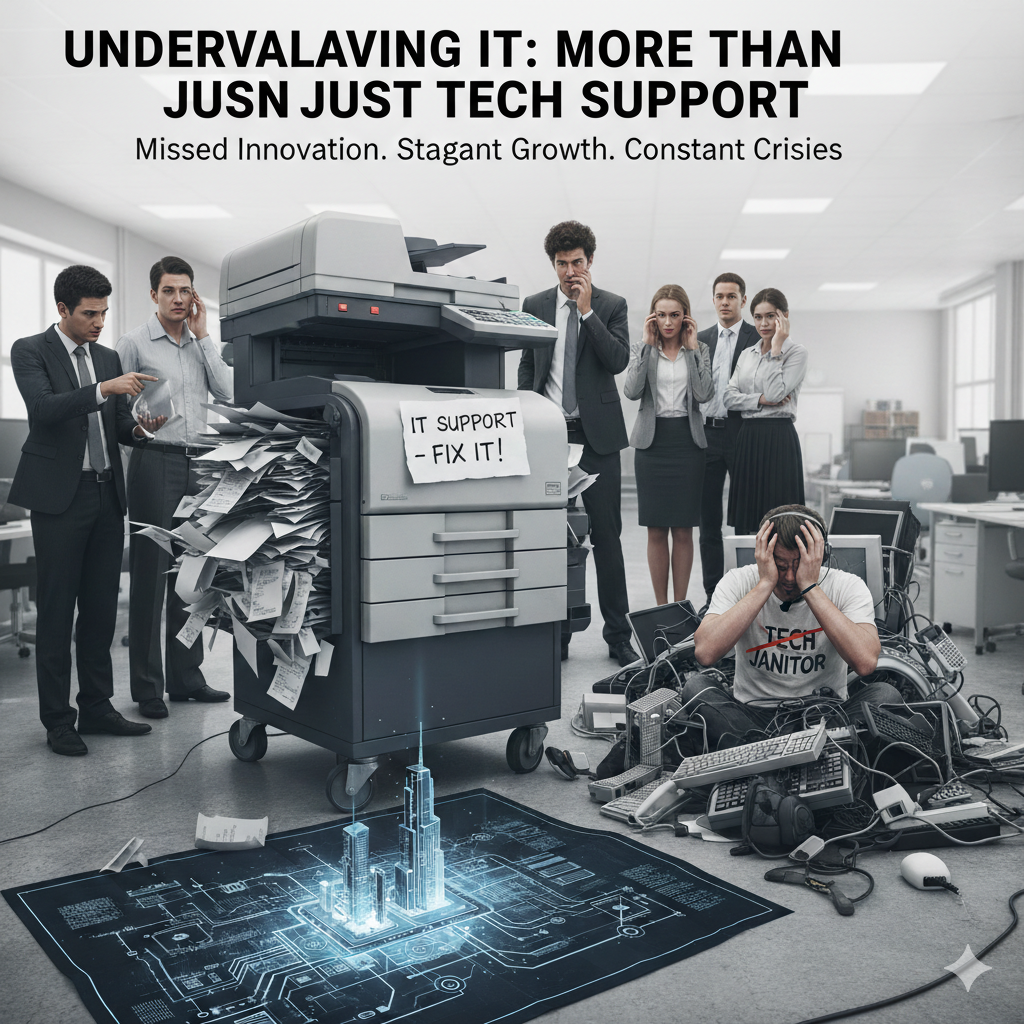
In many organizations, IT is still viewed primarily as a helpdesk, a troubleshooting team, or a back-office utility responsible for maintaining hardware and resetting passwords. While technology departments certainly provide operational support, limiting their role to reactive assistance within the enterprise IT support model creates long-term strategic consequences. When leadership treats IT purely as a cost center rather than a strategic driver inside the business technology ecosystem, innovation slows, risk increases, and growth opportunities are missed. Modern enterprises operate in digitally interconnected markets. Revenue streams, customer engagement channels, supply chains, compliance systems, and internal workflows all rely on digital platforms embedded within the enterprise technology infrastructure. To categorize IT as merely a support function ignores the reality that technology now underpins competitive differentiation. Organizations that fail to recognize this shift often struggle to adapt in rapidly evolving industries. Treating IT as a strategic partner is no longer optional. It is fundamental to sustained performance.
The Historical Perception of IT
Historically, IT departments emerged to manage servers, networks, and internal software systems within the enterprise infrastructure framework. Their mandate focused on stability, uptime, and technical troubleshooting. Business units defined strategy, and IT implemented requested solutions within the enterprise application environment. This separation made sense when technology primarily enabled administrative efficiency. However, as digital transformation accelerated and customer experiences migrated online, the boundary between business strategy and technology architecture dissolved inside the enterprise digital ecosystem. Despite this shift, many organizations still operate with outdated governance models that confine IT to reactive roles. When leadership fails to evolve this perception, the consequences ripple across the entire organization.
Strategic Blind Spots Emerge
When IT leaders are excluded from executive planning discussions within the enterprise governance model, strategic initiatives often proceed without full understanding of technological feasibility. Business executives may design ambitious growth strategies, market expansions, or product innovations without evaluating infrastructure readiness inside the enterprise architecture strategy. This disconnect leads to unrealistic timelines, underestimated budgets, and integration challenges. Technical debt accumulates when short-term solutions are implemented to meet executive demands without proper alignment inside the enterprise IT lifecycle management process. Including IT leadership in early strategic planning ensures that innovation aligns with technical capability. Exclusion creates blind spots that undermine execution.
Innovation Becomes Reactive Instead of Proactive
Organizations that treat IT solely as a service desk rarely leverage technology as a competitive differentiator within the enterprise innovation framework. Instead of proactively identifying automation opportunities, data analytics enhancements, or scalable cloud solutions inside the enterprise cloud computing infrastructure, IT teams focus on ticket resolution and maintenance. This reactive posture prevents experimentation. It limits the organization’s ability to explore emerging technologies such as AI-driven analytics, predictive maintenance systems, or advanced cybersecurity monitoring within the enterprise digital transformation roadmap. Companies that position IT as a strategic collaborator often innovate faster because technical leaders anticipate market shifts and propose solutions before operational challenges escalate.
Budget Allocation Reflects Misalignment
When IT is perceived strictly as overhead within the enterprise financial governance strategy, budgets prioritize cost minimization over long-term resilience. Investments in modernization, cybersecurity, redundancy, and monitoring tools within the enterprise risk management framework are often deferred to protect short-term margins. This cost-centric mindset leads to aging infrastructure, unsupported software, and limited scalability inside the enterprise infrastructure lifecycle. Eventually, deferred investment results in expensive emergency upgrades or prolonged downtime. Strategic organizations recognize that technology spending is not merely operational expense. It is capital investment in reliability, agility, and growth across the broader business continuity framework.
Risk Management Weakens
Cybersecurity threats, regulatory requirements, and data privacy obligations demand proactive oversight within the enterprise cybersecurity architecture. When IT operates in a narrow support role, strategic risk discussions may exclude technical insight from the enterprise security governance framework. Executives may underestimate exposure to vulnerabilities, assuming that security measures are sufficient without reviewing real-time monitoring data inside the digital risk management strategy. Compliance initiatives may proceed without understanding infrastructure dependencies. By elevating IT to a strategic advisory role, organizations strengthen risk evaluation and ensure that governance decisions align with operational realities.
Customer Experience Suffers
Customer interactions increasingly depend on digital platforms embedded within the enterprise service delivery ecosystem. E-commerce portals, mobile applications, CRM systems, and online support channels operate through interconnected systems inside the enterprise application architecture. If IT is confined to maintenance tasks, improvements in customer experience may lag. Slow load times, integration gaps, or unreliable systems reduce satisfaction. Business leaders may focus on marketing strategy without recognizing infrastructure limitations inside the enterprise performance management framework. Strategic IT involvement enables proactive optimization of digital touchpoints. It ensures that customer-facing systems align with brand expectations and growth targets.
Data Strategy Remains Underdeveloped
Data analytics drives modern decision-making within the enterprise business intelligence framework. However, without IT leadership contributing to data governance, integration, and architecture planning inside the enterprise data management strategy, insights may remain fragmented. Departments may maintain separate reporting systems. Data silos emerge. Executive dashboards may rely on inconsistent sources across the enterprise analytics ecosystem. This fragmentation reduces the reliability of strategic decisions. Treating IT as a strategic partner encourages unified data governance, secure integration, and scalable analytics infrastructure.
Organizational Silos Intensify
When IT functions separately from core business strategy within the enterprise operating model, collaboration weakens. Business units may pursue independent software purchases, creating shadow IT environments outside formal oversight in the enterprise IT governance framework. These silos increase complexity and risk. Systems may lack interoperability. Security standards may vary. Integration costs rise during modernization initiatives within the enterprise architecture alignment process. Embedding IT into cross-functional planning reduces fragmentation and strengthens operational cohesion across the broader enterprise growth strategy.
Talent Retention Becomes Challenging
Highly skilled technology professionals seek environments where their expertise contributes to innovation and strategic direction within the enterprise digital strategy. When IT roles are limited to routine troubleshooting inside the enterprise support structure, employee engagement declines. Talented engineers and architects may leave for organizations that value strategic input and technological creativity within the enterprise innovation ecosystem. Turnover increases recruitment costs and disrupts continuity. Recognizing IT as a strategic discipline enhances professional development opportunities and strengthens organizational stability.
Downtime and Operational Disruption Increase
Proactive infrastructure management requires investment in monitoring, redundancy, and performance optimization inside the enterprise IT operations model. When IT budgets prioritize immediate cost savings over resilience within the enterprise infrastructure governance framework, system reliability deteriorates. Downtime incidents often reflect cumulative underinvestment and limited strategic oversight. Leadership may attribute outages to technical failure without recognizing governance decisions that constrained modernization efforts inside the enterprise technology lifecycle strategy. Elevating IT to strategic status ensures that uptime and performance metrics become executive priorities.
Competitive Advantage Declines
Industries increasingly compete on digital capabilities. Organizations that integrate technology strategy into executive decision-making within the enterprise competitive strategy framework often outperform peers. They leverage automation, analytics, and scalable cloud systems inside the enterprise digital ecosystem to reduce cost and improve agility. Companies that confine IT to support functions struggle to respond quickly to market shifts. Product launches may be delayed due to infrastructure limitations. Customer expectations for seamless digital experiences may go unmet. Competitive resilience requires technology alignment at the highest levels of governance.
Redefining IT as a Strategic Partner
Transforming IT from a support function into a strategic driver requires structural change within the enterprise governance architecture. Technology leaders should participate in executive planning sessions. Infrastructure investment decisions should align with long-term growth objectives inside the enterprise strategic management framework. Performance metrics should extend beyond ticket resolution rates to include innovation outcomes, system scalability, cybersecurity posture, and digital transformation progress within the enterprise performance governance model. Cross-functional collaboration strengthens integration between operational goals and technical capability.
Building a Technology-Integrated Culture
Organizations must cultivate a culture that views technology as foundational to value creation within the enterprise business transformation strategy. This includes:
- Encouraging collaboration between business units and IT
- Integrating technical risk assessments into strategic planning
- Aligning budgeting processes with modernization roadmaps
- Prioritizing continuous learning within the enterprise digital innovation framework
Leadership messaging plays a central role. When executives emphasize the strategic importance of technology inside the enterprise growth ecosystem, cultural alignment strengthens.
Conclusion
Treating IT as a support function only may have been sufficient in a pre-digital era. Today, it limits innovation, weakens governance, increases risk, and constrains growth within the enterprise technology landscape. Technology no longer merely supports business operations it defines them. Organizations that integrate IT leadership into strategic planning, risk management, and innovation initiatives inside the business technology strategy position themselves for resilience and competitive advantage. Those that maintain outdated perceptions risk falling behind in an increasingly digital economy. IT is not simply a helpdesk. It is a strategic pillar. Recognizing this reality transforms technology from a reactive service into a proactive driver of sustainable success.