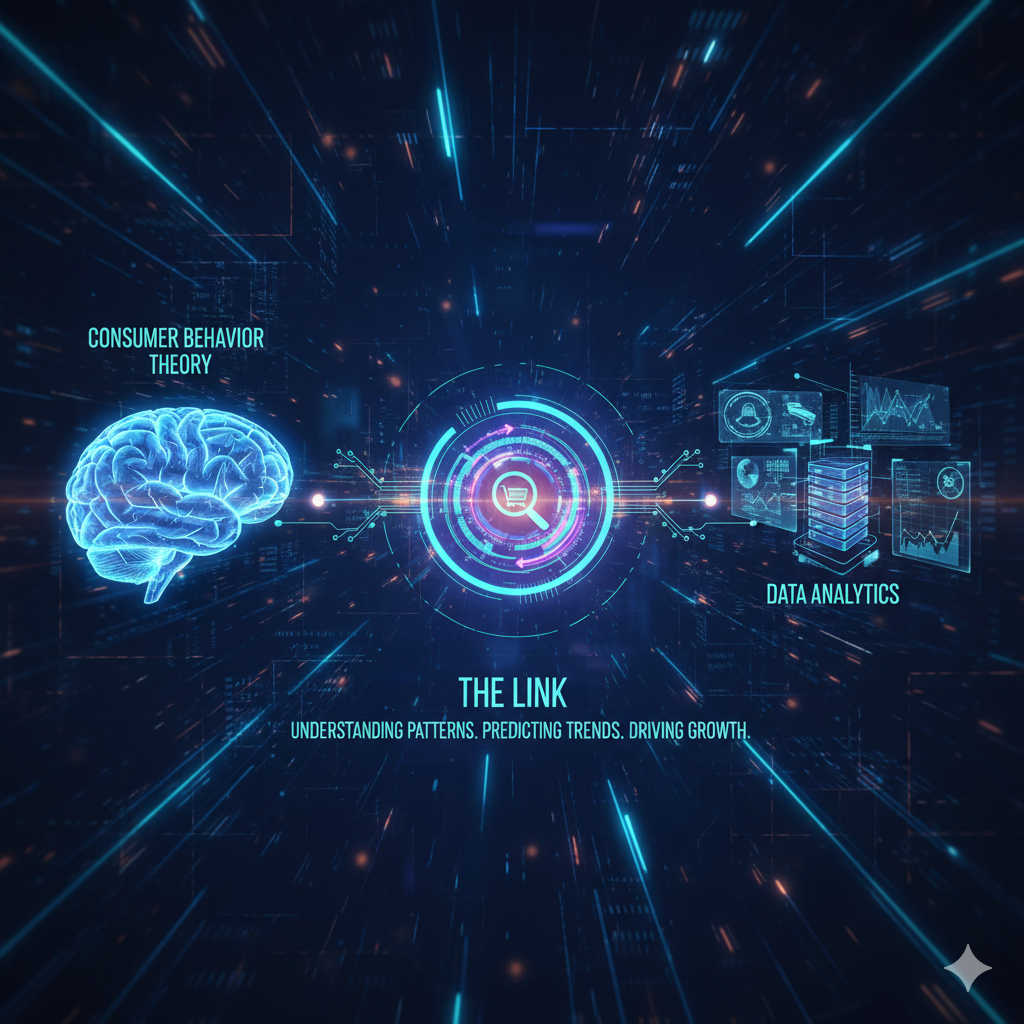
Understanding why people buy has been a central question in business for decades. Long before digital dashboards, tracking pixels, and artificial intelligence models existed, scholars and strategists studied consumer behaviour theory to uncover the psychological, social, and economic factors influencing purchasing decisions. Today, businesses operate in an environment saturated with information. Every click, search, scroll, and transaction generates measurable signals. This explosion of information has given rise to data analytics, a discipline focused on extracting insight from structured and unstructured datasets. While these two domains may appear distinct one theoretical and psychological, the other technical and quantitative they are deeply interconnected. The most successful organizations recognize that consumer behaviour theory provides the “why,” while data analytics delivers the “how” and “how much.”
Consumer behaviour theory explores how individuals make decisions about spending their time and money. It examines motivations, perceptions, attitudes, social influences, and emotional triggers. Concepts such as Maslow’s hierarchy of needs, perceived value, cognitive dissonance, and social proof help explain why customers prefer certain brands over others. These theories were developed through observation, surveys, interviews, and controlled experiments. They offer structured frameworks for understanding human decision-making. However, traditional research methods often relied on limited samples and periodic studies. While insightful, they lacked real-time scalability.
Data analytics transforms this theoretical understanding into measurable patterns at scale. Through behavioural data tracking, businesses can observe how thousands or millions of customers interact with digital platforms. Website heatmaps reveal where users focus their attention. Conversion funnels identify where prospects abandon the buying process. Purchase histories expose recurring preferences. Instead of relying solely on surveys about intention, companies now analyse actual behaviour. This shift from stated preferences to observed actions enhances accuracy and predictive capability.
One of the strongest links between consumer behaviour theory and analytics lies in segmentation. Traditional theory emphasizes that consumers are not homogeneous. Different groups respond differently based on demographics, lifestyle, personality, and motivation. In modern practice, data-driven segmentation operationalizes this principle. By analysing purchasing patterns, browsing behaviour, and engagement metrics, businesses create refined audience clusters. These segments allow targeted messaging that aligns with psychological drivers identified in theory. For example, value-oriented customers may respond to price incentives, while status-driven consumers prioritize exclusivity and brand prestige.
Another intersection emerges in the study of decision-making processes. Consumer behaviour theory often outlines stages such as problem recognition, information search, evaluation of alternatives, purchase decision, and post-purchase evaluation. Data analytics tracks these stages in digital environments. Search queries signal problem recognition. Product page visits indicate evaluation. Cart additions suggest intent. Reviews and feedback reflect post-purchase attitudes. By mapping digital touchpoints to theoretical stages, organizations gain clarity on where friction occurs and how to optimize experiences.
Emotions play a significant role in purchasing decisions. Theories highlight that buying is not purely rational; it is influenced by feelings such as trust, excitement, fear, and aspiration. While emotions were historically difficult to quantify, advancements in sentiment analysis and natural language processing (NLP) enable businesses to measure emotional tone in reviews, comments, and social media conversations. By analysing language patterns, companies detect shifts in consumer sentiment and adjust communication strategies accordingly. In this way, analytics quantifies psychological constructs once considered abstract.
The principle of social influence further demonstrates the integration of theory and analytics. Consumer behaviour research emphasizes the importance of peer opinions, reference groups, and societal norms. In digital ecosystems, these influences manifest through ratings, testimonials, influencer endorsements, and social sharing metrics. Analytics platforms measure engagement levels, referral sources, and network effects. Businesses can identify which forms of social proof generate higher conversion rates and refine strategies to amplify credibility.
Predictive modelling represents another powerful connection. Traditional theory explains tendencies and motivations, but it does not forecast individual behaviour with precision. Through predictive analytics, organizations use historical data to anticipate future actions. Machine learning algorithms identify patterns in past purchases, browsing frequency, and demographic characteristics to estimate the likelihood of conversion. These predictions reflect theoretical insights translated into algorithmic models. When executed responsibly, predictive analytics enhances personalization and efficiency.
Personalization itself is rooted in behavioural theory. Consumers prefer experiences that reflect their preferences and identity. Data analytics enables real-time customization of product recommendations, pricing strategies, and content delivery. Recommendation engines analyse user behaviour to present relevant options, reinforcing perceived value and reducing decision fatigue. The synergy between psychological understanding and computational analysis strengthens customer engagement.
Price sensitivity is another domain where theory and analytics converge. Economic and behavioural theories examine how consumers respond to pricing changes, discounts, and perceived fairness. Analytics tools measure price elasticity, tracking how demand fluctuates in response to adjustments. By combining theoretical frameworks with empirical data, businesses design pricing strategies that balance profitability and competitiveness.
Customer loyalty further illustrates this connection. Behavioural theory explains loyalty through satisfaction, trust, and emotional attachment. Data analytics measures repeat purchase frequency, churn rates, and engagement levels. By correlating behavioural indicators with transactional data, organizations identify loyalty drivers and intervene before attrition occurs. Loyalty programs, retention campaigns, and personalized communication strategies become more effective when informed by both psychological insight and quantitative evidence.
The integration of theory and analytics also enhances ethical considerations. Understanding consumer motivations helps organizations avoid manipulative tactics, while transparent data practices maintain trust. Responsible data governance ensures that analytical power does not exploit psychological vulnerabilities. Balancing insight with integrity protects long-term brand reputation.
Despite these advantages, challenges remain. Data without theoretical grounding can lead to misinterpretation. Correlation does not equal causation. A spike in sales following a marketing campaign may coincide with seasonal trends rather than campaign effectiveness. Theory provides context for interpreting patterns accurately. Conversely, theory without data risks becoming outdated or disconnected from evolving consumer behaviour. The most effective strategies combine conceptual frameworks with empirical validation.
Cross-functional collaboration is essential for maximizing this synergy. Marketing strategists, behavioural researchers, and data scientists must work together. Analysts translate behavioural hypotheses into measurable variables. Marketers design campaigns informed by psychological principles. Leadership ensures alignment between customer insight and business objectives. This integrated approach transforms isolated data points into strategic intelligence.
Technological advancements continue to strengthen this relationship. The growth of artificial intelligence, real-time analytics, and big data infrastructure expands the scale and speed at which insights are generated. However, technology alone cannot replace foundational understanding of human behaviour. Algorithms detect patterns, but theory explains meaning. Sustainable competitive advantage arises when organizations combine computational power with behavioural depth.
In highly competitive markets, companies that integrate consumer behaviour theory with data analytics achieve superior decision-making. They understand not only what customers are doing but why they are doing it. This dual perspective supports optimized marketing campaigns, improved product development, and enhanced customer experience design. It transforms reactive analysis into proactive strategy.
Ultimately, the link between consumer behaviour theory and data analytics represents the convergence of psychology and technology. One provides insight into human motivation; the other measures and predicts behavioural outcomes at scale. Together, they enable organizations to design strategies rooted in empathy, validated by evidence, and refined through continuous learning. In the modern business landscape, separating these disciplines limits potential. Integrating them unlocks deeper understanding, stronger relationships, and sustainable growth.