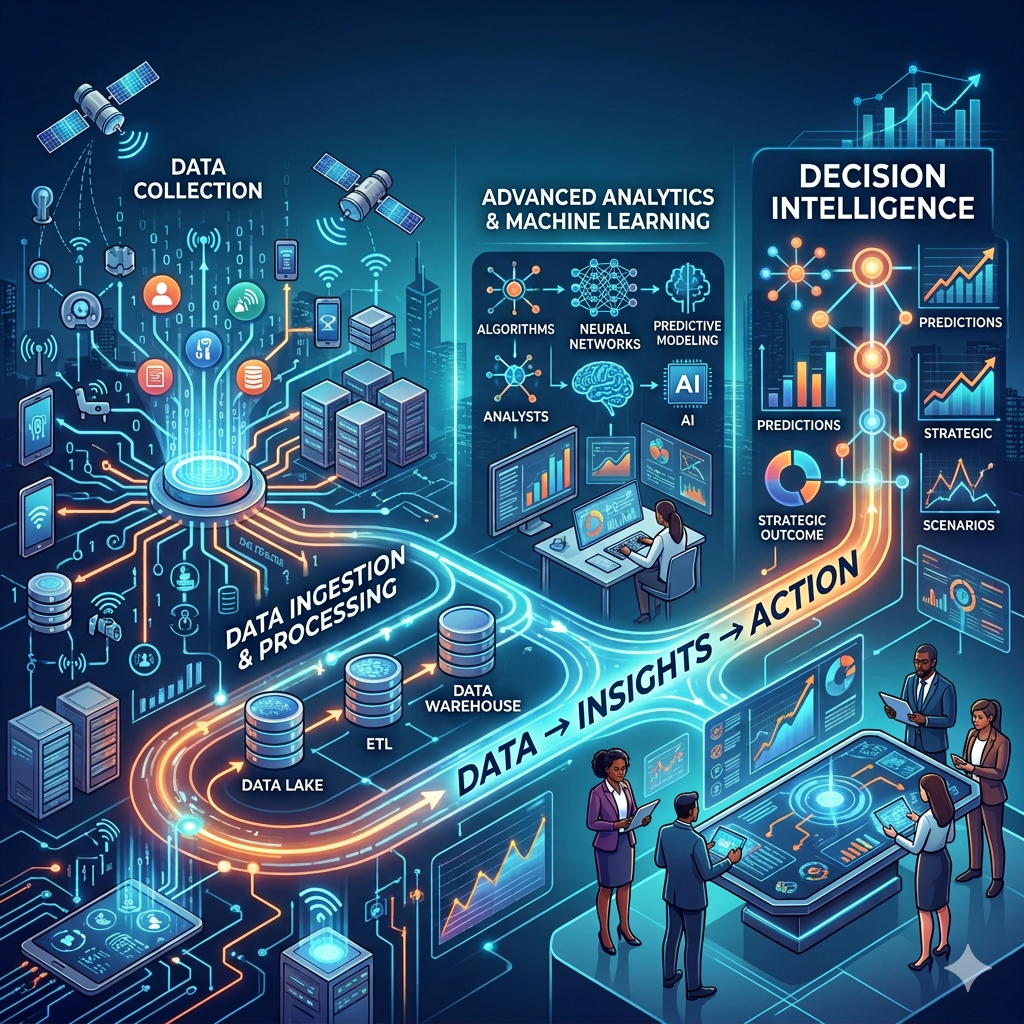
In the rapidly evolving business landscape, analytics is no longer limited to collecting and analyzing data. It is undergoing a profound transformation that is reshaping how organizations make decisions. What once began as a process of gathering information has now advanced into a sophisticated system capable of guiding strategy, predicting outcomes, and even recommending actions. Understanding the future of analytics: from data collection to decision intelligence reveals how businesses are moving toward a more intelligent, automated, and insight-driven approach to decision-making.
In its earlier stages, analytics focused primarily on data collection and storage. Organizations invested in systems to gather information from various sources such as transactions, customer interactions, and operational processes. The goal was to create repositories of data that could be accessed when needed. While this was an important foundation, simply collecting data did not provide immediate value. Much of this information remained underutilized because organizations lacked the tools and processes to analyze it effectively.
As technology advanced, businesses began to shift toward data analysis and reporting. This stage involved summarizing collected data into reports and dashboards that described past performance. These insights helped organizations understand trends, measure performance, and identify areas for improvement. However, this approach was still largely reactive, focusing on what had already happened rather than what might happen next.
The next phase in the evolution of analytics introduced advanced and predictive analytics. Organizations started using statistical models, machine learning algorithms, and pattern recognition techniques to forecast future outcomes. Instead of only analyzing historical data, businesses could now anticipate trends, estimate demand, and identify potential risks.
This shift marked a significant turning point. Predictive analytics enabled organizations to move from reactive decision-making to a more proactive approach. For example, companies could predict customer churn, optimize inventory levels, and plan marketing strategies based on expected outcomes. While this capability improved decision-making, it still required human interpretation to translate predictions into actions.
The future of analytics lies in the transition to decision intelligence, a more advanced stage where data, analytics, and artificial intelligence work together to support and automate decision-making processes. Decision intelligence goes beyond predicting outcomes; it provides actionable recommendations and evaluates the potential impact of different choices.
In this stage, analytics systems integrate data from multiple sources, analyze complex relationships, and generate insights that guide decisions in real time. These systems are designed to assist decision-makers by presenting not just information, but also suggested actions based on data-driven reasoning.
One of the key drivers of decision intelligence is the integration of artificial intelligence and machine learning into analytics platforms. These technologies enable systems to learn from data continuously, improving their accuracy and adaptability over time. As new data becomes available, models update automatically, ensuring that insights remain relevant in changing environments.
Another important aspect of this transformation is the rise of real-time analytics. In fast-paced industries, delays in decision-making can result in missed opportunities or increased risks. Real-time systems process data as it is generated, allowing organizations to respond immediately to changing conditions.
For example, businesses can adjust pricing strategies dynamically based on demand, personalize customer experiences instantly, or detect fraudulent activities as they occur. This immediacy enhances responsiveness and gives organizations a competitive edge.
The future of analytics also emphasizes data integration and connectivity. Modern organizations generate data across numerous platforms, including digital channels, operational systems, and external sources. Decision intelligence requires these datasets to be integrated into a unified framework.
By connecting data across departments, businesses gain a comprehensive view of their operations. This holistic perspective allows decision-makers to understand how different factors interact and influence outcomes. For instance, marketing performance can be linked with sales results, and operational efficiency can be connected to customer satisfaction.
Another significant development is the increasing importance of data visualization and accessibility. Advanced analytics tools are designed to present insights in intuitive formats, making them easier to understand and use. Interactive dashboards, visual representations, and user-friendly interfaces allow employees at all levels to engage with data.
This accessibility democratizes analytics, enabling more people within an organization to participate in data-driven decision-making. As a result, insights are not limited to specialized analysts but become part of everyday business processes.
The role of automation is also expanding in the future of analytics. Routine analytical tasks, such as data processing, reporting, and model updates, are increasingly handled by automated systems. This reduces manual effort and allows employees to focus on higher-level strategic activities.
Automation also enhances consistency and accuracy, as processes are executed in a standardized manner. In decision intelligence systems, automation can extend to recommending or even executing certain decisions based on predefined rules and models.
However, the transition to decision intelligence also introduces challenges. One of the most critical is ensuring data quality and governance. As analytics systems become more complex, the reliability of insights depends heavily on the accuracy and consistency of data. Organizations must establish strong governance frameworks to maintain data integrity.
Ethical considerations also become more prominent. Decision intelligence systems often rely on large datasets that may include sensitive information. Businesses must ensure that data is used responsibly and that privacy and security standards are upheld.
Another challenge involves balancing automation with human judgment. While decision intelligence systems can provide valuable recommendations, human expertise remains essential for interpreting results and considering broader context. Strategic decisions often involve factors that cannot be fully captured by data alone.
Cultural transformation within organizations is equally important. Adopting decision intelligence requires a shift in mindset from traditional decision-making approaches to a more data-driven culture. Employees must be willing to trust analytical insights and integrate them into their workflows.
Despite these challenges, the benefits of decision intelligence are substantial. Organizations that embrace this approach gain the ability to make faster, more accurate, and more consistent decisions. They can respond effectively to changes in the market, identify opportunities early, and manage risks proactively.
Ultimately, the future of analytics: from data collection to decision intelligence represents a fundamental shift in how businesses operate. Analytics is no longer just a tool for understanding the past; it is becoming a central component of decision-making processes.
By combining data, advanced analytics, and artificial intelligence, decision intelligence transforms information into actionable guidance. This evolution enables organizations to move beyond analysis and toward intelligent, automated decision-making.
In an increasingly complex and competitive environment, the ability to make informed decisions quickly and effectively is a critical advantage. Businesses that adopt decision intelligence are better positioned to navigate uncertainty, adapt to change, and achieve long-term success. As analytics continues to evolve, its role will become even more integral to shaping the future of business strategy.