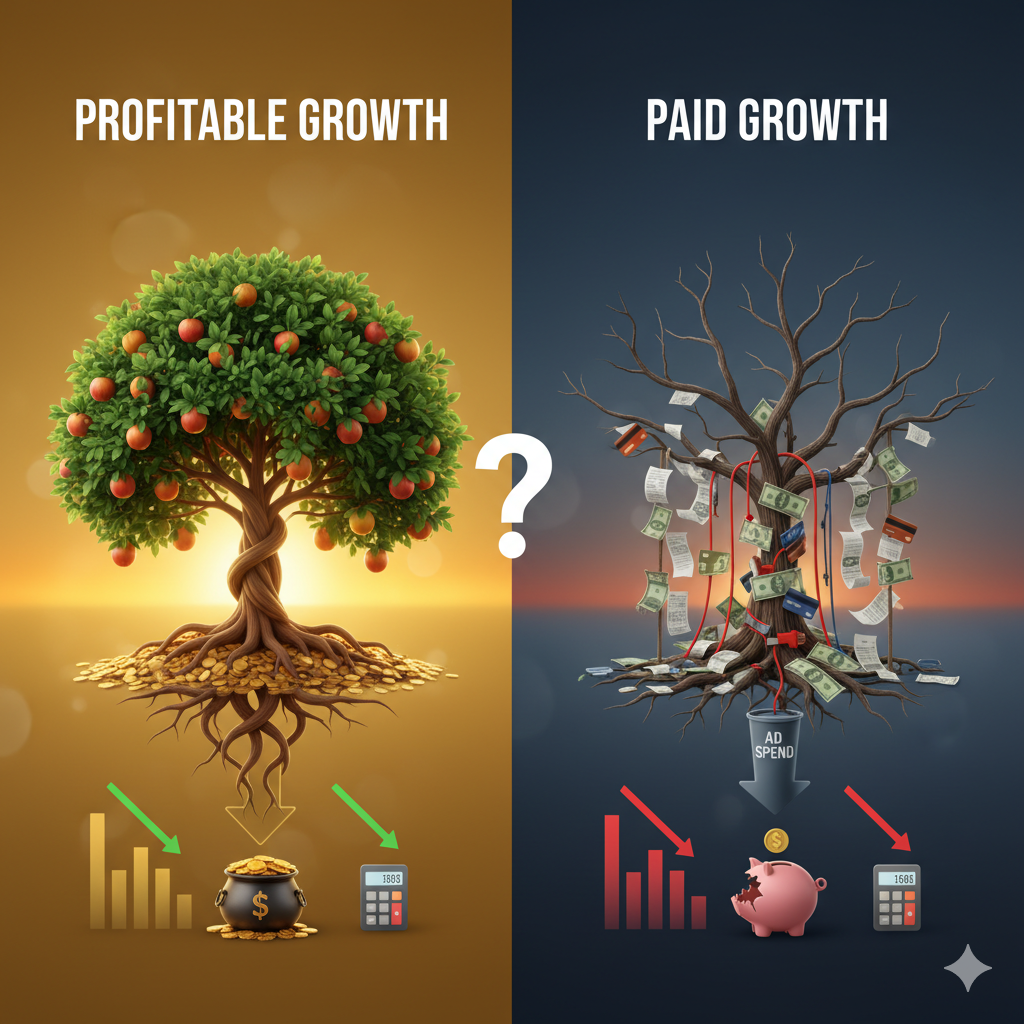
In boardrooms and marketing meetings across industries, growth is often celebrated as the ultimate indicator of success. Graphs move upward, dashboards glow green, and campaign reports highlight expanding reach, increasing leads, and rising conversion numbers. Yet beneath the surface of these impressive charts lies a critical distinction that too few organizations examine carefully: the difference between profitable growth and paid growth. At first glance, both may appear identical—revenue increases, customer numbers rise, and market presence expands. But the financial reality behind each tells a completely different story. One strengthens a company’s foundation, while the other quietly weakens it. Understanding this difference is no longer optional in today’s data-driven and capital-sensitive environment; it is essential for sustainable success.
Paid growth refers to expansion driven primarily by continuous spending on advertising, promotions, incentives, and acquisition campaigns. The moment the spending slows, the growth slows. In contrast, profitable growth occurs when revenue expands while maintaining or improving margins, cash flow, and operational efficiency. It is growth that sustains itself even when marketing budgets fluctuate. The distinction lies not in the speed of expansion but in the economic structure supporting that expansion. When organizations confuse the two, they risk building businesses that look impressive externally but struggle internally.
Modern marketing platforms make it easier than ever to generate traffic, leads, and even sales through paid campaigns. With sufficient budget allocation, companies can scale impressions rapidly across search engines, social platforms, and display networks. Dashboards then report improved customer acquisition numbers, increased website visits, and higher sales volumes. However, these reports often isolate performance metrics from financial metrics. Marketing teams may celebrate declining cost per click (CPC) or rising conversion rates, while finance teams observe shrinking gross margins and tightening cash flow. This disconnect creates an illusion of success.
The root issue often lies in how organizations define and measure growth. Many rely heavily on top-line indicators such as revenue growth percentage or market share gains. While these metrics are important, they do not reveal whether growth contributes to long-term value creation. If increased sales require proportionally higher marketing expenses, heavier discounting, or aggressive incentives, the company may be scaling revenue without scaling profitability. In such cases, growth becomes dependent on constant financial input, turning into paid growth rather than sustainable expansion.
A major driver of confusion is the overemphasis on vanity metrics. Metrics such as impressions, engagement rates, click-through rates, and even raw lead counts can create the perception of strong performance. However, these numbers do not automatically translate into net profit, return on investment (ROI), or improved customer lifetime value (CLV). When leadership focuses on activity metrics instead of economic impact, teams optimize for visibility rather than viability.
Another critical factor separating profitable growth from paid growth is the relationship between Customer Acquisition Cost (CAC) and Customer Lifetime Value (CLV). When acquisition costs rise faster than the lifetime revenue generated by customers, the business enters a dangerous territory. Even if total sales increase, the company may be spending more to acquire customers than it ultimately earns from them. This imbalance creates pressure on cash reserves and can lead to dependency on external funding. Profitable growth, by contrast, requires a healthy ratio between CLV and CAC, ensuring that each new customer contributes positively to long-term earnings.
Discount-driven strategies further complicate this distinction. Companies often accelerate sales through aggressive promotions, flash sales, or heavy discounts. Revenue surges during campaign periods, and performance dashboards show impressive spikes. Yet excessive discounting compresses profit margins, trains customers to wait for offers, and reduces brand equity. While paid campaigns and discounts can generate short-term momentum, they may undermine the financial strength needed for sustainable growth. Profitable growth demands disciplined pricing strategies aligned with cost structures and value positioning, not reactive discount cycles.
Cash flow dynamics also reveal whether growth is healthy or artificial. In many cases, businesses expand sales on extended credit terms or through promotional incentives that delay actual cash realization. While revenue figures rise, working capital requirements increase simultaneously. Marketing reports may highlight record sales months, but finance departments struggle to manage liquidity. Profitable growth ensures that revenue translates into positive operating cash flow, not just accounting entries.
Operational efficiency plays a vital role as well. Scaling marketing efforts without strengthening supply chain, fulfillment systems, or customer support can increase costs disproportionately. If the cost of serving each new customer rises as volume grows, margins shrink despite revenue expansion. Profitable growth integrates marketing strategy with operations management, ensuring that scale improves efficiency rather than eroding it.
The psychological bias toward growth at any cost further intensifies the problem. In competitive markets, organizations fear losing visibility or market share. As a result, they increase advertising budgets to maintain presence, even when marginal returns decline. This creates diminishing returns on ad spend and inflates marketing expenses without proportional revenue gains. Paid growth becomes a cycle where continuous spending sustains temporary performance, but the underlying economics remain fragile.
Financial discipline distinguishes companies that build lasting value from those chasing superficial expansion. Financial discipline involves aligning marketing decisions with contribution margins, break-even analysis, and long-term profitability projections. It requires evaluating whether each campaign strengthens the business model or merely boosts short-term metrics. When marketing and finance collaborate closely, campaigns are assessed not only by traffic or conversions but by their impact on earnings before interest and tax (EBIT) and overall profitability.
Data analytics should serve as the bridge between marketing ambition and financial reality. Advanced analytics can model customer retention rates, forecast lifetime value, and simulate margin impacts under different spending scenarios. However, analytics without financial interpretation can mislead. Predictive models might estimate higher conversion probabilities, but without incorporating cost structures and capital constraints, these predictions remain incomplete. Profitable growth demands integrated analytics that combine behavioral insights with economic metrics.
Brand positioning also influences the quality of growth. Companies relying heavily on paid advertising often struggle to build organic loyalty. If brand awareness exists primarily because of sponsored exposure, reducing ad budgets may significantly reduce visibility. Profitable growth, however, often includes a strong component of organic demand driven by trust, reputation, and customer advocacy. Organic growth lowers reliance on paid channels and improves overall margin stability.
Another overlooked dimension is customer retention. Many organizations invest heavily in acquisition while neglecting retention strategies. Acquiring new customers is typically more expensive than retaining existing ones. When churn rates remain high, companies must continuously fund acquisition to replace lost customers. This pattern inflates CAC and undermines profitability. Sustainable growth focuses on improving retention rates, enhancing customer experience, and increasing repeat purchase frequency.
Leadership perception plays a crucial role in shaping growth strategies. When executives equate growth solely with revenue acceleration, marketing teams are incentivized to maximize short-term sales regardless of cost. However, when leadership emphasizes return on capital employed (ROCE) and sustainable margin expansion, teams adopt more disciplined approaches. Strategic alignment between financial objectives and marketing goals determines whether growth strengthens or weakens the enterprise.
Technology platforms further complicate decision-making. Automated bidding systems and algorithm-driven campaigns promise optimized performance. While these tools can enhance efficiency, they often optimize for platform-specific metrics rather than overall profitability. For instance, campaigns might optimize for lowest cost per conversion without considering average order value or post-purchase behavior. Profitable growth requires holistic optimization across the entire customer journey, not isolated channel performance.
External funding can temporarily mask the difference between profitable and paid growth. Startups, in particular, may prioritize rapid expansion funded by venture capital. While this approach can capture market share, it may delay profitability indefinitely. Investors increasingly scrutinize unit economics to ensure that growth is economically viable. Companies that fail to transition from subsidized growth to self-sustaining profitability face significant risk when funding conditions tighten.
Market conditions also influence growth quality. During economic booms, increased consumer demand may support both paid and profitable growth simultaneously. However, during downturns, companies heavily dependent on paid campaigns often struggle. Advertising budgets shrink, consumer spending slows, and the fragile foundation of paid growth becomes evident. Profitable growth models, grounded in strong customer relationships and efficient cost structures, prove more resilient.
The strategic difference between the two growth models can be summarized through unit economics. If each additional customer contributes positive margin after covering acquisition and servicing costs, scaling amplifies profitability. If each new customer generates minimal or negative margin, scaling amplifies losses. Paid growth amplifies volume; profitable growth amplifies value.
Measurement frameworks must evolve to capture this nuance. Instead of celebrating revenue growth in isolation, organizations should track incremental profit, margin contribution per campaign, and long-term customer value creation. Marketing dashboards should integrate financial indicators alongside performance metrics. This integrated view ensures that growth narratives reflect economic reality rather than surface-level activity.
Cultural mindset is equally important. Teams must move beyond celebrating traffic spikes and lead surges toward understanding sustainable value creation. A culture that rewards profitable outcomes encourages smarter targeting, disciplined budgeting, and long-term thinking. Conversely, a culture that rewards only visible growth encourages excessive spending and short-term tactics.
Strategic pricing decisions further highlight the contrast. Aggressive pricing aimed at rapid market penetration can generate fast adoption but thin margins. If cost structures do not improve with scale, the company may struggle to convert revenue into profit. Profitable growth balances pricing strategy with cost management and perceived value, ensuring that expansion strengthens brand equity rather than eroding it.
Ultimately, the difference between profitable growth and paid growth lies in sustainability. Paid growth depends on continuous expenditure to maintain momentum. Profitable growth creates a virtuous cycle where satisfied customers generate repeat purchases, referrals, and organic demand, reducing reliance on paid channels. One builds dependency; the other builds resilience.
Organizations that understand this distinction invest in analytics that integrate marketing metrics with financial performance. They evaluate campaigns based on economic contribution, not just engagement. They align incentives across departments to ensure that growth benefits both top-line and bottom-line results. Most importantly, they recognize that true success is measured not by how fast revenue increases, but by how effectively that revenue translates into lasting profitability.
In a competitive marketplace where capital is limited and accountability is rising, the era of celebrating growth without examining its cost is fading. Companies must ask whether their expansion strategy strengthens margins, improves cash flow, and enhances long-term value. If the answer is no, they are likely pursuing paid growth disguised as progress. By shifting focus from mere expansion to economically sound growth, businesses can build foundations that endure beyond advertising cycles and market fluctuations.
Growth remains essential, but its quality matters more than its speed. Profitable growth sustains innovation, supports employees, and rewards stakeholders. Paid growth, while sometimes necessary as a strategic accelerator, should never become the default operating model. The organizations that thrive in the long run will be those that master the balance between marketing ambition and financial discipline, ensuring that every increment of growth contributes to lasting strength rather than temporary appearance.