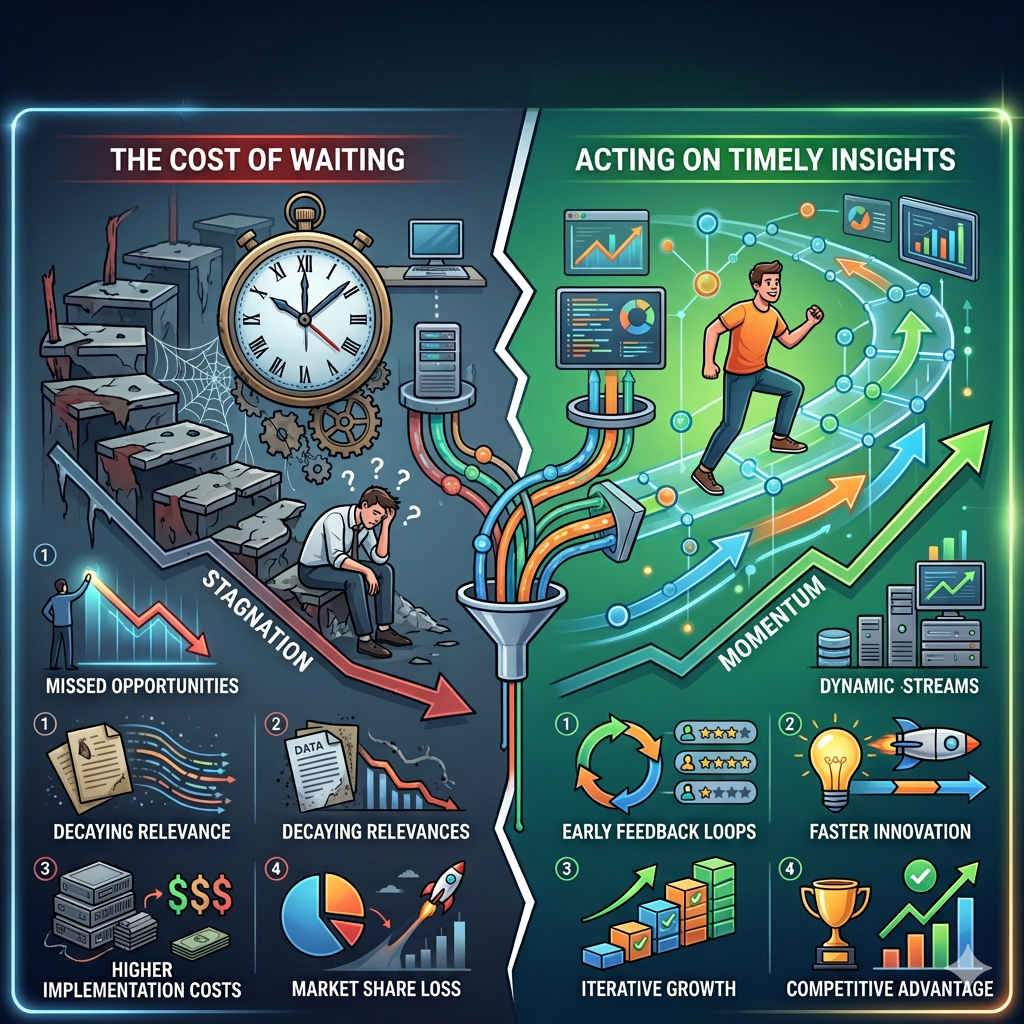
In data-driven organizations, accuracy and reliability are highly valued. Teams invest significant effort in cleaning datasets, validating sources, and building structured data pipelines before making strategic decisions. While this commitment to quality is important, it can also lead to an overlooked problem: the pursuit of “perfect data.” When organizations delay action until every dataset is complete, fully verified, and perfectly aligned, they risk slowing decision-making and missing opportunities. The cost of waiting for perfect data can be far greater than the risk of acting on imperfect information.
Data perfection is an appealing goal because it promises certainty. Decision-makers often believe that if they collect enough information and refine it thoroughly, the correct strategic direction will become obvious. However, real-world data environments are rarely flawless. Data arrives from multiple sources, definitions evolve, and measurement systems change over time. As a result, achieving absolute precision is often unrealistic.
The first cost of waiting for perfect data is lost time. Markets move quickly. Customer preferences shift, competitors introduce new strategies, and technological innovations reshape industries. When organizations delay decisions while refining datasets, they may respond too slowly to market changes. A decision made slightly earlier with incomplete data can sometimes be more valuable than a perfectly informed decision made too late.
Another cost arises from missed experimentation opportunities. Data-driven innovation often depends on testing ideas through controlled experiments, pilot programs, or incremental product launches. Waiting for fully validated data can postpone these experiments. Without experimentation, organizations lose the chance to generate new insights that only real-world testing can provide.
The pursuit of perfect data can also create analysis paralysis. Teams may continuously request additional datasets, deeper validation, or further modeling before reaching conclusions. While each improvement enhances accuracy, the marginal benefit gradually declines. At some point, additional data refinement contributes less value than timely action.
Decision-making efficiency is another factor. Business environments frequently require decisions under uncertainty. Leaders must evaluate probabilities, weigh trade-offs, and adapt as new information emerges. If teams insist on complete data certainty before acting, they may struggle to operate effectively in dynamic environments where uncertainty is unavoidable.
Financial implications also exist. Extensive data preparation, validation processes, and system integrations require resources. Data engineers, analysts, and infrastructure investments contribute to operational costs. While these investments are often justified, excessive emphasis on perfect data can divert resources away from strategic initiatives that directly generate value.
Another important consideration is diminishing returns in data quality improvements. Early data cleaning efforts typically produce significant accuracy gains by removing duplicates, correcting formatting errors, and aligning definitions. However, as datasets become more refined, further improvements may require disproportionate effort. The incremental accuracy gained may not significantly alter strategic decisions.
In many cases, imperfect data still provides meaningful directional insight. Trends, patterns, and relationships can often be detected even when datasets contain minor inaccuracies. For example, a demand forecast may not predict exact quantities, but it can still reveal whether demand is increasing or decreasing. These directional insights can guide timely decision-making.
Waiting for perfect data can also reduce organizational agility. Companies that act quickly based on available evidence can adjust strategies as new information appears. In contrast, organizations that wait for perfect datasets may react more slowly and struggle to adapt when conditions change.
Another overlooked cost is competitive disadvantage. Competitors who make faster decisions—even with slightly less precise data—may capture market opportunities first. Early movers often benefit from brand recognition, customer loyalty, and operational learning advantages that later entrants find difficult to overcome.
It is also important to recognize that data quality itself improves through use. When teams actively analyze and apply datasets, they often discover inconsistencies or gaps that can be corrected over time. Practical application reveals issues that might remain hidden in purely theoretical data preparation stages.
The solution is not to ignore data quality but to balance precision with practicality. Organizations should define acceptable data thresholds for different types of decisions. Strategic investments may require more rigorous validation, while operational adjustments may proceed with moderate levels of uncertainty.
Iterative decision-making frameworks can help manage this balance. Instead of waiting for perfect information, teams can make initial decisions based on available data and refine their approach as additional insights emerge. This process aligns with agile management principles that emphasize continuous learning and adaptation.
Another effective approach involves combining quantitative analysis with qualitative judgment. Market expertise, customer feedback, and industry experience can complement imperfect datasets. When analytical insights and managerial judgment align, decision confidence increases even without perfect data.
Data governance frameworks also contribute to efficiency by standardizing definitions and improving accessibility. When datasets are consistently structured and documented, teams spend less time verifying information and more time interpreting it.
Leadership culture plays a crucial role in overcoming the perfect data trap. If organizations penalize decisions made under uncertainty, teams become reluctant to act without exhaustive data validation. Encouraging responsible experimentation and learning-oriented decision-making reduces this hesitation.
Importantly, perfect data does not guarantee perfect decisions. Strategic choices involve assumptions about future conditions that data alone cannot fully predict. Even flawless historical data cannot eliminate uncertainty about future market dynamics.
The most effective organizations treat data as a guide rather than a prerequisite for action. They recognize that insight emerges through a combination of analysis, experimentation, and experience. By acting on reasonably reliable information while continuously refining their understanding, they maintain momentum in dynamic markets.
Ultimately, the cost of waiting for perfect data lies in delayed opportunity, reduced agility, and slower innovation. Businesses that balance analytical rigor with timely action gain a competitive advantage. They understand that while data quality matters, progress often depends on the willingness to move forward before every variable is perfectly defined.
In a rapidly changing business environment, success rarely belongs to those who wait for perfect certainty. It belongs to those who make informed decisions with available data and refine their strategies as new information emerges.