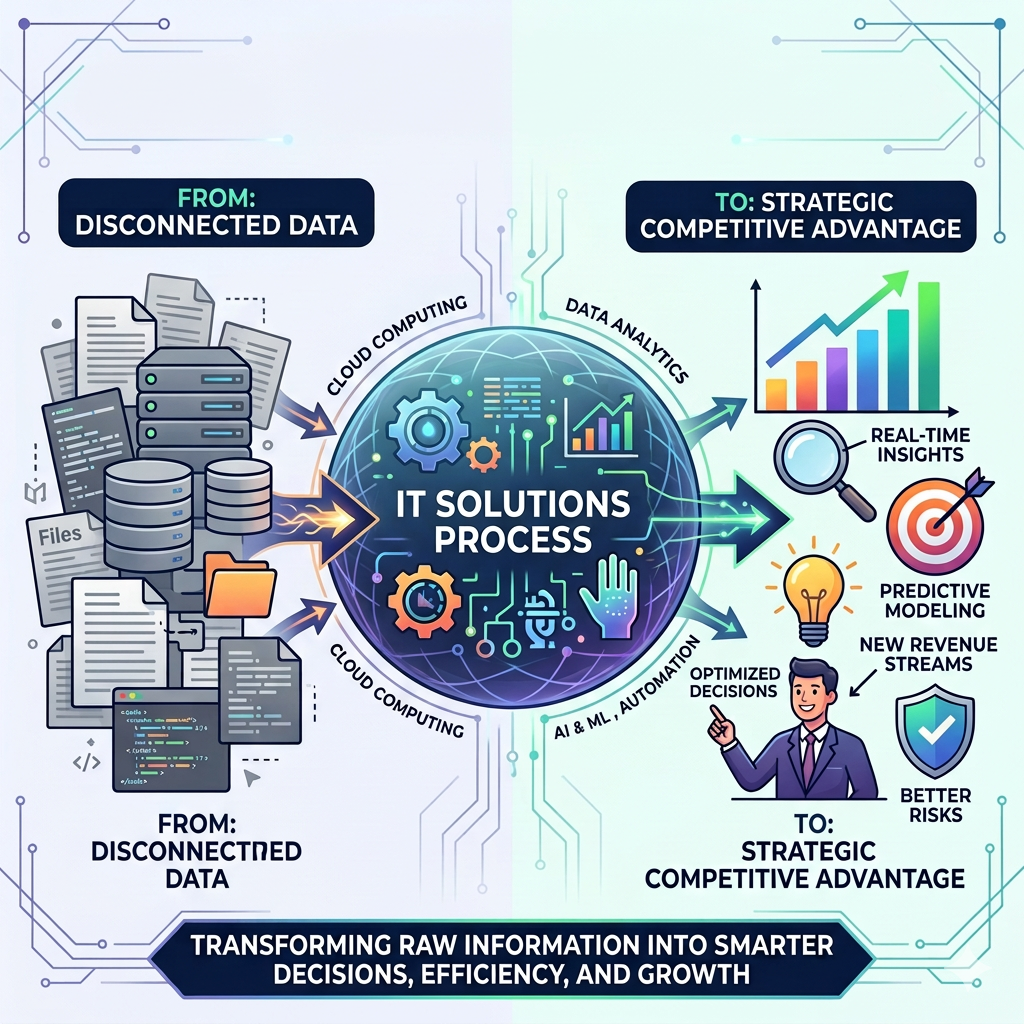
In today’s digital economy, data has become one of the most valuable assets a business can possess. Organizations across industries generate vast amounts of information through customer interactions, operational processes, financial transactions, and digital platforms. However, data alone does not create value. Its true potential lies in how effectively it is collected, processed, analyzed, and applied to decision-making. This is where modern IT solutions play a critical role. Understanding how modern IT solutions turn data into competitive advantage reveals how businesses can transform raw information into actionable insights that drive growth and differentiation.
At the foundation of this transformation is the ability of IT systems to collect and manage data efficiently. Businesses operate across multiple channels, including websites, mobile applications, physical locations, and enterprise systems. Each of these channels generates data in different formats and structures. Modern IT solutions provide the infrastructure needed to capture this information in a consistent and organized manner.
Advanced data management systems ensure that data is stored securely and remains accessible for analysis. By centralizing information from various sources, organizations create a unified view of their operations. This centralized approach eliminates fragmentation and allows decision-makers to analyze data more effectively.
Once data is collected and stored, the next step involves data processing and integration. Raw data is often incomplete, inconsistent, or duplicated. IT solutions use automated processes to clean, standardize, and combine datasets from multiple systems. This integration is essential for creating accurate and reliable analytical outputs.
For example, integrating customer data from marketing platforms, sales systems, and customer support channels allows businesses to understand the entire customer journey. Without integration, these datasets remain isolated, limiting the depth of analysis.
Another important role of modern IT solutions is enabling advanced analytics capabilities. Traditional analysis methods are no longer sufficient for handling the complexity and scale of modern data. IT platforms provide tools for statistical analysis, machine learning, and real-time data processing.
These tools allow organizations to move beyond basic reporting and explore deeper insights. Businesses can identify patterns in customer behavior, detect operational inefficiencies, and evaluate the impact of strategic decisions. Advanced analytics transforms data into meaningful information that supports informed decision-making.
One of the most powerful ways IT solutions create competitive advantage is through real-time decision-making. In fast-paced markets, the ability to respond quickly to changes can determine success or failure. Real-time analytics systems continuously monitor data and provide immediate insights.
For instance, e-commerce platforms can track customer activity as it happens, enabling personalized recommendations or targeted promotions. Similarly, supply chain systems can detect disruptions instantly and adjust operations to minimize impact. This responsiveness allows businesses to stay ahead of competitors who rely on delayed or static information.
Another key factor is the role of IT solutions in enhancing customer experience. Modern customers expect personalized interactions, seamless services, and quick responses. IT systems analyze customer data to understand preferences, behavior, and feedback.
These insights enable businesses to tailor their offerings and communication strategies. Personalized recommendations, targeted marketing campaigns, and efficient customer support all contribute to improved satisfaction and loyalty. Organizations that leverage data effectively can build stronger relationships with their customers, creating a significant competitive advantage.
Operational efficiency is another area where IT solutions make a substantial impact. Businesses often manage complex processes involving production, logistics, workforce management, and service delivery. IT systems analyze operational data to identify inefficiencies and optimize resource allocation.
For example, predictive maintenance systems can analyze equipment data to identify potential failures before they occur, reducing downtime and maintenance costs. Similarly, logistics platforms can optimize delivery routes based on real-time conditions, improving efficiency and reducing expenses.
Modern IT solutions also support predictive and prescriptive analytics, which further enhance competitive advantage. Predictive analytics uses historical data to forecast future outcomes, while prescriptive analytics suggests actions based on these predictions.
For instance, businesses can forecast demand to manage inventory levels more effectively or predict customer churn to implement retention strategies. Prescriptive models can recommend optimal pricing strategies, marketing investments, or operational adjustments. These capabilities allow organizations to anticipate changes and act proactively.
Another critical aspect is data security and governance. As businesses rely more heavily on data, protecting it becomes increasingly important. IT solutions implement security measures to safeguard sensitive information from unauthorized access or breaches.
At the same time, data governance frameworks ensure that data remains accurate, consistent, and compliant with regulations. Strong governance practices build trust in data, enabling organizations to make decisions with confidence.
Scalability is another advantage provided by modern IT solutions. As businesses grow, the volume and complexity of data increase. IT infrastructure must be capable of handling this growth without compromising performance. Cloud computing and scalable architectures allow organizations to expand their data capabilities efficiently.
This scalability ensures that businesses can continue to leverage data effectively as they evolve. It also reduces the need for significant upfront investments in infrastructure, making advanced analytics more accessible.
Collaboration and accessibility also improve through IT solutions. Modern platforms provide user-friendly interfaces and visualization tools that make data insights accessible to a wider range of employees. Decision-makers across departments can access relevant information and collaborate more effectively.
When data is shared across teams, organizations can align their strategies and ensure that decisions are based on consistent insights. This alignment reduces conflicts and improves overall efficiency.
Despite these advantages, turning data into competitive advantage requires more than technology alone. Organizations must develop a data-driven culture that encourages the use of analytics in decision-making. Employees must be trained to interpret data and apply insights effectively.
Additionally, businesses must focus on data quality. Inaccurate or inconsistent data can undermine analytical efforts and lead to poor decisions. Ensuring data accuracy and reliability is essential for maximizing the value of IT solutions.
Ultimately, how modern IT solutions turn data into competitive advantage lies in their ability to transform information into actionable insights. By collecting, integrating, analyzing, and applying data effectively, organizations can make better decisions, improve efficiency, and enhance customer experiences.
In an increasingly competitive and data-driven world, businesses that leverage modern IT solutions gain a significant edge. They are better equipped to anticipate changes, respond quickly to challenges, and capitalize on opportunities. By turning data into a strategic asset, organizations can achieve sustainable growth and long-term success.