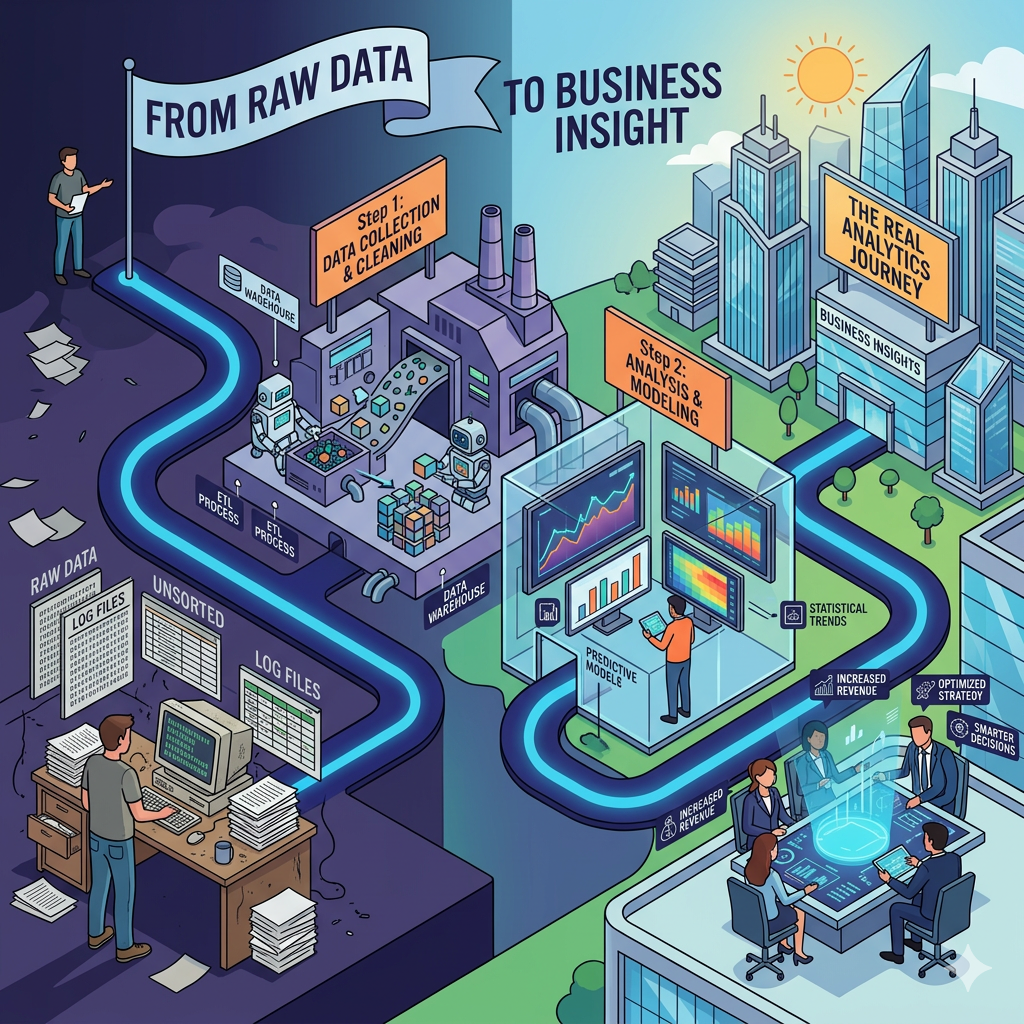
In today’s data-driven economy, organizations generate enormous volumes of information through daily operations, customer interactions, digital platforms, and internal processes. Despite this abundance, many businesses struggle to convert data into meaningful outcomes. The challenge is not the lack of data, but the ability to transform it into actionable understanding. This transformation is not immediate or simple—it involves multiple stages, each requiring careful execution. Understanding from raw data to business insight: the real analytics journey highlights how organizations move from scattered information to informed decision-making.
The journey begins with raw data collection, which forms the foundation of all analytical efforts. Businesses gather data from a wide range of sources, including transaction systems, websites, mobile applications, customer relationship platforms, financial records, and operational processes. This data is often unstructured, incomplete, and inconsistent. At this stage, it does not provide direct value because it lacks context and organization.
Raw data can include anything from customer purchase histories and website clicks to inventory logs and employee records. While this information reflects real-world activities, it remains fragmented across systems. Without proper structure, it is difficult to interpret or analyze effectively. This is why the initial stage of the analytics journey focuses on capturing data accurately and ensuring it is stored in a way that allows future processing.
The next critical step involves data cleaning and preparation. In real-world scenarios, data is rarely perfect. It may contain missing values, duplicate entries, inconsistent formats, or errors. These issues can distort analysis and lead to incorrect conclusions if not addressed.
Data cleaning involves identifying and correcting these inconsistencies. Duplicate records are removed, missing values are handled appropriately, and formats are standardized. This stage is often time-consuming, but it is essential for ensuring that subsequent analysis is reliable. Without clean data, even the most advanced analytical tools cannot produce meaningful insights.
Following preparation, the process moves to data integration and organization. Organizations typically operate multiple systems that generate separate datasets. To gain a complete view of operations, these datasets must be combined into a unified structure.
Integration involves aligning data from different sources, ensuring that fields match correctly and definitions are consistent. For example, customer data from marketing platforms must align with sales data and support records to create a comprehensive customer profile. This step is one of the most challenging aspects of the analytics journey because it requires both technical expertise and a deep understanding of business processes.
Once data is integrated, it becomes possible to perform data analysis. At this stage, organizations begin to explore patterns, trends, and relationships within the data. Analytical techniques range from basic statistical analysis to more advanced methods such as machine learning and predictive modeling.
Analysis answers important questions about business performance. It helps organizations understand what has happened, why it happened, and what factors influence outcomes. For example, analysis may reveal which products generate the highest revenue, which marketing campaigns are most effective, or which operational processes cause delays.
However, analysis alone does not complete the journey. The next step involves transforming analysis into insights. Insights go beyond numbers and patterns; they provide meaningful interpretations that guide decision-making. While analysis identifies trends, insights explain their significance and implications for the business.
For instance, identifying a decline in customer retention is an analytical finding. Understanding that this decline is caused by poor service experiences or delayed deliveries is an insight. Insights connect data with real-world actions, making them valuable for strategic planning.
Another important stage in the journey is data visualization and communication. Insights must be presented in a clear and understandable manner to be effective. Complex datasets and analytical results can be difficult to interpret without proper visualization.
Dashboards, charts, and visual representations help decision-makers grasp key findings quickly. Effective communication ensures that insights are accessible to stakeholders across the organization, enabling informed discussions and collaborative decision-making.
The journey continues with decision-making and action. This is where analytics delivers its true value. Insights must be translated into actions that improve business performance. Organizations use analytical findings to adjust strategies, optimize operations, enhance customer experiences, and manage risks.
For example, if analytics reveals that a specific customer segment has high lifetime value, businesses can focus marketing efforts on that segment. If operational data highlights inefficiencies, processes can be redesigned to improve productivity. The ability to act on insights is what differentiates successful analytics initiatives from those that remain purely theoretical.
Another critical aspect of the analytics journey is continuous monitoring and improvement. Business environments are dynamic, and conditions change over time. Insights that are relevant today may become outdated as new data emerges.
Organizations must continuously monitor performance and update their analyses. This ongoing process ensures that decisions remain aligned with current conditions. Feedback loops allow businesses to evaluate the impact of their actions and refine strategies accordingly.
The role of technology is central throughout this journey. Modern analytics platforms provide tools for data collection, processing, integration, analysis, and visualization. These technologies enable organizations to handle large volumes of data efficiently and generate insights in a timely manner.
However, technology alone is not sufficient. The success of the analytics journey depends on a combination of technical capabilities and organizational mindset. Businesses must foster a data-driven culture where decisions are supported by evidence rather than assumptions.
Data quality and governance also play a crucial role. Accurate and consistent data ensures that insights are reliable. Governance frameworks define standards for data management, ensuring that information is maintained and used responsibly.
Another important factor is the collaboration between different teams. Analysts, engineers, managers, and domain experts must work together to understand data and interpret insights. Effective collaboration ensures that analytical findings are relevant and actionable.
Despite its structured nature, the analytics journey is not always linear. Organizations may revisit earlier stages as new data becomes available or as business requirements change. This iterative approach allows for continuous refinement and improvement.
Ultimately, from raw data to business insight: the real analytics journey is about transforming information into value. Each stage—collection, preparation, integration, analysis, insight generation, and action—plays a vital role in this transformation.
Businesses that successfully navigate this journey gain a deeper understanding of their operations, customers, and markets. They are better equipped to make informed decisions, respond to changes, and identify opportunities for growth.
In an increasingly competitive environment, the ability to turn data into actionable insight is not just an advantage; it is a necessity. Organizations that invest in the complete analytics journey, rather than focusing on isolated stages, are more likely to achieve sustainable success and long-term impact.