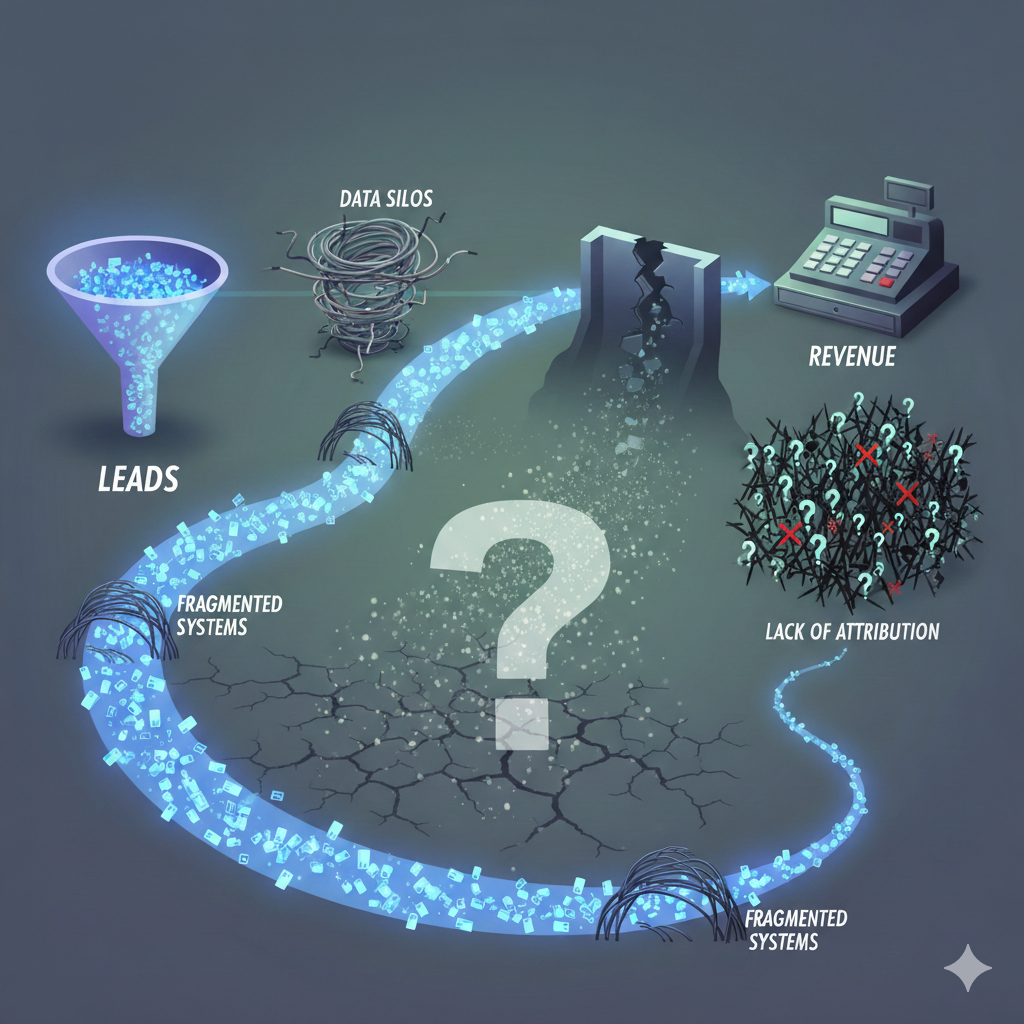
In today’s digital economy, businesses generate more marketing data than ever before. Every click, impression, email open, website visit, social interaction, and form submission creates measurable signals. Dashboards fill with numbers. Reports show rising lead counts, campaign reach, cost-per-click metrics, and engagement rates. Yet despite this abundance of data, many organizations struggle with a critical problem: they cannot clearly connect leads to revenue. Somewhere between the first interaction and the final sale, valuable data gets fragmented, distorted, delayed, or completely lost.
The journey from lead generation to revenue realization is rarely linear. It passes through marketing automation platforms, CRM systems, sales pipelines, analytics dashboards, and financial reporting tools. Each transition creates potential friction. When systems are disconnected or processes are inconsistent, the result is incomplete attribution, misaligned strategies, and missed revenue opportunities. Understanding where marketing data gets lost is the first step toward preventing leakage and building a measurable, optimized growth engine.
One of the earliest points of data loss occurs during lead capture. Businesses invest heavily in campaigns across paid ads, organic search, social media, events, and referrals. However, inconsistent tracking mechanisms undermine accuracy. Missing UTM parameters, broken tracking pixels, duplicate landing pages, or improperly configured forms can strip away source attribution. When attribution data is not captured at the first interaction, every subsequent analysis becomes flawed. Marketing teams may believe a campaign underperformed when in reality, the data trail simply disappeared.
Even when leads are successfully captured, the next risk appears in data integration gaps. Many organizations operate with separate platforms for marketing automation, CRM management, email campaigns, and analytics reporting. If these systems are not fully synchronized, data becomes fragmented. A lead generated through a webinar may not sync correctly into the CRM. Sales teams may update statuses manually without standardized formats. Analytics dashboards may pull data from incomplete fields. Each manual transfer or inconsistent sync increases the probability of data degradation.
Another significant point of leakage occurs during lead qualification. Marketing teams often measure success by volume — number of leads generated. Sales teams focus on quality — likelihood of conversion. Without a shared definition of Marketing Qualified Leads (MQLs) and Sales Qualified Leads (SQLs), data becomes misaligned. Leads may be passed prematurely or held too long. Rejection reasons may not be logged accurately. When qualification criteria lack clarity, valuable behavioral insights disappear, and conversion bottlenecks remain hidden.
The handoff between marketing and sales is one of the most vulnerable stages. In many organizations, this transition lacks structured documentation. Sales representatives may contact leads without reviewing full engagement history. Marketing engagement data — email clicks, content downloads, webinar participation — may not be visible within the CRM interface. As a result, contextual intelligence is lost. Without visibility into past interactions, sales conversations become generic rather than personalized, reducing conversion probability.
Data loss also occurs through manual data entry errors. When sales teams input notes, update deal stages, or modify contact details manually, inconsistencies emerge. Misspelled fields, incomplete entries, and skipped updates create inaccurate reporting. Over time, these small discrepancies accumulate into distorted forecasts. Revenue projections become unreliable because the underlying data lacks integrity. Automation reduces such risks, but many organizations still rely on manual processes at critical pipeline stages.
As leads move deeper into the sales funnel, tracking becomes increasingly complex. Multi-touch interactions — emails, calls, demos, proposals — generate fragmented activity logs. Without a unified tracking framework, it becomes difficult to identify which touchpoints truly influenced conversion. Organizations relying solely on first-touch or last-touch attribution models oversimplify the buyer journey. Revenue credit becomes inaccurately assigned, and marketing investments are misallocated.
A major breakdown occurs in attribution modeling. Many businesses struggle to connect marketing spend directly to closed revenue. When financial systems operate separately from marketing platforms, revenue attribution becomes guesswork. If deal values are not synced back to campaign data, ROI calculations remain incomplete. Marketing teams cannot confidently identify which channels generate profitable customers and which generate unqualified traffic. Without full-funnel visibility, optimization decisions rely on partial insights.
Customer relationship data is another frequent casualty. After conversion, ongoing engagement data — upsells, renewals, cross-sells — often resides in separate account management systems. If this post-sale data is not connected to original acquisition data, organizations miss long-term Customer Lifetime Value (CLV) insights. Marketing may focus on acquiring high-volume leads without understanding which channels produce the most profitable long-term customers. Revenue potential is obscured because lifecycle tracking ends at the initial sale.
Data silos intensify the problem. Different departments maintain separate KPIs, dashboards, and performance metrics. Marketing reports campaign metrics. Sales reports pipeline velocity. Finance reports revenue totals. Without unified data governance frameworks, cross-departmental visibility remains limited. Each team sees a portion of the truth, but no one sees the complete picture. This fragmentation creates strategic blind spots and internal misalignment.
Technology overload further complicates matters. Modern marketing stacks often include numerous tools — email automation, ad platforms, analytics dashboards, CRM systems, chatbot integrations, and reporting software. Each tool generates data independently. Without structured integration architecture, complexity increases exponentially. Instead of empowering teams, data abundance overwhelms them. Critical insights get buried beneath inconsistent reports and conflicting metrics.
Another overlooked source of data loss lies in incomplete feedback loops. When deals are lost, reasons are not always systematically recorded. When campaigns underperform, root causes are not deeply analyzed. When customers churn, behavioral patterns are not traced back to acquisition channels. Without structured feedback loops, valuable learning opportunities vanish. Marketing continues optimizing based on surface-level indicators rather than revenue-backed intelligence.
Real-time data latency also contributes to revenue disconnect. If marketing dashboards update daily while sales pipelines update weekly and finance reconciles monthly, insights arrive too late to influence decisions. Delayed visibility prevents proactive optimization. By the time underperforming campaigns are identified, budget has already been spent. Timeliness is essential for connecting leads to revenue accurately.
Organizational culture plays a role as well. In companies where marketing and sales operate independently, data collaboration weakens. Marketing may prioritize campaign creativity, while sales prioritizes deal closure. Without shared accountability for revenue outcomes, data sharing becomes secondary. Alignment requires unified revenue goals, shared performance dashboards, and collaborative strategy planning.
To prevent data loss, organizations must adopt an integrated Revenue Operations (RevOps) approach. RevOps centralizes marketing, sales, and customer data into a cohesive ecosystem. It standardizes processes, aligns KPIs, and ensures consistent reporting structures. Unified dashboards provide visibility from initial lead capture through final revenue recognition. When systems communicate seamlessly, the customer journey becomes measurable and optimizable.
Automation is another essential solution. Automated data capture reduces manual errors and preserves attribution integrity. API-based integrations ensure that campaign data flows directly into CRM records. Workflow automation standardizes lead scoring and qualification criteria. Automation minimizes human dependency at critical transition points.
Robust data governance policies further strengthen reliability. Standardized naming conventions, validation rules, and periodic data audits maintain accuracy. Governance frameworks ensure that each data point is traceable and accountable. Clean data builds confidence in reporting and enables accurate forecasting.
Advanced analytics and AI-driven attribution models also enhance visibility. Multi-touch attribution frameworks analyze complex buyer journeys and assign weighted revenue credit to each interaction. Predictive analytics identify patterns linking marketing behaviors to revenue outcomes. Intelligent systems highlight bottlenecks and recommend optimization strategies.
Ultimately, the journey from leads to revenue is not just about generating more data; it is about preserving data integrity across every stage. The cost of lost marketing data is not merely analytical inconvenience — it translates into wasted budget, missed opportunities, inaccurate forecasts, and reduced growth potential.
Organizations that close the gap between lead generation, pipeline management, and revenue attribution gain a strategic advantage. They allocate budgets with precision, personalize outreach effectively, and forecast growth confidently. Most importantly, they transform marketing from a cost center into a measurable revenue driver.
The challenge is not data scarcity. It is data fragmentation. The solution lies in integration, alignment, governance, and accountability. When marketing data flows seamlessly from first interaction to final transaction, businesses gain clarity. And with clarity comes control over growth, profitability, and long-term success.