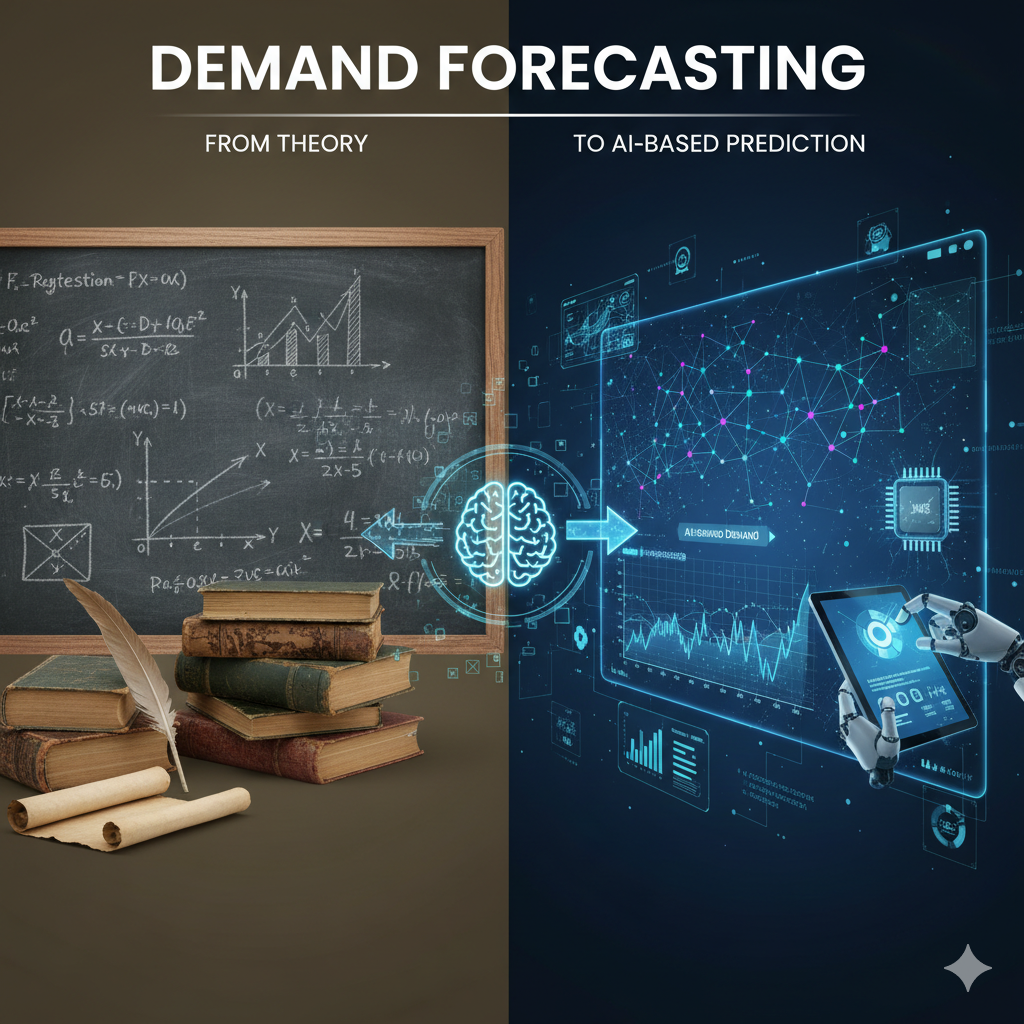
Accurate demand forecasting has always been central to effective business planning, yet the methods used to predict demand have evolved dramatically over time. Traditionally rooted in economic theory and statistical modelling, forecasting was once limited by manual calculations, historical averages, and simplified assumptions about consumer behaviour. Today, the integration of artificial intelligence (AI) and advanced analytics has transformed forecasting into a dynamic, real-time predictive discipline. Moving from theory to AI-based prediction represents not merely a technological shift but a fundamental change in how organizations anticipate market behaviour, allocate resources, and manage risk.
At its theoretical foundation, demand forecasting begins with classical economic principles such as demand and supply theory, consumer preference modelling, and price responsiveness. Economists historically relied on time-series analysis, regression models, and moving averages to estimate future sales based on past patterns. These methods assume that historical trends, seasonality, and cyclical behaviour provide reliable indicators of future demand. While these models remain valuable, they often struggle to account for sudden market disruptions, nonlinear relationships, and complex consumer behaviour patterns that characterize modern markets.
Traditional forecasting methods, including trend analysis, exponential smoothing, and ARIMA models, rely heavily on structured historical data. These statistical tools identify patterns such as seasonality and growth trends, enabling companies to make informed projections. However, they typically require clean, stable datasets and assume relatively predictable environments. In volatile industries such as fashion, technology, or e-commerce consumer preferences shift rapidly, and static models may fail to capture emerging signals. This limitation highlights the need for more adaptive systems capable of processing large volumes of diverse data inputs.
One of the core challenges in demand forecasting lies in understanding price elasticity and external influencing factors. Economic theory emphasizes that demand is affected not only by price but also by income levels, substitute goods, complementary products, and macroeconomic conditions. Traditional regression models attempt to incorporate these variables, yet they often struggle with multicollinearity and complex interdependencies. As markets become increasingly interconnected, forecasting must account for a wider range of variables, including social trends, weather conditions, digital engagement metrics, and even geopolitical events.
The transition to AI-based prediction addresses many of these limitations. Artificial intelligence systems, particularly those using machine learning algorithms, can process vast datasets and identify nonlinear relationships that traditional models may overlook. Instead of relying solely on predefined equations, machine learning models learn patterns directly from data. This adaptive capability allows forecasting systems to evolve continuously as new information becomes available. In practical terms, businesses can detect demand shifts earlier and respond more proactively.
A significant advancement in AI-driven forecasting is the use of neural networks and deep learning models. These models simulate human cognitive processes, identifying complex correlations between variables. For instance, an AI system may analyze social media sentiment, search engine trends, historical sales, promotional campaigns, and macroeconomic indicators simultaneously. By integrating structured and unstructured data, AI enhances prediction accuracy beyond the capabilities of traditional statistical techniques. This multidimensional analysis provides a holistic view of demand drivers.
Another transformative feature of AI-based forecasting is real-time data processing. Traditional forecasting cycles often operate monthly or quarterly, limiting responsiveness. AI systems, by contrast, can update predictions continuously as new transactions occur. In industries such as retail or logistics, this agility significantly improves inventory planning and resource allocation. Real-time forecasting reduces the risk of stockouts or overstocking, directly impacting customer satisfaction and operational efficiency.
The integration of predictive analytics into supply chain management further illustrates the power of AI in forecasting. By linking demand predictions with production schedules and distribution networks, companies can optimize inventory levels and minimize waste. Forecast accuracy directly influences procurement decisions, warehouse management, and transportation planning. When demand projections are precise, operational costs decline and service reliability improves. This alignment between forecasting and operations creates measurable competitive advantages.
AI-based forecasting also enhances scenario analysis and risk management. Traditional models often provide single-point estimates, whereas AI systems can simulate multiple scenarios based on varying assumptions. Businesses can evaluate best-case, worst-case, and most-likely demand outcomes. This probabilistic approach improves decision-making under uncertainty. For example, during economic downturns or supply disruptions, AI models can rapidly adjust projections to reflect new realities, enabling agile strategic responses.
Despite these advancements, the transition from theory to AI-based forecasting requires careful implementation. Data quality remains paramount. AI systems are only as reliable as the data they process. Inconsistent, incomplete, or biased data can distort predictions. Therefore, organizations must invest in data governance, integration systems, and standardized data collection processes. Strong foundational data infrastructure ensures that AI delivers meaningful and accurate insights.
Ethical considerations also emerge in AI-driven forecasting. Algorithms may inadvertently incorporate biases present in historical data. Transparent model design and ongoing validation are essential to prevent discriminatory or unfair outcomes. Businesses must balance automation with human oversight, ensuring that AI supports rather than replaces strategic judgment. While AI enhances computational power, managerial expertise remains critical in interpreting results and aligning predictions with broader organizational goals.
Furthermore, AI-based forecasting supports demand segmentation. Instead of generating aggregate forecasts, machine learning models can predict demand at granular levels—by customer segment, region, product category, or time interval. This precision enables targeted marketing strategies, personalized pricing, and optimized promotional planning. Granular forecasting aligns closely with modern customer-centric business models, where personalization and responsiveness define competitive success.
The financial implications of improved forecasting are substantial. Accurate demand prediction reduces carrying costs, enhances cash flow management, and strengthens profit margins. Inventory optimization minimizes capital tied up in unsold goods, while accurate production planning reduces excess labour and resource expenditure. In data-driven enterprises, forecasting accuracy directly correlates with financial performance and operational stability.
From a strategic perspective, AI transforms forecasting from a reactive tool into a proactive intelligence system. Instead of simply extrapolating past patterns, AI anticipates emerging trends. For example, predictive models can detect early signals of shifting consumer preferences through digital behaviour analysis. Businesses can then adapt product offerings or marketing strategies before competitors recognize the change. This anticipatory capability enhances innovation and strategic agility.
However, it is essential to recognize that AI does not eliminate uncertainty entirely. External shocks—such as pandemics, regulatory changes, or geopolitical conflicts—can disrupt even the most sophisticated models. Therefore, combining AI-driven insights with managerial judgment and contingency planning remains critical. Hybrid approaches that integrate economic theory, statistical modelling, and AI algorithms often yield the most robust results.
The journey from theoretical forecasting models to AI-based prediction represents a natural evolution driven by technological progress and market complexity. Economic theory continues to provide foundational principles, guiding variable selection and interpretive frameworks. Statistical methods remain valuable for baseline analysis. AI builds upon these foundations, expanding predictive capacity and adaptability. Together, they create a comprehensive forecasting ecosystem capable of navigating dynamic environments.
In conclusion, demand forecasting has progressed from classical economic models to advanced AI-based prediction systems that leverage machine learning, real-time analytics, and multidimensional data integration. While traditional theories provide structural understanding, artificial intelligence enhances precision, agility, and scalability. Organizations that successfully integrate theory with AI-driven analytics achieve superior forecasting accuracy, operational efficiency, and strategic resilience. In a rapidly evolving marketplace, the ability to anticipate demand accurately is no longer a competitive advantage alone it is a strategic necessity for sustainable growth.