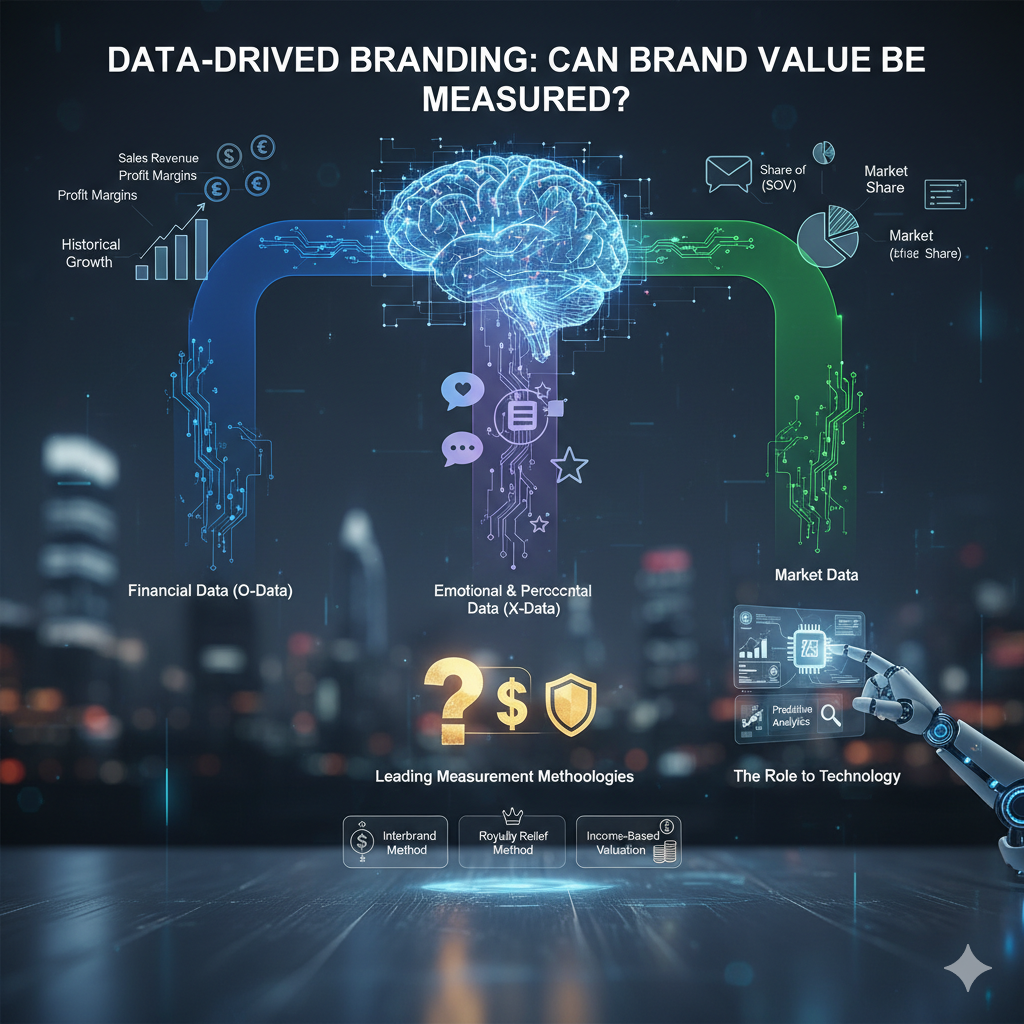
For decades, branding was considered an intangible art something built through storytelling, design, emotional resonance, and long-term consistency. It lived in perception rather than spreadsheets. Yet in today’s analytics-driven environment, executives increasingly demand measurable outcomes from every investment, including brand-building efforts. This raises a challenging question: can brand value truly be measured using data-driven branding frameworks, or does its intangible nature resist quantification? The debate continues because branding operates at the intersection of emotion and economics, making measurement complex but not impossible.
At its foundation, brand value represents the financial and strategic advantage a company gains from strong brand recognition, trust, and customer loyalty. It influences purchasing decisions, pricing power, retention rates, and competitive differentiation. However, unlike direct-response campaigns that generate immediate conversions, branding often produces delayed and indirect outcomes. This time lag complicates measurement. When sales rise months after a campaign, determining how much of that growth resulted from brand-building versus other factors becomes difficult.
Traditional accounting frameworks rarely capture brand equity directly on financial statements unless it is acquired externally. Yet from a managerial economics perspective, brand strength influences demand elasticity and long-term profitability. A strong brand often enables premium pricing because customers perceive higher value. This reduced price sensitivity is measurable through elasticity analysis. If demand remains stable despite price increases, brand equity likely plays a role. In this way, economic modeling provides indirect evidence of brand value.
One common method of assessing brand impact involves tracking brand awareness, brand recall, and brand recognition metrics through surveys and market research. These indicators measure how well consumers remember and identify a brand. While useful, they do not directly translate into financial outcomes. Awareness without conversion does not generate revenue. Therefore, businesses must connect awareness metrics with behavioral data such as purchase frequency, retention rates, and lifetime value.
The concept of customer lifetime value (CLV) offers a bridge between branding and financial performance. Strong brands tend to attract loyal customers who make repeat purchases and advocate for the company. Higher retention rates and longer customer lifespans increase CLV. By analyzing retention trends before and after brand campaigns, businesses can estimate branding’s influence on long-term profitability. Although this approach does not isolate branding perfectly, it reveals patterns that indicate brand-driven loyalty.
Digital transformation has expanded opportunities for measurement through data analytics. Online platforms generate detailed interaction data, including engagement rates, sentiment analysis, and share-of-voice metrics. Social listening tools analyze consumer conversations to assess brand perception in real time. Positive sentiment trends may correlate with increased sales or reduced churn. By combining qualitative sentiment data with quantitative revenue data, organizations develop a more comprehensive understanding of brand performance.
Another dimension of data-driven branding is evaluating brand equity models such as financial valuation frameworks. These models estimate brand value by analyzing projected future earnings attributable specifically to brand strength. Techniques may incorporate discounted cash flow analysis, royalty relief methods, or excess earnings approaches. While these calculations rely on assumptions, they provide structured methodologies for approximating financial brand value. Such models are commonly used during mergers, acquisitions, and strategic evaluations.
However, measurement challenges persist because branding influences multiple stages of the customer journey. It shapes initial awareness, affects trust during consideration, and reinforces satisfaction after purchase. Attribution becomes complex when branding interacts with performance marketing channels. A consumer might convert through a paid advertisement, but prior brand familiarity likely influenced their decision. Overreliance on short-term attribution models risks undervaluing branding’s long-term contribution.
Another measurable aspect of brand strength is pricing power. Companies with strong brands can often command premium prices without significant loss of demand. This pricing flexibility directly impacts profit margins. By analyzing changes in gross margin relative to competitors, firms can infer brand-driven differentiation. If customers consistently choose a higher-priced option despite alternatives, brand equity likely contributes to perceived value.
Brand-driven businesses also tend to exhibit stronger customer retention and lower customer acquisition cost (CAC) over time. Loyal customers require less promotional incentive and are more likely to recommend the brand to others. Referral traffic and organic growth reduce dependence on paid acquisition channels. Measuring trends in acquisition efficiency and retention stability provides indirect yet meaningful indicators of brand strength.
Data-driven branding also incorporates predictive analytics. By analyzing historical brand engagement and sales data, companies can forecast how branding investments may influence future revenue streams. For instance, consistent increases in engagement metrics may precede growth in conversions. Predictive models allow organizations to estimate long-term returns rather than focusing solely on immediate outcomes.
Despite technological advancements, some aspects of brand value remain inherently qualitative. Emotional connection, cultural relevance, and symbolic meaning cannot be fully captured through numerical analysis. Behavioral economics suggests that consumers often make decisions based on subconscious associations rather than rational comparisons. Data may reveal patterns, but it cannot always explain the emotional drivers behind them. Recognizing this limitation prevents overconfidence in purely quantitative models.
Moreover, external factors such as market trends, economic shifts, and competitive actions influence brand perception. Isolating branding impact requires controlled experimentation, such as geographic brand-lift studies or holdout testing. These experimental methods provide clearer evidence of causal relationships between branding campaigns and business outcomes. However, they demand careful planning and sufficient scale.
Organizational alignment also determines measurement success. Marketing, finance, and analytics teams must collaborate to define shared metrics. Without alignment, branding may be evaluated through superficial engagement statistics rather than strategic financial indicators. Integrating branding metrics with profitability analysis strengthens credibility and executive support.
Importantly, the pursuit of measurable branding should not compromise creativity or authenticity. Excessive focus on short-term metrics can discourage bold campaigns that build long-term recognition. Data should inform strategic direction without constraining innovation. The most effective branding strategies balance analytical insight with creative vision.
In conclusion, data-driven branding demonstrates that brand value can indeed be measured though not with perfect precision. Through analysis of price elasticity, customer lifetime value, retention rates, sentiment trends, and financial valuation models, businesses can approximate brand impact on profitability and growth. While some emotional dimensions remain intangible, structured data analysis transforms branding from a purely abstract concept into a measurable strategic asset. Rather than asking whether brand value can be measured at all, the more relevant question becomes how accurately and comprehensively organizations choose to measure it. When approached thoughtfully, data-driven branding provides meaningful insights that support sustainable competitive advantage and long-term business success.