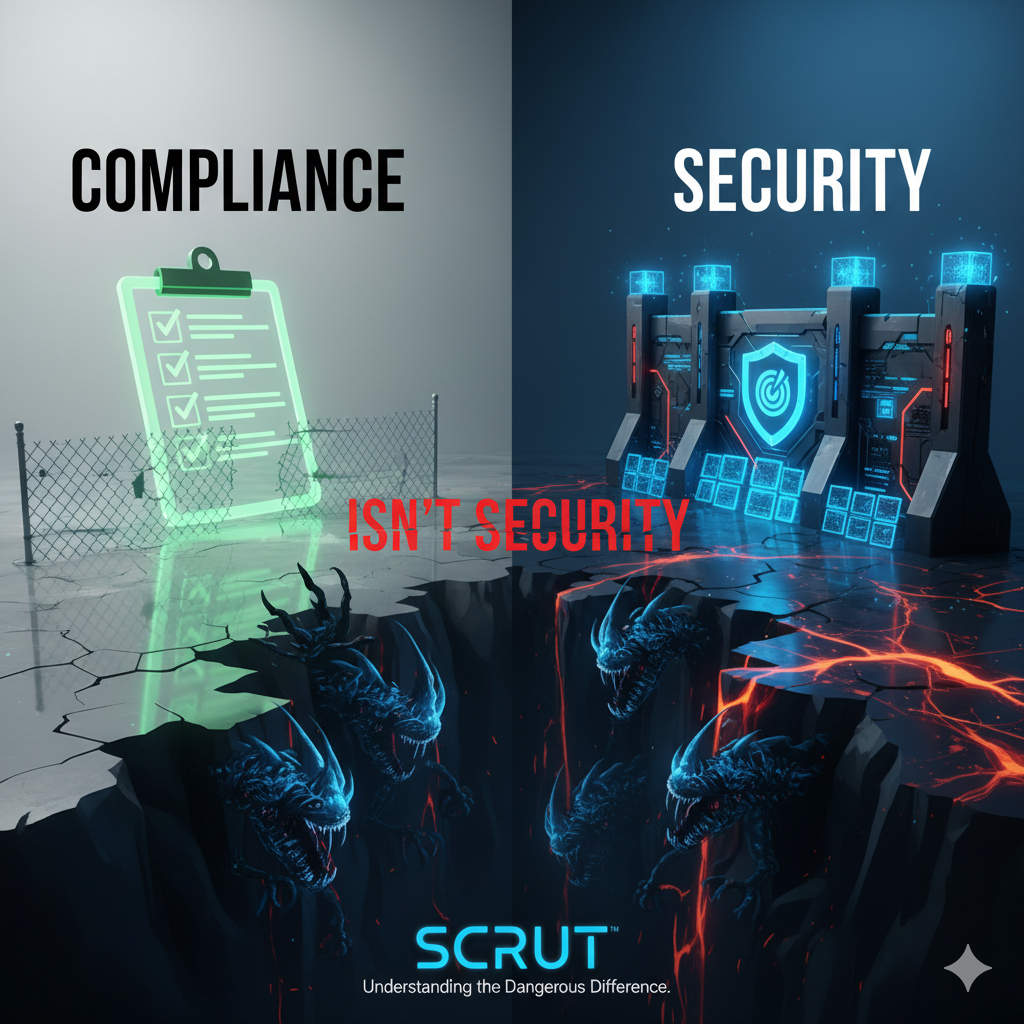
Many organizations proudly state that they are “fully compliant.”
They have passed audits.
They meet regulatory requirements.
They follow documented standards.
But here is the uncomfortable truth:
Compliance does not automatically mean security.
While compliance frameworks establish minimum standards for data protection and operational control, they are not designed to eliminate all cyber risk. In fact, many companies that experience data breaches were fully compliant at the time of the incident.
This creates a dangerous misunderstanding. Businesses assume that once they satisfy regulatory checklists, their systems are secure. That assumption can lead to serious vulnerabilities.
Understanding the difference between compliance and security is critical for modern organizations operating in an increasingly complex threat landscape.
Below are five key distinctions that explain why compliance alone is not enough.
1. Compliance Sets Minimum Standards — Security Requires Continuous Defence
Compliance frameworks such as ISO, SOC 2, HIPAA, PCI-DSS, or GDPR define baseline requirements. They outline policies, documentation practices, access controls, and data handling standards that organizations must follow. However, these frameworks are designed to create a minimum acceptable level of protection — not maximum resilience. For example, a compliance standard may require password complexity rules. But strong passwords alone do not stop phishing attacks, credential stuffing, or insider threats. Compliance often focuses on whether controls exist, not whether they are actively effective against evolving threats. Security, on the other hand, is dynamic. Cyber threats evolve daily. Attack techniques adapt to bypass standard controls. New vulnerabilities emerge constantly.
True security requires:
- Continuous monitoring
- Threat intelligence integration
- Real-time response capability
- Regular vulnerability assessments
- Proactive system hardening
Compliance ensures documentation exists. Security ensures defences actually work under attack. Organizations that treat compliance as the final goal may overlook the need for continuous improvement in their security posture.
2. Compliance Is Periodic — Security Is Ongoing
Most compliance audits occur annually or semi-annually. During these review periods, organizations prepare documentation, review controls, and demonstrate adherence to regulatory requirements. Once the audit passes, many businesses shift focus back to operations. The problem is that cybercriminals do not operate on audit schedules. A company may pass an audit in January and suffer a breach in March because:
- A new vulnerability emerged
- An employee fell victim to phishing
- A system patch was delayed
- A configuration error went unnoticed
Compliance validation reflects a moment in time. Security must operate every moment. Organizations that rely heavily on audit cycles may invest heavily before inspections but reduce vigilance afterward. This reactive approach creates exposure gaps between audit periods. Effective security requires ongoing testing, penetration simulations, continuous monitoring, and regular updates — not just periodic review. Compliance is event-based. Security is process-based.
3. Compliance Focuses on Documentation — Security Focuses on Risk Reduction
Compliance frameworks emphasize documented policies and procedures. Organizations must demonstrate that:
- Policies exist
- Roles are defined
- Controls are implemented
- Data handling procedures are documented
While documentation is important, paperwork alone does not prevent breaches. For example, a company may have a documented incident response plan. However, if employees are not trained or if the plan is outdated, response efforts may fail during a real attack.
Security prioritizes actual risk reduction. It evaluates:
- Which assets are most critical
- Which threats are most likely
- Which vulnerabilities are exploitable
- Which controls are most effective
Security strategy adapts based on risk assessments, threat modelling, and real-world attack simulations. Compliance may confirm that encryption is used. Security evaluates whether encryption keys are properly managed and monitored. Documentation supports governance. Risk management strengthens protection. The distinction is subtle but critical.
4. Compliance Is Standardized — Security Must Be Customized
Compliance frameworks are designed to apply broadly across industries. They provide standardized requirements that ensure consistency across organizations.
However, every business has unique risk factors.
A healthcare provider faces different threats than a fintech startup.
An e-commerce platform faces different risks than a manufacturing company.
A multinational corporation faces different exposure than a local firm.
Compliance standards cannot account for every specific risk scenario.
Security strategies must be tailored to the organization’s:
- Industry sector
- Operational model
- Data sensitivity
- Geographic footprint
- Threat landscape
For example, a company heavily dependent on cloud services requires advanced cloud security configuration management. Another organization may need stronger endpoint protection due to a remote workforce.
Compliance ensures baseline control alignment. Security requires context-aware defense mechanisms.
Treating compliance as a one-size-fits-all solution ignores unique vulnerabilities.
5. Compliance Reduces Legal Risk — Security Reduces Operational Risk
Compliance primarily protects organizations from regulatory penalties, lawsuits, and contractual violations. It demonstrates that reasonable steps were taken to meet industry standards.
This is important for legal protection and reputation management.
However, even fully compliant organizations can suffer operational disruption.
A ransomware attack can halt production.
A data breach can damage customer trust.
A system compromise can disrupt supply chains.
Regulators may acknowledge compliance efforts, but customers and partners focus on impact. Security reduces the likelihood and severity of operational disruption. It prioritizes business continuity, resilience, and rapid recovery. While compliance can mitigate legal consequences, security mitigates operational damage. Organizations must recognize that legal compliance does not guarantee immunity from cyber threats.
Why the Confusion Persists
The confusion between compliance and security often arises because both involve similar terminology controls, policies, audits, encryption, monitoring. Additionally, achieving compliance requires significant investment. Once that investment is made, leadership may assume sufficient protection has been achieved. However, compliance is a foundation not a ceiling. It establishes necessary structure but does not eliminate emerging threats. Security maturity requires continuous adaptation beyond compliance requirements.
Building a Security-First Approach Beyond Compliance
To move beyond compliance-based thinking, organizations should consider the following strategic steps:
1. Conduct Regular Risk Assessments
Identify critical assets and evaluate realistic threat scenarios specific to the organization’s operations.
2. Implement Continuous Monitoring
Deploy tools that detect anomalies, unauthorized access, and unusual behavior in real time.
3. Perform Penetration Testing
Simulated attacks reveal vulnerabilities that compliance checklists may not expose.
4. Invest in Employee Awareness
Human error remains one of the leading causes of breaches. Training must go beyond policy acknowledgment.
5. Align Security with Business Strategy
Security should support innovation and growth — not simply fulfill regulatory obligations. Organizations that treat compliance as the starting point — rather than the final goal — are better prepared to face modern cyber risks.
Conclusion
Compliance and security are related but fundamentally different.
Compliance ensures adherence to established standards.
Security ensures resilience against evolving threats.
Relying solely on compliance creates a false sense of safety. It may protect against fines, but it does not guarantee protection against breaches.
In today’s digital environment, threats move faster than regulatory updates. Organizations must adopt a proactive, risk-driven security approach that extends beyond documentation and audits.
True protection requires vigilance, adaptability, and continuous improvement.
Because being compliant may satisfy regulators.
But being secure protects your business.